lrb.co.uk
James Butler | Just Voting
lrb.co.uk · Feb 27, 2026 · Collected from GDELT
Summary
Published: 20260227T194500Z
Full Article
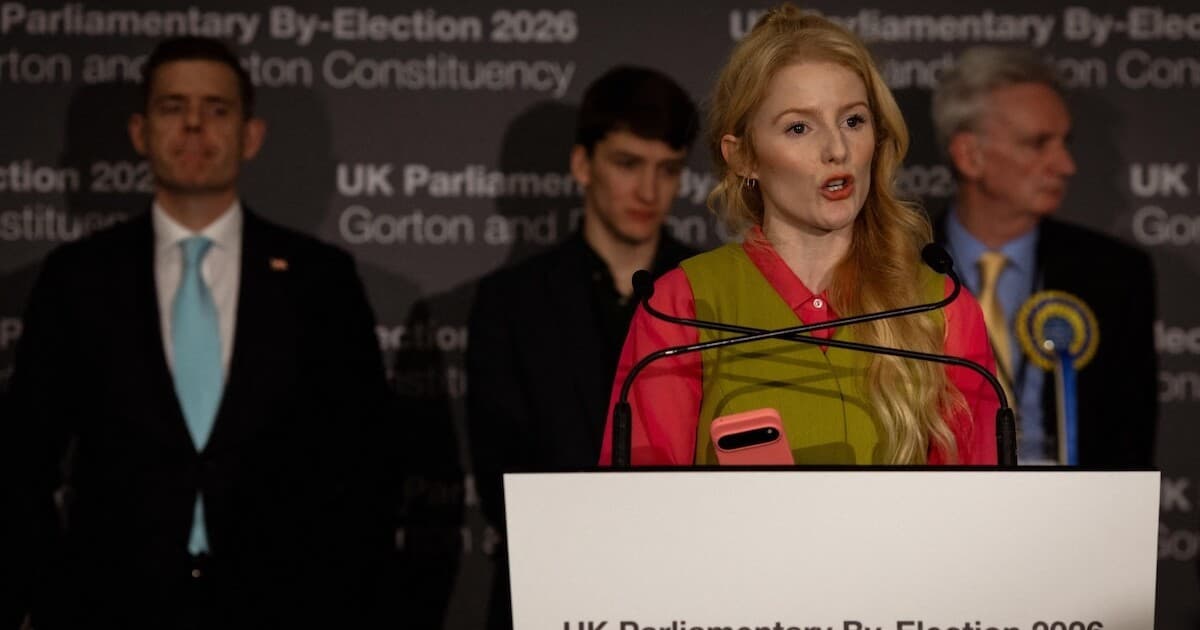
The Green Party’s Hannah Spencer has won the Gorton and Denton by-election with 41 per cent of the vote. The result was more definitive than polls suggested, with Reform taking 29 per cent and Labour’s vote collapsing to 25 per cent (from 51 per cent in 2024). Both the Conservatives (1.9 per cent) and Liberal Democrats (1.8 per cent) lost their deposits. The hair’s breadth that appeared to separate the two progressive options – a split vote that might have enabled a Reform victory – turned out to be a chasm. As in the Caerphilly Senedd by-election last October, which returned a Plaid Cymru MS, progressive voters opted decisively for the more explicitly and coherently left-wing party. For Keir Starmer’s Labour, which has staked its existence on appeasing the right, that is a stark message unlikely to be heeded.In her victory speech, Spencer argued that working people were being ‘bled dry’ in a country that works to ‘line the pockets of billionaires’. ‘I don’t think it’s extreme or radical to think that working hard should get you a nice life,’ she said. The speech could once easily have been delivered by a centre-left Labour politician. The professional backgrounds of the candidates are telling: Spencer is a plumber and gas engineer; Reform’s Matthew Goodwin, a former academic turned far-right influencer; and Labour’s Angeliki Stogia, a corporate lobbyist for public-private partnerships. Unusually for British politics, the winner was the candidate with the normal job.The result is a catastrophe for Labour. Its strategists had imagined that the party would benefit from a direct contest with Reform, able to bully left-wing voters into swinging behind the party as it tries to lure back defectors to its right with awkward reactionary posturing. Sometimes called a ‘Macron strategy’, after the only European leader more unpopular than Starmer, it has now failed in two by-elections, this one in a historically ultra-safe seat. Labour strategy is often a prisoner of inertia, and the hatred of the left shared by many of its elected officials will make it hard for it to abandon this doomed position before its inevitable drubbing in the local elections in May. ‘Vote Labour (or else)’ is not a winning slogan.It’s possible to read too much into by-election results, but governing parties can also undervalue the messages they send. Labour’s grand strategy wasn’t its only error. The decision to block Andy Burnham’s candidacy was widely and rightly understood as a squalid stitch-up to forestall a challenge to Starmer’s leadership. Burnham’s local popularity (and his clear distance from the party’s ruling clique) mean he might well have won Gorton and Denton, though it’s less obvious that Labour would have won the ensuing contest to replace him as mayor of Greater Manchester. The Peter Mandelson scandal, which stained much of the party’s establishment, didn’t help. Its dirty campaigning – inventing a fake tactical voting front; smearing the Greens as drug pushers – failed. Labour’s smear habit is part of Mandelson’s legacy: he targeted the Liberal Democrats as ‘soft on drugs, high on taxes’ in a 1995 by-election. It’s been a recurrent habit for Labour candidates in a corner since.But Mandelson isn’t a sufficient scapegoat. The Labour leadership are addicted to ‘hippie-punching’ because it makes them feel better about their own abandonment of political principle and their tenuous working-class credentials. It makes them feel serious, and dignifies the political compromises they were anyway eager to make as ‘maturity’. But it also drives away socially progressive Labour voters, who have been told by the party that their quite ordinary beliefs are contemptible, unserious and electoral poison. It used to be a core belief (as Mandelson purportedly once said about working-class voters) that such progressives had nowhere else to go. That is no longer true.Reform’s failure to take the seat shouldn’t be surprising. It’s far down their target list and they wouldn’t need it for a general election victory. Their candidate, Matthew Goodwin, is an obnoxious, cynical and transparently self-interested far-right grifter from outside the constituency. His campaign manager was suspended after a torrent of misogynist, homophobic and racist posts, including a dalliance with Holocaust denial, were exposed by Hope Not Hate. But anti-racists should find it sobering that ten thousand voters nonetheless endorsed a candidate who has repeatedly argued that certain non-white British citizens, born and raised here, nonetheless do not qualify as ‘really British’. The taboo on Powellism – a racist ‘send ’em back’ politics euphemised as ‘remigration’ – is rapidly eroding.Having been beaten by a progressive candidate, Goodwin, once a political scientist, claimed: ‘I don’t think the progressives beat us.’ He said ‘the progressives were told how to vote’ and blamed a ‘coalition of Islamists and woke progressives’ for his loss. As part of the reactionary international, he displays an obvious dislike of a universal and equal franchise. In the days before the election, Reform had raised the spectre of ‘sectarian’ or ‘religious’ voting. It’s fatuous to claim that a Muslim voting for a feminist plumber standing for a party that’s vocal on trans rights and headed by a gay Jew is somehow making a religious vote, but the claim persists. It’s an attempt to import the paranoid histrionics of the French far right over so-called ‘Islamo-gauchisme’, a poisonous label that tries to designate both Muslims and the left as anti-national subversives, outside the category of legitimate politics. But a vote to punish a sitting government for its foreign policy, the cost of living and a domestic reactionary turn, or against a party whose leader has vowed to create a ‘British ICE’, isn’t sectarian voting. It’s just voting.Goodwin has been given unfortunate succour by a breathless ‘emergency report’ from Democracy Volunteers, which claims to have observed ‘family voting’ at polling stations. Such claims should be treated with caution. Volunteer observers are well-intentioned but often overzealous, with a tendency to report false positives. Poll workers are also trained to look for signs of coercive or ‘family’ voting and intervene, and the officers administering the election have rejected the claim and questioned the decision of observers not to raise the matter at the time (as they were entitled to do). Family voting does happen, usually in strongly patriarchal, conservative families – but it is rare. The secret ballot is important, and should be ferociously guarded. Reform would like this to be the story of the election to make a political victory of its defeat.Had Reform taken the seat, there would have been much talk in the press of a seismic refashioning of the political landscape, the importance of the party’s programme, the seriousness of its challenge. The Green victory is no less seismic, and arguably more so: Reform’s previous incarnations (Ukip, the Brexit Party) have won by-elections before, but the Greens’ quadrupling of their vote and winning in a historically safe Labour seat ought to force a major reassessment. The Greens can now plausibly argue that they are not a wasted vote but, in a swathe of seats, the obvious progressive choice. Reform – already splintering with the departure of Rupert Lowe to form the even further right Restore Britain – may yet tear itself apart. On one side are those who desire a monstrous hybrid of Powellite racism with Americanised pseudo-Christian culture war; on the other are the ex-Tories who want to transform it into Conservatism 2.0, cleansed of Cameron-era nods to social progress. But it would be unwise for the left to write the party off too soon, however much hope there may be for its demise.The Greens can expect renewed hostility from much of the press: the Telegraph is already proclaiming the end of democracy, a political system it has never been particularly enamoured with. Zack Polanski is likely to find himself smeared, and party policy caricatured as the return of the loony left. But the party may welcome the attention: it has long been under-represented in mainstream political journalism. In contrast to the reflexive cringe of Labour politicians, Polanski has not retreated from positions scorned by right-leaning journalists. Many historically Labour voters will have been relieved to hear someone saying on air that they don’t hate migrants, billionaires have too much money and progressive politics is not a cause for self-flagellation or shame.One of the stories of this election is a major transfer of votes within the progressive bloc from Labour to Green. Certainly some Labour voters, and the overwhelming majority of former Conservative voters, went to Reform. Half of eligible voters did not cast a ballot. But perhaps most striking is that all traditional parties were beaten by two insurgents taking 70 per cent of the vote. A wide field of plausible competitors under first past the post will make the next general election difficult to predict. Preparing a campaign strategy will involve a lot of guesswork, even with strong data.A Labour Party optimist, if such a creature still exists, could construct a reassuring story: the Greens have replaced the Liberal Democrats as a party of protest but voters will return in a general election; blocking Burnham cast a pall; Reform are likely to tear themselves apart in the next two years. But these would be delusional comforts. It is just as likely that the 20 per cent of voters whom Labour has considered its guaranteed ‘floor’ were sticking around only for want of a plausible alternative and in fear of letting Farage in. Both of those excuses have now vanished, though Starmer dismissed the result as a standard anti-incumbency protest, taking the opportunity again to smear the Greens as extremists.The last few months have seen the prime minister’s authority over his own party ebb. His backbenc
Share this story