NewsWorld
PredictionsDigestsScorecardTimelinesArticles
NewsWorld
HomePredictionsDigestsScorecardTimelinesArticlesWorldTechnologyPoliticsBusiness
AI-powered predictive news aggregation© 2026 NewsWorld. All rights reserved.
Trending
FebruarySignificantMilitaryTimelineFederalDigestChinaDiplomaticTensionsCompanyFridayFaceParticularlyTurkeyTalksStateIranDrugEscalatingGovernanceCaliforniaTargetingDespiteDisease
All Articles
James Webb reveals a barred spiral galaxy shockingly early in the Universe
Science Daily
Published about 9 hours ago

James Webb reveals a barred spiral galaxy shockingly early in the Universe

Science Daily · Feb 27, 2026 · Collected from RSS

Summary

Astronomers have spotted what may be one of the universe’s earliest barred spiral galaxies — a striking cosmic structure forming just 2 billion years after the Big Bang. The galaxy, COSMOS-74706, dates back about 11.5 billion years and contains a stellar bar, a bright, linear band of stars and gas stretching across its center, similar to the one in our own Milky Way.

Full Article

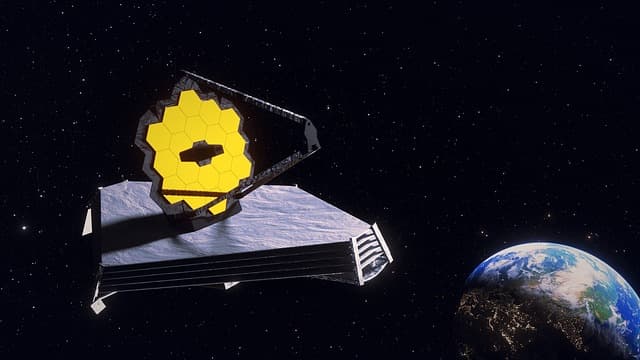
A research team led by Daniel Ivanov, a physics and astronomy graduate student in the Kenneth P. Dietrich School of Arts and Sciences at Pitt, has identified a strong candidate for one of the earliest known spiral galaxies with a stellar bar. These bright, elongated structures can strongly influence how galaxies grow and change over time. The Milky Way itself contains a stellar bar at its center. The newly studied galaxy, named COSMOS-74706, appears to have existed about 11.5 billion years ago. By analyzing its light, researchers were able to determine its place in cosmic history and narrow down when barred structures may have first formed in the universe. "This galaxy was developing bars 2 billion years after the birth of the universe," Ivanov said. "Two billion years after the Big Bang." The results were presented at the 247th meeting of the American Astronomical Society. What Is a Stellar Bar? As the name suggests, a stellar bar is a straight, elongated feature that stretches across the central region of a spiral galaxy. "A stellar bar is a linear feature at the center of the galaxy," Ivanov said. Rather than being a single object, the bar is made up of tightly packed stars and gas. When viewed from above or below the galaxy's disk, this alignment creates the appearance of a bright line cutting through the middle. These bars are more than just visually striking. They can shape a galaxy's long term development by channeling gas from the outer regions inward. This inward flow can fuel the supermassive black hole at the galaxy's core and reduce star formation across the surrounding disk. Why This Discovery Stands Out Other teams have previously reported possible barred spiral galaxies from even earlier periods. However, those findings relied on less precise measurements of redshift. In contrast, COSMOS-74706 was confirmed using spectroscopy, which provides more reliable distance data. In some earlier cases, the galaxy's light was also distorted by passing near a massive object, an effect known as gravitational lensing. In essence, Ivanov said, "It's the highest redshift, spectroscopically confirmed, unlensed barred spiral galaxy." Although the galaxy dates back to a very early era, Ivanov was not entirely surprised. Computer simulations have suggested that stellar bars could begin forming at redshift 5, or roughly 12.5 billion years ago. Still, he noted that such objects are not expected to be common at that stage of cosmic history. "In principle, I think that this is not an epoch in which you expect to find many of these objects. It helps to constrain the timescales of bar formation. And it's just really interesting." Powered by the James Webb Space Telescope The research relied in part on observations from the NASA/ESA/CSA James Webb Space Telescope. Data were obtained through the Space Telescope Science Institute, which is operated by the Association of Universities for Research in Astronomy, Inc., under NASA contract NAS 5-03127, which is supported by NASA. The project also received support from the Brinson Foundation.


Share this story

Read Original at Science Daily

Related Articles

Science Dailyabout 8 hours ago
Scientists discover diet that tricks the body into burning fat without exercise

Researchers found that cutting two amino acids common in animal protein—methionine and cysteine—made mice burn significantly more energy. The boost in heat production was nearly as powerful as constant exposure to cold temperatures. The mice didn’t eat less or exercise more; they simply generated more heat in their beige fat. The discovery hints that diet alone might activate the body’s calorie-burning machinery.

Science Dailyabout 9 hours ago
A lost moon may have created Titan and Saturn’s rings

Saturn’s largest moon, Titan, may have been born in a colossal cosmic crash. New research suggests Titan formed when two older moons slammed together hundreds of millions of years ago—an event so violent it reshaped Saturn’s entire moon system and may have indirectly sparked the formation of its iconic rings. Clues come from Titan’s unusual orbit, its surprisingly smooth surface, and the strange behavior of the tumbling moon Hyperion.

Science Dailyabout 10 hours ago
Iron outperforms rare metals in stunning chemistry advance

Researchers at Nagoya University have created a more efficient iron-based photocatalyst that could reduce the need for rare and expensive metals in advanced chemistry. Unlike earlier designs, the new catalyst uses far fewer costly chiral ligands while still precisely controlling the three dimensional structure of molecules.

Science Dailyabout 10 hours ago
Scientists turn methane into medicine in stunning breakthrough

Scientists have unveiled a breakthrough way to turn natural gas—long burned as fuel—into valuable chemical building blocks for medicines and other high-demand products. By designing a clever iron-based catalyst powered by LED light, researchers managed to activate stubborn molecules like methane and transform them into complex compounds, even creating the hormone therapy drug dimestrol directly from methane for the first time.

Science Dailyabout 11 hours ago
MIT study finds Earth’s first animals were likely ancient sea sponges

Scientists at MIT have found compelling chemical evidence that Earth’s earliest animals were likely ancient sea sponges. Hidden inside rocks over 541 million years old are rare molecular “fingerprints” that match compounds made by modern demosponges. After testing rocks, living sponges, and lab-made molecules, researchers confirmed the signals came from life — not geology. The discovery suggests sponges were thriving in the oceans well before most other animal groups appeared.

Science Dailyabout 14 hours ago
Stunning 3D maps reveal DNA is structured before life “switches on”

For decades, scientists believed a fertilized egg’s DNA began as a shapeless mass, only organizing itself once the embryo switched on its genes. But new research reveals that the genome is already carefully arranged in three dimensions long before that critical activation step, known as Zygotic Genome Activation. Using a powerful new method called Pico-C, researchers captured this hidden DNA architecture in unprecedented detail, showing that a complex scaffold is built early to control which genes will later turn on.