wrp.org.uk
We wont fold to US pressure ! – Iran President Pezeshkian insists - Workers Revolutionary Party
wrp.org.uk · Feb 24, 2026 · Collected from GDELT
Summary
Published: 20260224T003000Z
Full Article
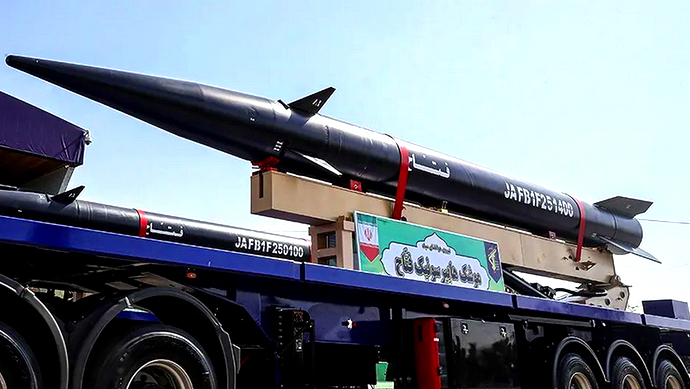
Iran’s Fattah-1 hypersonic missile – can travel at speeds exceeding Mach-5IRANIAN President Masoud Pezeshkian has pledged not to give in to pressure from the United States after Donald Trump said he was considering limited strikes to force a deal on Tehran’s nuclear programme.Pezeshkian’s comments on Saturday came amid high tensions in the Gulf, with the US continuing to expand its military presence with the deployment of two aircraft carriers and dozens of jets.‘We will not bow down in the face of any of these difficulties,’ Pezeshkian said at a ceremony to honour members of the Iranian Paralympics team.‘World powers are lining up with cowardice to force us to bow our heads. Just as you did not bow down in the face of difficulties, we will not bow down in the face of these problems,’ he said.Iran and the US resumed indirect talks on Tehran’s nuclear programme in Oman earlier this month, and held a second round in Switzerland last week.Although Washington and Tehran described the talks in overall positive terms, they failed to achieve a breakthrough.Iranian Foreign Minister Abbas Araghchi said on Friday that a diplomatic solution appeared within ‘our reach’ and that his country was planning to finalise a draft deal in ‘the next two to three days’ to send to Washington.According to the US media, the airpower Washington is amassing in the region is the greatest since its invasion of Iraq in 2003.In the past few days, Washington has deployed more than 120 aircraft to the Middle East, while the world’s largest aircraft carrier, the USS Gerald R Ford, is on its way to join the USS Abraham Lincoln carrier strike group already positioned in the Arabian Sea.Iran emphasised in a letter to the United Nations Security Council on Friday that the build-up ‘must not be treated as mere rhetoric’.Although Iran is not seeking ‘tension or war and will not initiate a war’, any US aggression will be responded to ‘decisively and proportionately’, they added.The letter came after Trump claimed on Thursday during his inaugural ‘Board of Peace’ meeting that ‘bad things will happen’ without a ‘meaningful deal’.Clarifying his remarks on Air Force One later that day, Trump said Iran had ‘10, 15 days, pretty much, maximum’.On Friday, in response to a reporter’s question on whether the US could take limited military action as the countries negotiate, Trump said, ‘I guess I can say I am considering that.’A few hours later, he told reporters that Iran had ‘better negotiate a fair deal’.Fears of a regional conflict have prompted countries including Sweden, Serbia, Poland and Australia to advise their citizens in Iran to leave the country.Meanwhile, an Iranian military commander has dismissed as ‘theatrical’ the US buildup of warships and fighter jets in the West Asia region over the past few weeks amid tensions over Tehran’s civilian nuclear programme, stating that the Leader of the Islamic Revolution has vigorously responded to such over-the-top manoeuvres.‘Our nation knows very well that ships and other armament now deployed in the Persian Gulf and the Sea of Oman waters have been cruising in different parts of the world for years,’ Deputy Inspector of the Khatam al-Anbiya Central Headquarters, Brigadier General Mohammad Jafar Asadi, said on Sunday.He added that the deployment of ships in the region has entered the propaganda phase, and the response to such a theatrical move was well given by Ayatollah Seyed Ali Khamenei, who said lately that ‘Of course an aircraft carrier is a dangerous device, but more dangerous than the carrier is the weapon that can send it to the bottom of the sea.’The senior commander went on to recall the failure of the enemies of the Islamic Republic over the past 47 years.‘We hope that evil warmongers like America, England, France, Germany, and the Zionist regime will eventually end as cancerous tumours in the West Asia region,’ he said.Brigadier General Asadi also reiterated the combat readiness of the Iranian Armed Forces, emphasizing they are prepared to defend and will act much more firmly and mightily than in the past.‘The response of the Armed Forces to any miscalculation and act of foolishness by the enemy will be more devastating than ever,’ he said.On Friday, the Iranian ambassador and permanent representative to the United Nations criticised recent remarks made by the US president as breaches of international law, calling for swift measures to avert further tensions and cautioning that Iran will assert its legitimate right to self-defence under the United Nations Charter if assaulted.In a formal letter dated February 19 and addressed to United Nations Secretary-General Antonio Guterres and UN Security Council President James Kariuki, Amir Saeid Iravani cited the repeated and explicit US threats of the use of force, including references to potential military operations launched from Diego Garcia and other regional bases.The Iranian envoy asserted that such statements constitute a breach of Article 2(4) of the Charter of the United Nations and risk destabilising an already volatile region.US special envoy to West Asia, Steve Witkoff, said on Saturday that US President Trump is ‘curious’ as to why Iran has not ‘capitulated’ to US demands to strike a deal on its nuclear programme.Speaking to Lara Trump, the president’s daughter-in-law on Fox news, Witkoff said: ‘The president asked me that this morning, and he’s – I don’t wanna use the word frustrated… because he understands he’s got plenty of alternatives, but… he’s curious as to why they haven’t, I don’t wanna use the word capitulated, but why they haven’t capitulated.’He added that Trump is wondering ‘why, under this pressure, with the amount of sea power and naval power over there, why haven’t they come to us and said, “we profess we don’t want a weapon, so here’s what we’re prepared to do”?’Claiming that Iran has enriched uranium beyond levels needed for civilian purposes, Witkoff said that Trump’s red lines require Iran to maintain ‘zero enrichment’ of uranium.He also confirmed in the interview that he had met with Reza Pahlavi (the son of the ex-shah of Iran), ‘I met him at the direction of the president,’ he said, without providing further details.While the interview came in the backdrop of Iran-US tensions, on one hand, Trump is constantly calling upon Iran to ‘make a deal,’ while on the other hand, he is continuously increasing military presence in the region.Meanwhile, Tehran has also constantly stated that it would respond decisively to any act of fresh military adventurism, as in the case of the US attacks last June, which prompted a ballistic missile barrage against Al Udeid, Washington’s most important regional airbase, which is located in Qatar.As tensions escalate in the Persian Gulf amid the US military buildup, Iran has methodically assembled a diverse and sophisticated arsenal designed to confront the most powerful symbol of American naval power – the aircraft carrier.The United States has, in recent weeks, dispatched two of its most formidable warships, the USS Abraham Lincoln and the USS Gerald R. Ford, to the waters surrounding the Persian Gulf.With US President Donald Trump threatening that diplomacy must succeed or military action will follow, the rhetoric from Washington has been met with a calculated and determined response from Tehran.Iranian armed forces, led by the Islamic Revolution Guards Corps (IRGC), held extensive naval exercises in the Strait of Hormuz, which was followed by joint drills with Russia.At the heart of this equation lies a strategic question that has occupied military planners for decades: can a relatively smaller naval power deter or even damage a nuclear-powered aircraft carrier?For Iran, the answer is not found in a single wonder weapon, but in a comprehensive, layered, and constantly evolving anti-access strategy.This approach, built on decades of indigenous development and asymmetric thinking, seeks to transform the narrow waters of the Strait of Hormuz and the vast expanse of the Arabian Sea into a high-risk environment for any adversary, proving that the era of the aircraft carrier’s perceived invulnerability in close proximity to Iranian shores is effectively over.The strategic confrontation between Iran and the United States was crystallised in recent remarks by the Leader of the Islamic Revolution, Ayatollah Seyyed Ali Khamenei.Responding directly to the deployment of American naval forces and the threats emanating from Washington, he framed the contest not as one of ships versus ships, but of will versus hardware.Ayatollah Khamenei acknowledged the inherent danger posed by a US aircraft carrier, describing it as a certainly dangerous piece of equipment.However, he immediately pivoted to the core of Iran’s defensive doctrine, stating that far more dangerous than the carrier itself is the weapon capable of sending it to the bottom of the sea.This pronouncement was a declaration of strategic intent. He pointed to the failure of the US to subdue the Islamic Republic for 47 years as proof that mere military might does not guarantee victory.
Share this story