Foreign Policy
Ukraine’s Lost Generation
Foreign Policy · Feb 27, 2026 · Collected from RSS
Summary
Students and teachers are struggling to keep education alive in underground schools.
Full Article
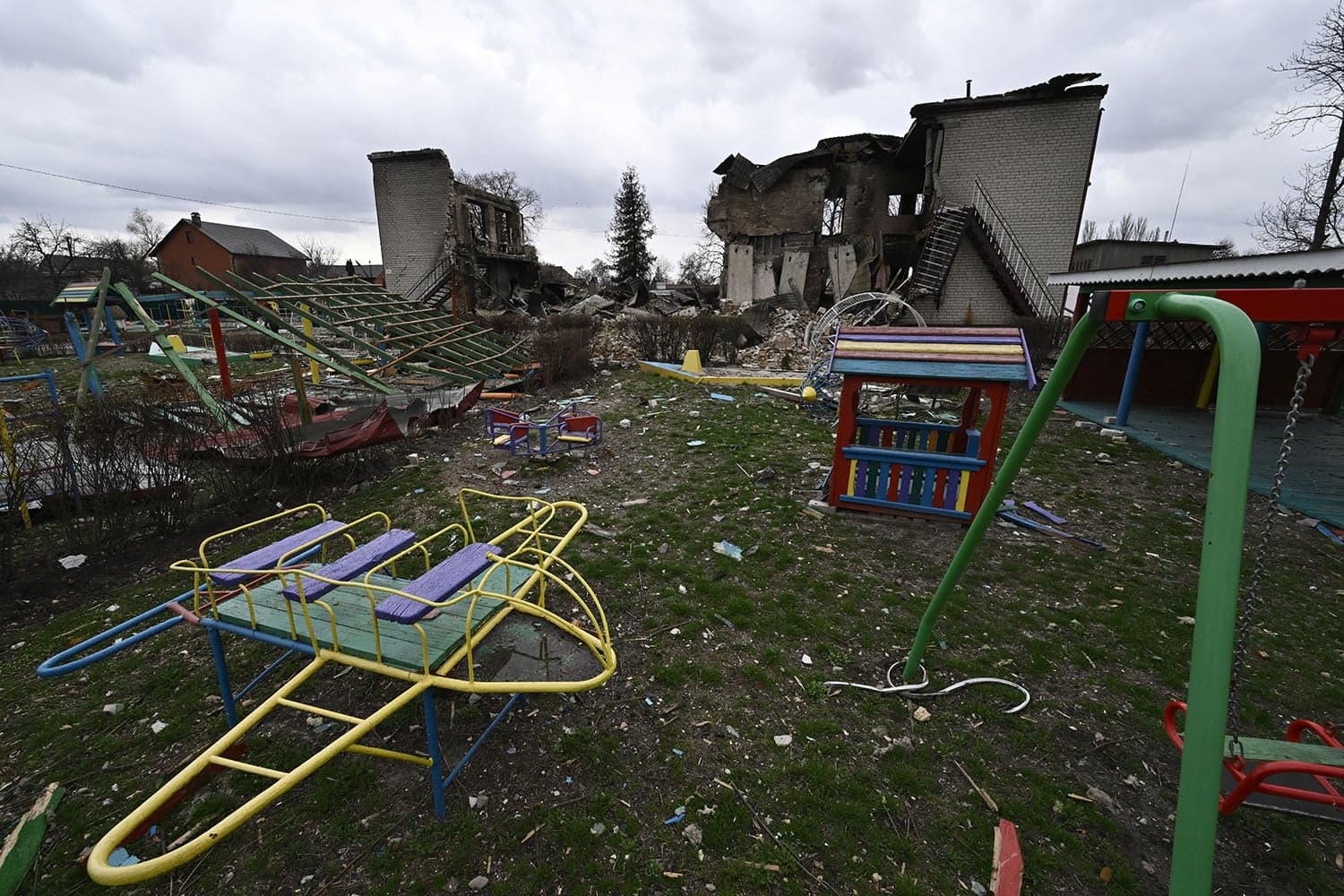
PECHENIHY, Ukraine—Pechenihy is a village of bombed-out homes and drab, Soviet-era mid-rise apartments amid pine forests and fields of black, fertile soil. At the beginning of the war, Russian forces occupied the settlements across the river from Pechenihy. Half of the village’s population fled; those who remained lived under constant shelling for over six months. Pechenihy resident Oksana Drozdova and her two young sons left their home behind in March 2022 for Schmallenberg, a town in western Germany. Drozdova was determined that her children would maintain their ties to Ukraine, and put her older son, then 10 years old, through a grueling educational regimen: German school from 7 a.m. to 4 p.m., then hours of Ukrainian language and history assignments in the evenings. Drozdova’s sons asked when they could go home nearly every day. Soon, Drozdova found herself wondering the same thing. “If we postponed our return, it would be more difficult to integrate our children to [Ukrainian] society,” she told Foreign Policy. As the Russian invasion of Ukraine drags into its fifth year, Ukraine’s next generation is scattered across the world. Years of war have crippled Ukraine’s educational system, leading to widespread learning loss and under-socialization for the 3.5 million students who remain in Ukraine. Meanwhile, the approximately 1.6 million Ukrainian schoolchildren who live in Russian-occupied areas of the country and the nearly 1 million students in the European Union are fast losing their connection to their home country. A group of people in winter coats standing in an underground train station. Ukrainian refugees arrive by train in Berlin on March 6, 2022. Carsten Koall/Getty Images Parents like Drozdova are grappling with impossible questions send their children to foreign schools or take their chances with the Ukrainian system? By the summer of 2023, things were looking up, Drozdova thought. Ukraine was launching a long-awaited counteroffensive, and the Russians had been pushed back from the immediate vicinity of Pechenihy. More promisingly, Pechenihy’s school, which had been hit by Russian artillery the previous year, was set to open an underground shelter beneath the destroyed school, giving schoolchildren a space to socialize after their online classes. In August 2023, as her younger son was set to begin first grade, the family returned to Pechenihy. Drozdova, who had worked in advertising before the war, found a new job teaching Ukrainian, English, and math at the school. In January 2025, a renovation of the underground space enabled students to begin attending in-person classes every day. “It was just a paradise for us,” Drozdova said. “All the equipment we needed for education was in the school.” But in March 2025, three Russian drones hit the renovated school at night. Though nobody was on site, the strikes severed the power lines and partially flooded the underground facilities, rendering the classrooms frigid and unusable. A repair is projected to cost at least $1 million—far more than the cash-strapped village can afford. Two students stand in a classroom with black chairs and tables as well as overhead lighting. Students stand in an underground classroom at their school in Pechenihy, Ukraine, on March 19, 2025. Violeta Santos Moura/Reuters I visited Pechenihy in December 2025, during a winter of gloom and power outages. The Ukrainian counteroffensive had fizzled out years earlier, and though the Russians are no longer directly across the river from Pechenihy, a steady stream of missiles and drones continues to bombard the area nearly every day. “We are terribly afraid. We punish ourselves in our minds that children live here,” Pechenihy resident Dariia Pokhodenko, who has two school-age daughters, told me. With their school gone again, Pokhodenko and Drozdova’s children, along with hundreds of other students in Pechenihy, receive their education via a patchwork online curriculum. Chronic power cuts have made sustained video calls impossible, leaving students to spend their days trudging through asynchronous assignments. In early December, during one of the most festive times of the year, the children of Pechenihy watched a video of Saint Nicholas Day celebrations on their phones and TV screens. When Drozdova left Schmallenberg, she said her government-assigned interpreter called her a “criminal” for bringing her children back to Pechenihy. “I came back here for the Ukrainian school,” Drozdova said. “But now I can’t even tell you why I’m still here.” Young children sit at desks with blue and yellow balloons. First graders on the first day of the new school year in Irpin, Ukraine, on Sept. 1, 2025.Genya Savilov/AFP via Getty Images Since the beginning of the war, Russian attacks have destroyed one in seven Ukrainian educational facilities. “[This is] a tactic of terror and disruption of any forms of regular life,” said Anna Novosad, founder of the savED foundation, a Ukrainian educational NGO. The scale of educational losses from four consecutive academic years lost to war—and before that, two years lost to COVID—are difficult to precisely quantify, yet just eight months into the war, the drop in learning for Ukrainian children was comparable to missing two years’ worth of school. Nobody expects that figure to have improved, especially while over one-third of students in Ukraine continue to lack access to full-time in-person education. “We [have] a generation of primary school kids who might well have never been to school physically,” Novosad said. Ukrainian children have also endured isolation, suffered through Russian occupation, been bombed, and lost parents on the front line. Some react by closing themselves off from the world; others become aggressive in a bid for attention. Without support, “these children will be traumatized adults who will lack emotional intelligence,” said Olha Bihun, a psychologist who works with children in the Kyiv region. “Children who study in European schools have quality education. Those in occupied territory have the Russian propaganda educational system. It’s even totally different inside the country, between those who attend school offline and those who study online,” Roman Hryshchuk, a member of the Ukrainian parliament who sits on the education committee, told me. “The inequality, it’s huge.” Such inequalities are visible in places like Bohdanivka, a modest agricultural village near Kyiv. For weeks in the spring of 2022, Russian forces camped out in the local school, venturing out to . “You just basically went to bed, and you didn’t know whether you would wake up,” said Olena Bobko, a local mother of two. Two men in orange reflective vests walk by a destroyed multicolored playground with a destroyed building in the background. Local residents walk past a destroyed kindergarten in Bohdanivka on April 12, 2022. Genya Savilov/AFP via Getty Images In April 2022, when the Russians retreated, they set fire to the school, gutting the building and leaving behind a terrorized population. The children “saw everything with their own eyes,” said Anna Tkachenko, a math and computer science teacher in the village. Yet Bohdanivka is cautiously on the road to recovery. With the help of savED, the village’s former community hall was renovated into a school for elementary schoolers; the nonprofit also constructed a new modular facility with six classrooms for the middle schoolers. All 250 schoolchildren in Bohdanivka attend in-person school five days a week, learning to code on donated laptops, participating in online games in health class, and exercising in makeshift gym sessions. The occupation casts a long shadow. Fifth graders, once again socializing in classrooms, closely follow the progress of the war online and darkly murmur to each other that Russian President Vladimir Putin is selling Ukrainian children “by the kilo”—their interpretation of Russia’s kidnapping of Ukrainian children. Still, the children are rebounding remarkably well, from joining extracurricular clubs to organizing a student government, Bohdanivka school principal Lyudmyla Deyko told me. “These are our students. We understood that we have to do everything to keep the children in our [community],” Deyko said. “They know that the adults have taken care of a place for them to have their childhood.” On the other side of Ukraine, in villages like Pechenihy, few such spaces exist. Though Drozdova occasionally hosts cooking classes for students at her home, formal in-person classes remain prohibited. As a result, “the children have no communication,” she said. “They can’t put together sentences to show what’s on their minds. … We can’t predict what will be next, because we are the first parents that are [raising] this dead generation.” A group of children walk in a white hallway with a metal ceiling and overhead lighting. Children walk down a corridor at an underground school in Kharkiv, Ukraine, on Oct. 16, 2025.Oleksii Filippov/AFP via Getty Images There are few opportunities for older students to venture out by themselves. In Kharkiv, a metropolis in eastern Ukraine devastated by Russian strikes, I visited Uyava, a community space that hosts frequent events for teenagers and young adults in beanbag-filled rooms fitted with blast-resistant windows. Over the years, a strong community of regulars has formed, yet for most attendees, Uyava is the only place where they can socialize and mingle with their peers. While some students in university meet offline, in-person gatherings are “super forbidden” for high schoolers, said Uyava co-founder Vasylisa Haidenko. But reminders abound that the teenagers who spend their nights at Uyava may miss out on a future altogether. As Haidenko and I spoke, we sipped cups of steaming, fragrant tea. The blend was created by a young man from Kharkiv who had dreamed of opening a teahouse in the city before he died fighting in the war, Haidenko told me. Meanwhile, in the occupied
Share this story