miragenews.com
Thunderstorms Spark Ghostly Treetop Coronae , First Seen
miragenews.com · Feb 24, 2026 · Collected from GDELT
Summary
Published: 20260224T001500Z
Full Article
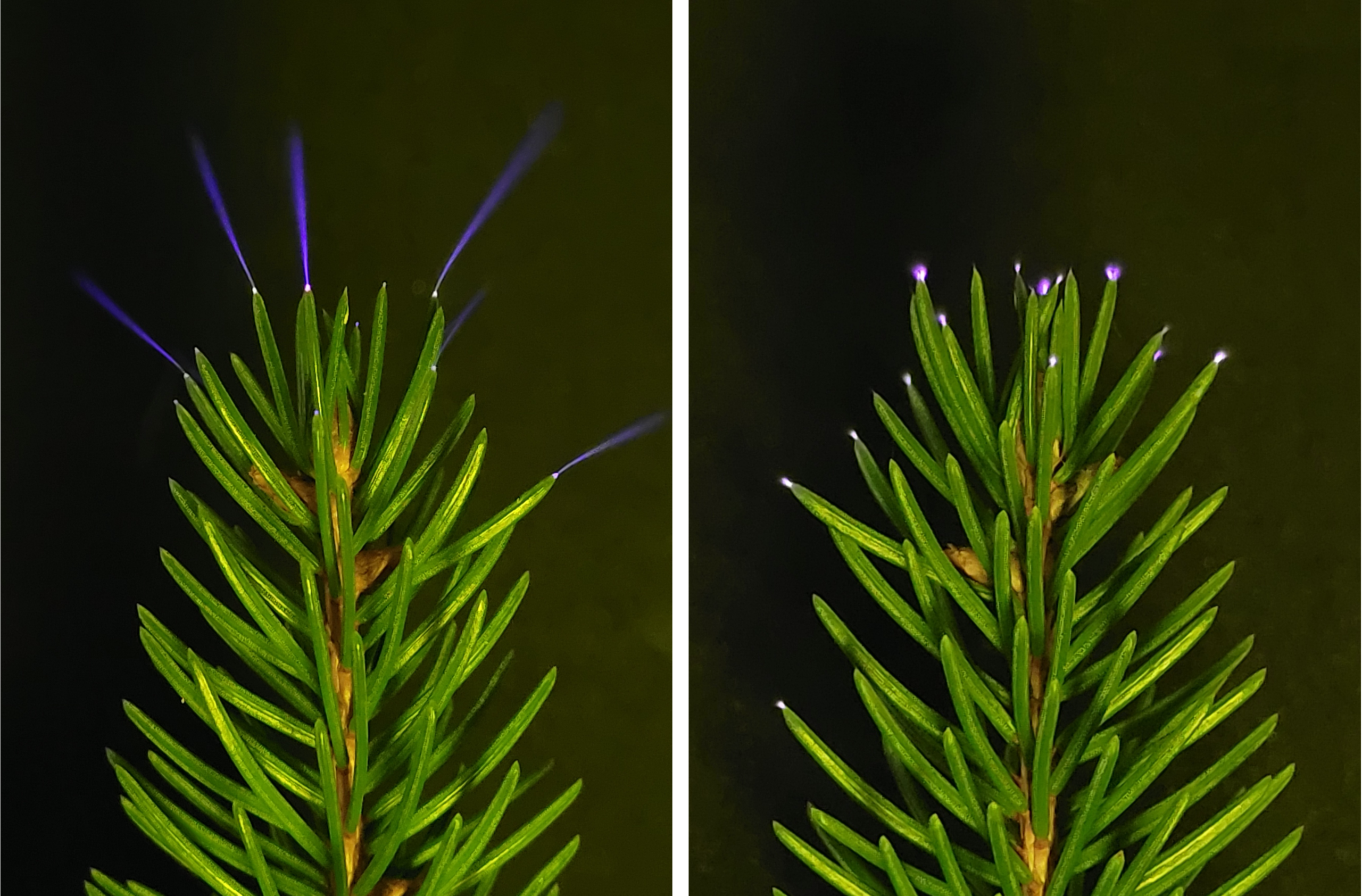
American Geophysical Union Coronae glow on the tips of spruce needles, induced by charged metal plates in a laboratory. These weak electric discharges subtly singe the tips of leaves and needles, and new observations indicate they may occur ubiquitously across treetops under thunderstorms. Credit: William Brune For the first time, researchers have observed and measured weak electrical discharges, known as coronae, on trees during thunderstorms. A new study describes the near-invisible sparkles appearing similarly on branches of several tree species up and down the U.S. East Coast during the summer of 2024, implying that thunderstorms may paint entire canopies with a scintillating blue glow, albeit too faintly for human eyes to see.Coronae also burn the very tips of leaves. Given the ubiquity with which they may occur across forests during storms, the researchers speculated that these coronae could harm the canopy, potentially shaping the evolution of trees to limit that damage."These things actually happen; we've seen them; we know they exist now," said Patrick McFarland, a meteorologist at The Pennsylvania State University and lead author of the study. "To finally have concrete evidence [of] that…is what I think is the most fun."The study appears in Geophysical Research Letters, AGU's journal for high-impact, innovative, and timely articles on major advances across the geosciences.Finding faint flickers among the leavesScientists have speculated about weak electrical discharges on plants under thunderstorms for almost a century but have never observed or measured them in the wild until now, only inferring their existence from anomalies in the electric field in forests during storms. Lab experiments over the past half-century had at least demonstrated how they could form in the wild: The charge of a thunderstorm overhead induces an opposite charge in the ground below. That ground charge, attracted to the one above, travels toward the highest point it can reach - in this case, the tips of leaves in the treetops - through which electricity discharges, forming coronae."In the laboratory, if you turn off all the lights, close the door and block the windows, you can just barely see the coronae. They look like a blue glow," McFarland said, recalling how his team recreated the phenomenon indoors by placing grounded tree leaves beneath charged metal plates.Similar lab experiments with potted trees also revealed a striking relationship: the coronae's UV radiation scaled proportionally with the electrical current the team measured in the trees. This raises the possibility that those UV emissions could offer a way to gauge that current and any damage it causes. Studies in the 1960s, McFarland said, revealed that current flows in trees broke down cell membranes and destroyed the chloroplasts trees use to photosynthesize.A man, a plan, and a storm-chasing minivanDocumenting coronae under real thunderstorms, however, would require a different approach - specifically, a 2013 Toyota Sienna kitted out with a weather station, electric field detector, laser rangefinder, and roof-mounted periscope directing light to an ultraviolet camera. This last piece of equipment would enable the team to detect the coronae in the field based on their UV emissions, since even the low ambient light under a stormy sky drowns out the light coronae emit in the visible spectrum."We had to take out one of the seats and put in these vibration-dampening pads so our instruments wouldn't bounce up and down as we drove," McFarland said. "The most fun part was taking a jigsaw and cutting a twelve-inch hole in the roof. Totally killed the resale value, but that's fine." The modified Toyota Sienna the team used to observe coronae on trees under thunderstorms in the field. The roof-mounted periscope directs light to an ultraviolet-sensitive camera to detect coronae outdoors, where ambient light renders them invisible to human eyes. Credit: Patrick McFarland With the minivan ready, it was time to go storm-chasing. Hunkered around a video feed inside the car, the team trained the camera on three branches of a sweetgum tree in Pembroke, North Carolina."We sit there and stare at this video while the thunderstorm's raging overhead," McFarland said. "You're looking for the faintest signals on a video feed of nothing…It's really difficult to tell in real time if you're seeing anything."Analyzing the video afterwards, however, revealed 41 coronae on leaf tips in the span of 90 minutes - the tip-off usually being clusters of UV signals that tracked with the branches as they swayed in the wind. The glows lasted up to 3 seconds, often hopping from leaf to leaf. Coronae occurred and behaved similarly on a nearby loblolly pine and on trees under four other storms the team chased that summer between Florida and Pennsylvania, despite differences in tree species and in the strength of the storm overhead.That could mean coronae arise in abundance, radiating from tens to hundreds of leaves on every treetop under a thunderstorm, McFarland estimated. If you had superhuman vision, "I believe you'd see this swath of glow on the top of every tree under the thunderstorm," he said. "It'd probably look like a pretty cool light show, as if thousands of UV-flashing fireflies descended on the treetops."If so, that ubiquity could cascade into larger impacts: coronae leave leaf tips visibly burnt within seconds. Some of the team's lab work speculates that this could damage the cuticle, the waxy covering protecting the leaf from UV damage and dehydration. Although a single corona doesn't appear to do much harm, the team speculates that repeated coronae across the canopy from multiple storms could damage the leaves - enough so, perhaps, for trees to have evolved ways of minimizing this damage over millennia. McFarland hopes to work with forest ecologists and botanists to investigate further."That's really where I'd like to go next, to figure out what impacts this has on the tree itself and on the forest as a whole," he said.Notes for journalists: This study is published in Geophysical Research Letters, an open access AGU journal. View and download a pdf of the study here. Neither this press release nor the study is under embargo.Paper title: "Corona Discharges Glow on Trees Under Thunderstorms"Authors: Patrick J. McFarland, The Pennsylvania State University, University Park, United StatesW. H. Brune, The Pennsylvania State University, University Park, United StatesD. O. Miller, The Pennsylvania State University, University Park, United StatesJ. M. Jenkins, The Pennsylvania State University, University Park, United States AGU (www.agu.org) is a global community supporting more than half a million professionals and advocates in Earth and space sciences. Through broad and inclusive partnerships, AGU aims to advance discovery and solution science that accelerate knowledge and create solutions that are ethical, unbiased and respectful of communities and their values. Our programs include serving as a scholarly publisher, convening virtual and in-person events and providing career support. We live our values in everything we do, such as our net zero energy renovated building in Washington, D.C. and our Ethics and Equity Center, which fosters a diverse and inclusive geoscience community to ensure responsible conduct.Subscribe or change your emailing preferences for the AGU Newsroom /Public Release. This material from the originating organization/author(s) might be of the point-in-time nature, and edited for clarity, style and length. Mirage.News does not take institutional positions or sides, and all views, positions, and conclusions expressed herein are solely those of the author(s).View in full here.
Share this story