Gizmodo
Clustered Story
Samsung’s Galaxy S26 Phones Are Light On Hardware Upgrades, Heavy on AI
Gizmodo · Feb 25, 2026 · Collected from RSS
Summary
No surprise here. The Galaxy S26, S26+, and S26 Ultra really lean into AI features.
Full Article
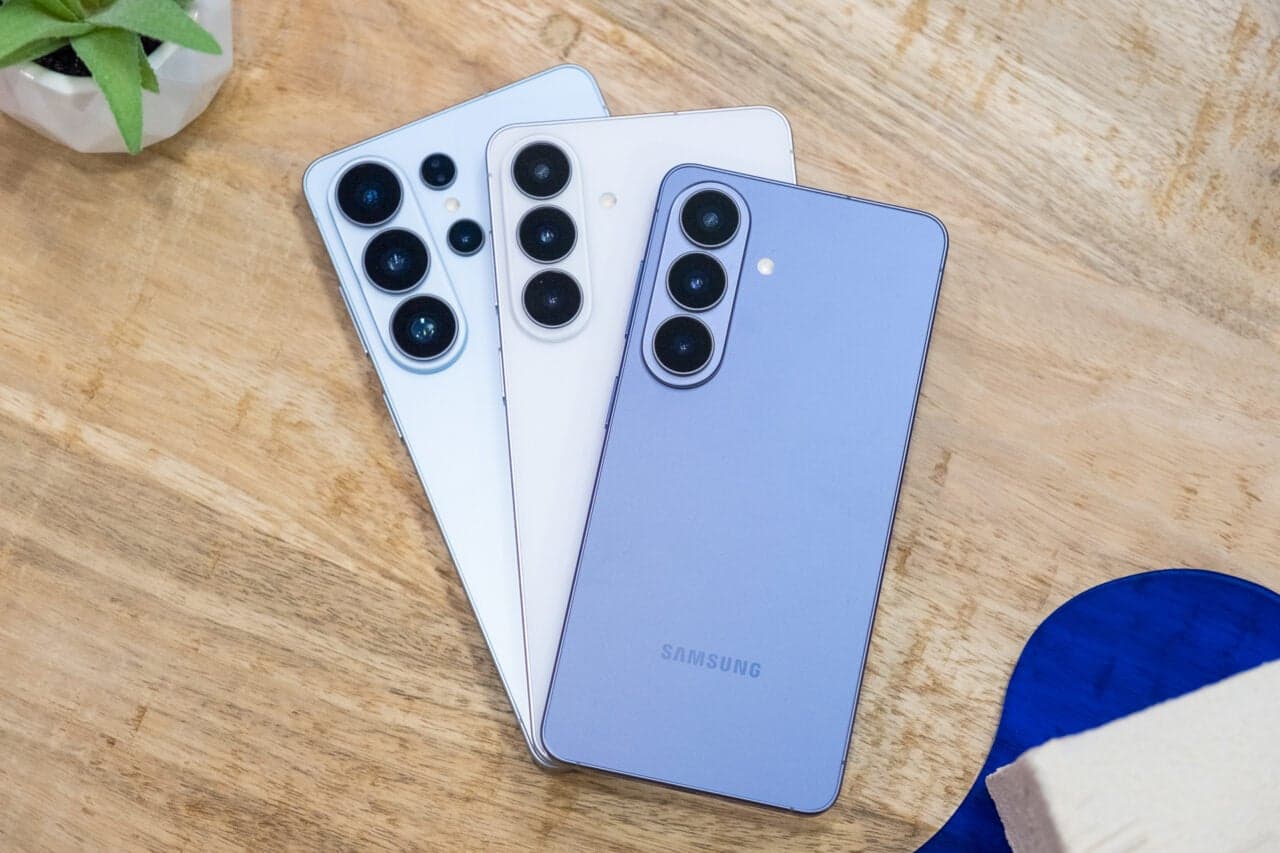
Right on schedule: Samsung has just announced its latest flagship smartphones, the Galaxy S26 series, at its Galaxy Unpacked event in San Francisco. The Galaxy S26 series follows the same refresh pattern of past years: small tweaks to an established formula. That may make the new Galaxy S26, S26+, and S26 Ultra, which are available for preorder today, Feb. 25, and at retail starting on Mar. 11, sound a bit tame, but that’s just how these annual phone launches are now. That doesn’t mean there’s nothing to get excited about. Specifically, the Galaxy S26 Ultra has a new display feature called “Privacy Screen” that I want every other phone to copy. See Galaxy S26/S26+ at Samsung.com See Galaxy S26 Ultra at Samsung.com Goodbye titanium (on the S26 Ultra) The Galaxy S26 Ultra ditches titanium for aluminum. © Adriano Contreras / Gizmodo Let’s skip right to the most notable changes first. Just like Apple did with the iPhone 17 Pros, Samsung has ditched titanium for aluminum. Apple justified the metal frame downgrade as a way to improve the iPhone 17 Pro’s thermals, allowing heat to disperse more evenly across the phone’s backside with the aid of a new vapor chamber for better cooling, which in turn prevents performance throttling. In the S26 Ultra’s case, the aluminum means a lighter device at 214g versus the S25 Ultra’s 233g. I have not touched any of the Galaxy S26 phones in person—I couldn’t make it to Unpacked because of the blizzard that hit the U.S. Northeast just before the event—but my colleague, Adriano Contreras, who took all of the photos in this article, did, and he told me they definitely feel lighter, though no less solid in the hand. The Galaxy S26 and S26+ are largely the same phones as their S25 and S25+ predecessors. © Adriano Contreras / Gizmodo The regular S26 and 26+ both stick with aluminum frames. This time around, the S26 Ultra also has the same rounded corner radii as the other S26 models. Altogether, Samsung says the less boxy design on the S26 Ultra gives the whole S26 lineup a more unified design. Beyond other small tweaks like an updated camera island that resembles the one found on the Galaxy Z Fold 7 and S25 Edge, the S26 series is just another touchscreen slab. If you’re looking for a less traditional form factor, consider Samsung’s foldables like the Z Fold 7 or the Z Flip 7. A screen that’s more private in public © Adriano Contreras / Gizmodo The biggest selling point the S26 Ultra has going for it is its new “Privacy Display.” This is a pixel-level display technology that lets you darken the sides or top of the screen to prevent others from seeing your content. It’s sort of like one of those privacy screen protectors that you can apply on top of your phone’s screen, except it’s built into the S26 Ultra. The Privacy Display feature is also more than just a built-in privacy screen protector. It can also obscure notifications, passwords, PIN codes, and pattern unlocks to safeguard them from potential peepers. Again, I have not seen or tried the Privacy Display feature for myself, but Adriano tells me that it’s “impressive.” In his own words: “When I saw it only blur a text notification bubble up top, that’s when I said out loud, ‘sold!'” © Adriano Contreras / Gizmodo Sounds really neat. The only downside is that the Privacy Display feature is exclusive to the S26 Ultra; the S26 and S26+ do not have it. Faster performance, faster charging, and slightly improved cameras As I said, the S26 series is mostly a minor hardware refresh. Almost everything is the same compared to the S25 series. The S26 Ultra has the same 6.9-inch screen; the S26+ has the same 6.7-inch display; the S26 screen is slightly larger at 6.3 inches versus the S25’s 6.2 inches, though it retains the same previous resolution. All three S26 phones are powered by Qualcomm’s latest Snapdragon 8 Elite Gen 5 for Galaxy chip. This is a customized version of the regular Snapdragon 8 Elite Gen 5 chip that other phone makers have access to. Samsung says you can expect a CPU that’s up to 19% faster, a GPU that’s up to 24% faster, and an NPU (neural processing unit for AI and machine learning) that’s up to 39% faster. Combined with a redesigned vapor chamber that Samsung claims dissipates more heat, the phones should throttle less, too. © Adriano Contreras / Gizmodo The battery capacities for all three S26 phones are identical to their predecessors: 4,300mAh on the S26, 4,900 on the S26+, and 5,000mAh on the S26 Ultra. The only difference is in charging speeds on the S26 Ultra, which can now fast wire charge at up to 60W and fast wireless charge at up to 25W. The regular S26 supports fast wired charging at up to 25W; the S26+ at up to 45W. For fast wireless charging, the S26 supports up to 15W and the S26+ up to 20W. To my disappointment, none of the S26 phones have built-in magnetic wireless charging at all. Even Google added magnetic wireless charging (Pixelsnap) to its Pixel 10 series (except the new Pixel 10a). Samsung’s defense is that all of its official S26 cases come with built-in magnets and that adding them would have made the phones thicker. I still think that Samsung shouldn’t have cheaped out here, especially on the S26 Ultra. As for the cameras on the S26, S26+, and S26 Ultra—they’re basically the same as before, too. The S26 and S26+ have a triple-lens camera system made up of a 50-megapixel f/1.8 wide, a 12-megapixel f/2.2 ultrawide, and a 10-megapixel f/2.4 3x optical telephoto zoom. The S26 Ultra has a quad-lens camera system comprised of a 200-megapixel f/1.4 wide, 50-megapixel f/1.9 ultrawide, 10-megapixel f/2.4 3x optical telephoto zoom, and a 50-megapixel f/2.9 5x optical telephoto zoom (with 10x optical-quality zoom). Eagle-eyed tech nerds will notice that the apertures on all four of the S26 Ultra cameras are larger (smaller f-stop number). Samsung says the 200-megapixel shooter is 40% brighter and the 50-megapixel tele is 37% brighter, which means low-light shots should look a little better. The company is also highlighting improvements to its “Nightography” video recording. The S26 Ultra is the only model with an S Pen stylus. © Adriano Contreras / Gizmodo All of the S26 phones have a 12-megapixel f/2.2 selfie camera. Samsung says it’s made improvements to exposing skin tones. No square-shaped image sensor to let you hold the S26 phones in portrait mode to shoot horizontal selfies like you can with the Center Stage camera on the iPhone 17 series and iPhone Air. More Galaxy AI… everywhere The Now Nudge feature uses AI to offer task suggestions. © Adriano Contreras / Gizmodo I expected Samsung to add more Galaxy AI features, but I think it may have gone too far this time. Unlike previous years, when Samsung sprinkled a few new AI features into its phones to get users familiar with what’s possible with the technology, the S26 phones feel like they have too many Galaxy AI features—so many that it might be hard to remember them all. Samsung truly stuffed the S26 phones with AI everywhere. “Now Nudge” works like the Pixel 10’s “Magic Cue” feature, proactively looking at your data and suggesting tasks like adding event details to a calendar, setting reminders, or sharing images from a specific day if you mention it in a text message. The “Now Brief” hub can now surface more timely reminders and events, pulling from incoming notifications. An “Automated app action” feature can let you enter a prompt like “call me an Uber to Seoul Station,” and the AI will launch the app and tap through the various buttons, and then ask for your final payment confirmation. This is Samsung’s take on agentic computing, where an AI does everything for you; it’s also limited to Uber at launch. The Automated app action AI feature operating Uber on your behalf. © Adriano Contreras / Gizmodo AI can now sort your screenshots into eight categories (social media, coupons, boarding passes, events, locations, barcodes, QR codes, and chats) to make it easier to find stuff later. “Circle to Search” can now identify multiple pieces of clothing in images of an outfit, which…. Samsung says will make it easier to shop for those pieces. There’s an improved Photo Assist feature that lets you describe changes you want to make to a photo; it’s similar to the Pixel’s “Help me edit” feature that uses Gemini to make photo edits. A “Creative Studio” lets you use a prompt to create images for wallpapers and stickers—I admit, creating stickers seems kind of fun. “Document Scan” is a beefed-up document scanner with settings to automatically remove fingers, creases, or page folds, and then compile the scanned pages into a single PDF. The “Audio Eraser” feature that uses AI to erase background noise from videos now works in select third-party apps like YouTube and Instagram. The Creative Studio image generator can be used to create images, wallpapers, and stickers. © Adriano Contreras / Gizmodo Samsung is also including “Call Screening,” which uses Galaxy AI to answer calls from unknown numbers and then transcribe them, and “Scam Detection,” which uses AI to identify potential scam callers. And if you thought Bixby was dead—it’s not. It’s been rebooted as an “Intelligent Device Agent” that can better understand natural language when it comes to stuff like getting help with your device settings. Samsung also says it’s integrated Perplexity to aid with expanded prompts when you might need an answer for a prompt that requires wider knowledge from the internet. Altogether, it’s a lot of AI to take in. How useful any of these features will be will come down to the individual. Tech companies are telling us how useful AI this and that will be in automating time-consuming tasks, but on phones, I’ve yet to fully trust them. Even on the Pixel 10 Pro, which I’m still dailying, I still find myself ignoring most of the Gemini features. A $100 Price Hike for the S26 and S26+ © Adriano Contreras / Gizmodo All three S26 phones will be available in four colors: Cobalt Violet, sk
Share this story