Gizmodo
Clustered Story
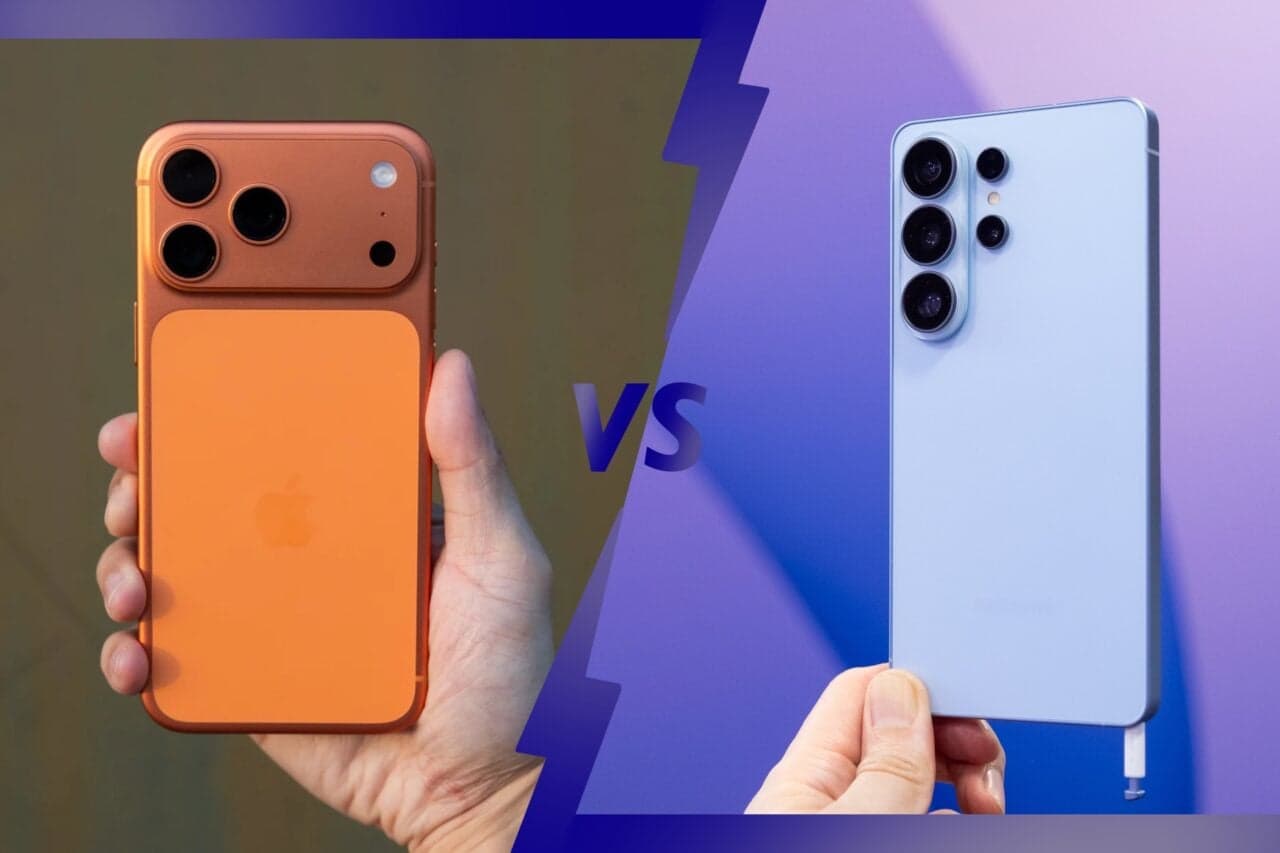
Samsung Galaxy S26 vs. iPhone 17: Is It All About AI?
Gizmodo · Feb 25, 2026 · Collected from RSS
Summary
On paper, the Apple and Samsung's latest phones are nearly neck and neck on all major features.
Full Article
If you have no care for AI software features and a privacy screen, there’s very little difference between last year’s Samsung Galaxy S25 and the new Galaxy S26. As phones are being crushed by ballooning memory prices, there are even fewer ways to distinguish between Apple’s flagship iPhone 17 and Samsung’s latest mobile device—whether that’s the screen, performance, or even the pill-shaped camera bump. See Galaxy S26/S26+ at Samsung.com See Galaxy S26 Ultra at Samsung.com Galaxy S26 vs. iPhone 17: Price Let’s just get one thing out of the way. Both baseline non-Ultra Galaxy S26 phones cost $100 more than the previous generation. The Galaxy S26 starts at $900. The larger S26+ comes in at $1,100. The flagship S26 Ultra with all the bells and whistles demands $1,300, the same as the Galaxy S25 Ultra. The big new feature for the Galaxy S26 Ultra is the privacy display. © Adriano Contreras / Gizmodo For now, the iPhone is a less expensive choice. The iPhone 17 Pro Max starts at $1,200 for the same 256GB storage space. A regular iPhone 17 starts at $800. Samsung may be feeling the impacts of the ongoing RAM shortage, especially as it refused to downgrade any memory spec (which would also hamper the phone’s AI processing capabilities). The Galaxy S26, S26+, and S26 Ultra go up for preorder Feb. 25 and start shipping Mar. 11. Galaxy S26 vs. iPhone 17: Design Not the most vibrant of color choices. © Adriano Contreras / Gizmodo All phones look the same nowadays, and that’s never been more true than with the Galaxy S26 compared to the iPhone 17. Instead of titanium on the Galaxy Ultra and the iPhone Pro (which were all the rage just a year or two ago), the new phones all have aluminum frames. This keeps them light with less chance for overheating, but at the cost of durability. One of the few ways to tell these devices apart is the lack of a programmable Action button on Galaxy phones and the different logo emblazoned on the back. The new Galaxy devices come in the classic cobalt violet purplish color. There’s another sky blue, black, and white version. If you want a silver or pink gold color, you need to order from Samsung online. The regular iPhone 17 comes in black, white, “Mist Blue,” “Sage,” and “Lavender” colorways. However, the most popular color of all was the iPhone 17 Pro in “Cosmic Orange.” There’s no Galaxy S26 model that seems as bold as Apple’s pumpkin tone. The iPhone 17 went for a vertically oriented camera bump, similar to the Samsung Galaxy phones. © Adriano Contreras / Gizmodo The Galaxy S26 is lighter than the iPhone 17 at 167g (0.36 pounds) compared to Apple’s 177g (0.39 pounds). Galaxy S26 vs. iPhone 17: Displays Both phones have 6.3-inch displays, though both hit different resolutions (2,340 x 1080 on the Galaxy S26 and 2,622 x 1,206 on the iPhone 17). The iPhone 17 has a slightly higher PPI (pixels-per-inch) spec at 460 compared to 411. Both the iPhone 17 and Galaxy S26 support refresh rates up to 120Hz. The real difference is between the iPhone 17 Pro and Galaxy S26 Ultra. Samsung’s new flagship not only maintains support for the included S Pen that slots into the phone’s base, but it also sports a 3,120 x 1,440 resolution screen with a stated 500 PPI. The iPhone 17 Pro Max, with a similar 6.9-inch display, has a lower 2,868 x 1,320 resolution with 460 PPI. And that’s not all. Samsung’s Galaxy S26 Ultra is the only phone currently with a special Privacy Display. The feature blacks out parts of the screen to prevent onlookers from reading your texts from any angle other than directly in front of the phone. Galaxy S26 vs. iPhone 17: Performance Yes, the S26 Ultra still has an S Pen slot that Apple is loath to include with an iPhone Pro Max. © Adriano Contreras / Gizmodo Despite rumors that Samsung’s lower-end phones would use a self-made Exynos chip, all three Galaxy phones are powered by a Snapdragon 8 Elite Gen 5 for Galaxy chip. This is Qualcomm’s mobile flagship chip built on a 3nm process with two “prime cores” at a 4.6GHz clock speed and another six “performance” cores running at 3.6GHz. The Galaxy S26 and S26+ also sport 12GB of RAM. The S26 Ultra comes with 12GB of RAM or 16GB if you also pay for the version with 1TB of storage. The iPhone 17 Pro maxes out at 12GB. The base iPhone 17 only has 8GB of RAM. I’ve personally benchmarked a dummy version of Qualcomm’s Snapdragon 8 Elite Gen 5 and found it could outperform an iPhone 17 Pro and its A19 chip in CPU and GPU tasks to a marginal degree (though that unit also had 24GB of RAM—which neither iPhone 17 nor Galaxy S26 has). That dummy phone also tended to get hot very quickly, drastically reducing overall performance. We’ll have to see how the latest Galaxy S26 phones handle thermals, especially considering other devices with this chip, like the Redmagic 11 Pro, have to resort to full liquid cooling. Galaxy S26 vs. iPhone 17: Cameras So much zoom. © Adriano Contreras / Gizmodo Both the Galaxy S26 and S26+ sport a standard 50-megapixel wide lens at f/1.8, a 12-megapixel ultrawide at f/2.2, and a single telephoto lens with 10 megapixels and f/2.4. Compare that to the iPhone 17’s dual 48-megapixel wide and ultrawide lenses (f/1.6 and f/2.2, respectively). The Galaxy S26 and S26+ effectively have the same camera setup as on the S25 and S25+. Meanwhile, the Galaxy S26 Ultra has four camera lenses, including a 200-megapixel wide at f/1.4, 50-megapixel ultrawide at f/1.9, and two telephotos (10-megapixel 3x optical zoom with f/2.4 and 50-megapixel 5x optical zoom with f/2.9 and 10x optical-quality zoom). The iPhone 17 Pro has a triple-lens camera, all with 48 megapixels; the periscope telephoto lens has an f/2.8 aperture with 4x optical zoom (and 8x optical-quality zoom). The Galaxy S26 Ultra may have the iPhone 17 Pro beat in pure zoom functionality. What this looks like in practice is another matter entirely. On the camera software front, Samsung is pushing even more AI here as well. There are extra features to generate stickers based on your images. There’s also a toggle to let Samsung’s AI automatically adjust lighting in your scenes so you no longer have half your friends’ faces buried in shadow. These are all very selective features. Anybody who cares about shooting on phones will ignore these AI camera enhancements entirely. Regular users may find they have some use in their daily life. While the iPhone 17 supports Apple ProRes codecs and the whole slate of HDR standards, the new Galaxy phones now support Samsung’s own APV (Advanced Professional Video) codec, which will support high-quality video up to 8K resolution. Galaxy S26 vs. iPhone 17: Battery life © Adriano Contreras / Gizmodo For the sake of battery life, the Galaxy S26 may have the edge (no, not that one). The S26 houses a 4,300 mAh battery, the S26+ has a 4,900 mAh battery, and the S26 Ultra has a 5,000 mAh battery. The base iPhone 17 only has a 3,692 mAh battery and an iPhone 17 Pro Max with eSIM has a 5,088 mAh battery (less with a nano SIM). The S26 Ultra supports 60W fast charging and 25W wireless fast charging (not available on the other two phones). The iPhone 17 Pro supports 40W fast charging and 25W MagSafe/fast wireless charging. The regular iPhone 17 has the same wired and wireless charging speeds. Things are slightly different with the Galaxy S26 and S26+. For wired charging, the S26 supports 25W and the S26 supports 45W. For wireless charging, the S26 supports 15W and the S26+ up to 20W. So if you’re comparing charging speeds for the Galaxy S26 to the iPhone 17 Pro, Apple’s is faster. One thing that Samsung has yet to come up with is a magnetic solution akin to MagSafe or Google’s PixelSnap. Galaxy S26 vs. iPhone 17: AI With all these Galaxy AI features running under the hood, we’ll have to see how battery life shakes out. The S26 lineup fully proclaims it’s the first real “Agentic AI phone” (if you ignore how every other Google Pixel and Samsung Galaxy phone from the last two years were all-in on AI). That includes new and semi-new features. We’ve seen Google’s Magic Cue in action on the Pixel 10. Samsung’s version is called “Now Nudge,” and it essentially digs through your various apps to surface important information like weather updates and important text messages. Samsung’s phones also have access to “automated app actions” that use AI to automatically accomplish certain tasks. Samsung showed off how this could call an Uber ride or get your food delivered. At launch, automated actions can only connect through Uber, Grubhub, and DoorDash. Apple is still getting its feet under it to showcase the AI-enhanced Siri. It will likely run on a Google-built AI model, should it ever make its debut. Apple has long promised Siri will be able to take cross-app actions in an agentic form, like Samsung’s phones. It’s not here yet, and Apple has yet to share when we could see the AI-ified Siri in person. While the Galaxy phones can claim they have a better battery life and more (or really, any) AI features, it’s the price hike that leaves a bad taste in the mouth. Few are likely thinking of swapping OS ecosystems, but now that Apple has reached parity with Samsung at the base level, Android phones will need something more than promises of “agentic” devices to put them over the top. See Galaxy S26/S26+ at Samsung.com See Galaxy S26 Ultra at Samsung.com
Share this story