Foreign Policy
Clustered Story
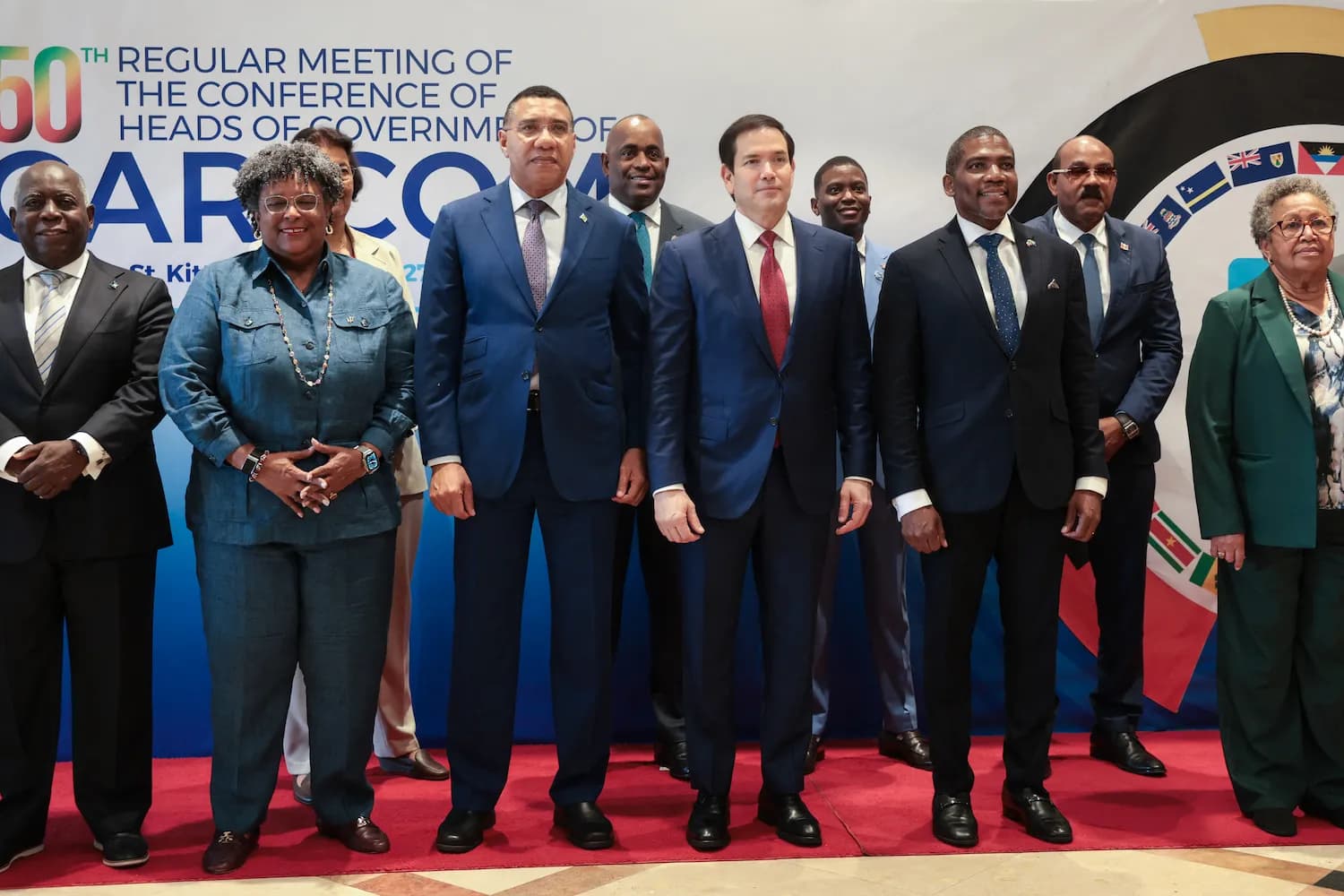
Rubio Meets With Caribbean Leaders to Discuss U.S. Policy
Foreign Policy · Feb 25, 2026 · Collected from RSS
Summary
Many regional leaders worry that the U.S. oil embargo on Cuba will have spillover consequences.
Full Article
Welcome back to World Brief, where we’re looking at U.S. policy in the Caribbean, Germany fostering trade ties with China, and Zimbabwe’s push for local minerals processing. The Caribbean’s ‘Decisive Hour’ U.S. President Donald Trump’s Donroe Doctrine is front and center at this week’s Caribbean Community leaders’ summit. The 15-nation bloc and five associate members kicked off four-day proceedings in St. Kitts and Nevis on Tuesday to discuss major pressing issues, including how U.S. policy is impacting the region. But with the arrival of U.S. Secretary of State Marco Rubio on Wednesday, Caribbean leaders are expected to also prioritize resetting relations with Washington. Welcome back to World Brief, where we’re looking at U.S. policy in the Caribbean, Germany fostering trade ties with China, and Zimbabwe’s push for local minerals processing. Sign up to receive World Brief in your inbox every weekday. Sign up to receive World Brief in your inbox every weekday. By submitting your email, you agree to the Privacy Policy and Terms of Use and to receive email correspondence from us. You may opt out at any time. Enter your email ✓ Signed Up The Caribbean’s ‘Decisive Hour’ U.S. President Donald Trump’s Donroe Doctrine is front and center at this week’s Caribbean Community leaders’ summit. The 15-nation bloc and five associate members kicked off four-day proceedings in St. Kitts and Nevis on Tuesday to discuss major pressing issues, including how U.S. policy is impacting the region. But with the arrival of U.S. Secretary of State Marco Rubio on Wednesday, Caribbean leaders are expected to also prioritize resetting relations with Washington. Trump heralded the success of the Donroe Doctrine during his State of the Union address late Tuesday. The White House is “restoring American security and dominance in the Western Hemisphere, acting to secure our national interests and defend our country from violence, drugs, terrorism, and foreign interference,” he said. As part of the Donroe Doctrine, U.S. forces have carried out deadly strikes on alleged drug trafficking boats in the Caribbean, with the most recent operation killing three people on Monday; blocked oil shipments to Cuba; and captured then-Venezuelan President Nicolás Maduro in a brazen nighttime operation. Some Caribbean leaders have praised the United States’ military actions, particularly the seizure of Maduro, which Trump claimed on Tuesday was “an absolutely colossal victory for the security of the United States” that opens up “a bright new beginning for the people of Venezuela.” But many leaders are concerned that continued U.S. intervention in the region could have devastating humanitarian and economic consequences. The region “stands at a decisive hour,” St. Kitts and Nevis Prime Minister Terrance Drew said during the summit’s opening remarks on Tuesday. “The global order is shifting. Supply chains remain uncertain, energy markets fluctuate, and climate shocks intensify.” Among the biggest concerns is Washington’s pressure campaign on Cuba. By Trump threatening to impose U.S. tariffs on any nation that supplies Havana with oil, the island has been forced to ration energy, halt surgeries, and suspend flights. The White House has also pressured other countries to reject Cuban medical missions, cutting Havana off from a key source of foreign currency. This has all contributed to a growing humanitarian crisis on the island that Caribbean leaders fear could destabilize the broader region. “It must be clear that a prolonged crisis in Cuba will not remain confined to Cuba,” Jamaican Prime Minister Andrew Holness said on Tuesday. “It will affect migration, security, and economic stability across the Caribbean basin.” However, on Wednesday, the U.S. Treasury Department posted new guidance on its website that appeared to somewhat relax the oil restrictions on Cuba, stating that it would authorize companies seeking licenses to resell Venezuelan oil to Cuba as long as such transactions “support the Cuban people, including the Cuban private sector (e.g., exports for commercial and humanitarian use in Cuba).” But, it added, “transactions involving, or for the benefit, of any persons or entities associated with the Cuban military, intelligence services, or other government institutions” would not be authorized. Other key concerns of the Caribbean nations include U.S. demands that they accept third-country deportees, consider allowing U.S. military hardware in their nations, and reduce favorable relations with China. It is unclear which of these issues were discussed with Rubio during a closed-door meeting on Wednesday. However, Bahamian Foreign Minister Fred Mitchell told The Associated Press on Tuesday that the bloc planned to stress the importance of “mutual respect and a rules-based order.” While in St. Kitts and Nevis, Rubio also plans to meet separately with Drew and Trinidad and Tobago Prime Minister Kamla Persad-Bissessar, according to the U.S. State Department. Today’s Most Read The United States Is Misreading Iran by Ali Hashem Four Years of War in Europe by FP Contributors Why Tehran’s Two-Tiered Internet Is So Dangerous by Bruce Schneier What We’re Following Merz wins in Beijing. China vowed on Wednesday to import more high-quality German goods, delivering a big victory for German Chancellor Friedrich Merz, who hoped that his trip to Beijing this week would help reset bilateral ties amid Europe’s increasingly turbulent economic relationship with the United States. But Merz’s arrival in Beijing was not all niceties. The German leader laid out a list of trade criticisms to an audience that included Chinese Premier Li Qiang. Merz’s demands included urging China to strengthen the value of its currency, continue exporting critical minerals to Europe, and reduce subsidies for its domestic manufacturers. “In view of the uncertainties caused by customs policy that we see around the world, we can now set a different example in our bilateral relations, through the reliability and security of the economic relations between our two countries,” Merz said. It appears that Merz’s gamble was a success, with Chinese President Xi Jinping lauding the two nations’ vital relationship. “The more turbulent and intertwined the world becomes, the more China and Germany need to strengthen strategic communication and enhance strategic mutual trust,” Xi said on Wednesday. Pausing critical exports. Zimbabwe suspended exports on Wednesday of all raw minerals and lithium concentrates (including those currently in transit) pending a government investigation into alleged malpractice during the exportation process. “This review is part of a broader effort to curb leakages and enhance efficiency within our systems,” Zimbabwe’s mines ministry wrote in a letter dated Feb. 17 and seen by Reuters on Wednesday. The pause will remain in effect until mining firms establish processing operations inside the country, in accordance with government requirements. Currently, most lithium concentrate exports are sent to China for further processing to make battery-grade materials. However, Harare has pushed mining firms to process these minerals locally to promote cleaner energy sources. Zimbabwe was on track to end all lithium concentrate exports by January 2027. But Wednesday’s immediate export suspension accelerates this timeline. Zimbabwe ranks among the top global producers of lithium concentrate. Last year, Harare exported around 1.13 million metric tons of the material, up 11 percent from 2024. Mining accounts for 14.3 percent of the country’s GDP, according to the World Bank, making it Zimbabwe’s second-largest contributor after manufacturing. Modi’s balancing act. Indian Prime Minister Narendra Modi kicked off a two-day visit to Israel on Wednesday, during which he plans to discuss strengthening defense, tech, and trade collaboration with Israeli Prime Minister Benjamin Netanyahu. For Modi, the trip will test New Delhi’s foreign-policy strategy, as India seeks to balance bilateral relations between Israel and other Middle East nations. For Netanyahu, the meetings are a potential avenue to increase Israeli military exports. In 2017, Modi became the first prime minister in India’s history to visit Israel, marking a major turning point in the two countries’ ties. But the looming threat of U.S. military intervention in Iran has cast a shadow over the two-day trip. New Delhi maintains diplomatic and economic ties with Tehran, though they have been strained due to U.S. sanctions and tariffs targeting Iran. Meanwhile, Israel has long viewed Iran as its top adversary, most recently culminating in a 12-day war last June. Netanyahu may view Modi as a potential tool to curb Iran’s influence. During a cabinet meeting this week, the Israeli prime minister said he seeks to create an “axis of countries” that includes India to confront “the radical Shiite axis” and “the radical Sunni axis.” Tehran is a Shiite Muslim theocracy. However, experts believe that India is unlikely to join any formal alliance that could jeopardize its precarious position in the Middle East. Odds and Ends Mona Lisa is all smiles for the Louvre’s new director. French President Emmanuel Macron appointed Christophe Leribault—an 18th-century art historian with experience overseeing the Musée d’Orsay, the Musée de l’Orangerie, and the Palace of Versailles—to the directorial role on Wednesday in the hopes that his impressive resume will usher in a new age for the crisis-ridden museum. “Leribault’s priority will be to strengthen the safety and security of the building, the collections, and people, to restore a climate of trust, and to carry forward, together with all the teams, the necessary transformations for the museum,” the French Culture Ministry said. The Louvre had a tough 2025, suffering a lucrative jewel heist, water pipe damage, and massive staff strikes. Here’s to hoping that 2026 brings a little less scandal.
Share this story