sci.news
Moon is More Geologically Active than Previously Thought
sci.news · Feb 19, 2026 · Collected from GDELT
Summary
Published: 20260219T014500Z
Full Article
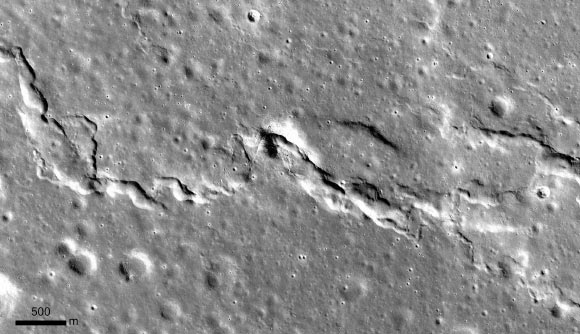
Planetary scientists have identified thousands of small mare ridges (SMRs) across the Moon’s maria, pointing to active tectonic forces that may shape the next era of space exploration. They’ve also demonstrated that SMRs are geologically young — bentween 50 and 310 million years old — and are widespread. A small mare ridge in Northeast Mare Imbrium taken by the Lunar Reconnaissance Orbiter Camera. Image credit: NASA / GSFC / Arizona State University. Both the Moon and the Earth are tectonically active; however, the tectonic forces affecting each body are different. Earth’s crust is divided into plates that have converged, separated, and slide past each other to produce expansive mountain ridges, deep ocean trenches and a ring of volcanoes around the Pacific Ocean. The Moon’s crust is not divided into plates, yet stresses within the lunar crust give rise to several distinctive landforms. One of the most common of these is lobate scarps, which form when the crust compresses and the resulting forces push material up and over adjacent crust along a fault, creating a ridge. These scarps, found in the lunar highlands, have formed only within the last billion years, or the last 20% of the Moon’s history. In 2010, Smithsonian Institution researcher Tom Watters discovered that the Moon is slowly shrinking. This contraction caused the lobate scarps in the lunar highlands to form. Yet the formation of lobate scarps does not account for all the recent contractional landforms on the Moon. Another recently identified class of tectonic landforms is SMRs. These geological features are caused by the same forces that form lobate scarps. But while lobate scarps are found in the highlands, SMRs are found only in the maria. In the new research, Dr. Watters and his colleagues aimed to map out SMRs in the lunar maria and analyze their connection to recent tectonic activity. “Since the Apollo era, we’ve known about the prevalence of lobate scarps throughout the lunar highlands, but this is the first time scientists have documented the widespread prevalence of similar features throughout the lunar mare,” said Dr. Cole Nypaver, also of Smithsonian Institution. “This work helps us gain a globally complete perspective on recent lunar tectonism on the Moon, which will lead to a greater understanding of its interior and its thermal and seismic history, and the potential for future moonquakes.” The researchers compiled the first catalog of SMRs across the nearside lunar maria. They discovered 1,114 new SMR segments, increasing the number of known SMRs across the Moon to 2,634. They also found that the average SMR was 124 million years old, consistent with the average age of lobate scarps (105 million years old). Those ages suggest that, like the lobate scarps, the SMRs are among the youngest geologic features on the Moon. Finally, the analysis shows that SMRs formed via the same type of faults as lobate scarps, and that lobate scarps in the highlands often transition to SMRs in the mare, suggesting a similar origin for these two structures. Together with lobate scarps in the lunar highlands, the new SMR data provide a more complete picture of recent contractional tectonic activity on the Moon. “Our detection of young, small ridges in the maria, and our discovery of their cause, completes a global picture of a dynamic, contracting Moon,” Dr. Watters said. The results were published in the Planetary Science Journal. _____ C.A. Nypaver et al. 2025. A New Global Perspective on Recent Tectonism in the Lunar Maria. Planet. Sci. J 6, 302; doi: 10.3847/PSJ/ae226a
Share this story