Gizmodo
Humans Sketched Oddly Precise Geometric Patterns Onto Ostrich Eggs 60,000 Years Ago
Gizmodo · Feb 26, 2026 · Collected from RSS
Summary
Prehistoric humans had a surprisingly sophisticated understanding of geometric rules, as this study suggests.
Full Article
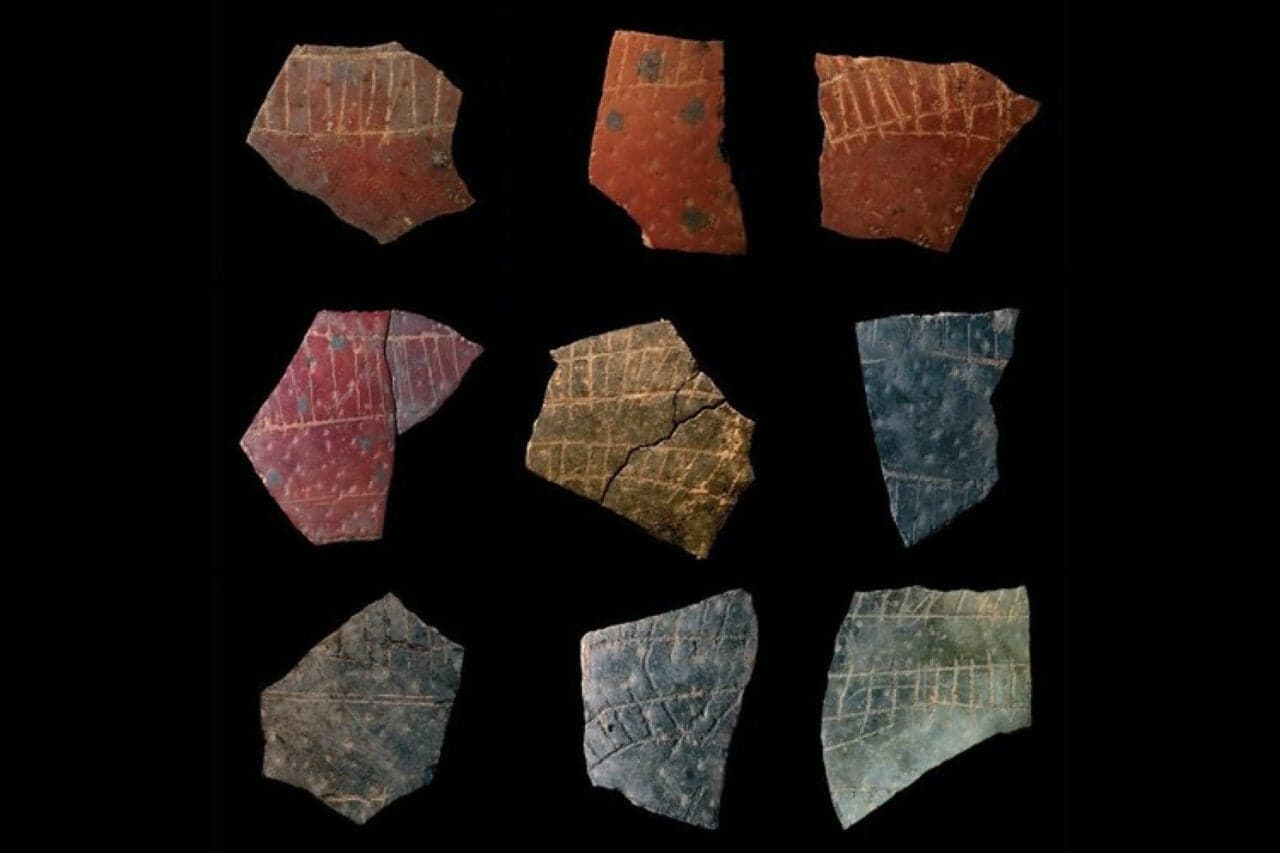
Ostrich eggs are huge. Big enough, in fact, for ancient humans to use them as primitive writing surfaces for showcasing their mathematical prowess, according to a new study. The paper, published recently in PLOS One, describes an investigation of 112 ostrich eggshell fragments dating back more than 60,000 years from three archaeological sites in southern Africa. These eggshells had odd markings etched onto their surfaces, which researchers reconstructed in fine detail using geometric and statistical techniques. In doing so, they identified highly consistent patterns that couldn’t have been random or improvised—meaning these prehistoric humans had a fairly good grasp of geometry. “We are talking about people who did not simply draw lines but organized them according to recurring principles—parallelisms, grids, rotations, and systematic repetitions,” Silvia Ferrara, a historian at the University of Bologna in Italy, said in a statement. Neither rock nor paper This isn’t the first time researchers have found prehistoric humans using ostrich shells in unique ways. For example, in 2020, University of Michigan researchers hypothesized hunter-gatherer groups in southern Africa gifted ostrich eggshell beads to their significant other around 33,000 years ago. Earlier in 2010, researchers had noticed odd engravings on ostrich eggshells from more than 60,000 years ago. Subsequent research even took steps to classify some of them according to their “shared geometric characteristics,” according to the new study. But that was about it, as there hadn’t really been any exploration of whether these patterns reflected “genuine cognitive structuring” in early humans, the paper noted. The researchers aimed to address this gap in the new study. A pattern in shapes For the latest analysis, the researchers created a thorough reconstruction of the eggshell engravings. Then, they determined key geometric variables, such as distinct angles, groups of parallel lines, or repeated use of hatches, grids, or diamond-shaped motifs. From these steps, the team assessed how intentional these markings were based on spatial organization, or the overall harmony of all the etchings on the shell. An example of how the researchers traced the patterns engraved on ostrich eggshells. © Ferrara et al., 2026 Fascinatingly, the team’s statistical analysis revealed that more than 80% of the configurations drawn on the shells had coherent spatial regularities. Simpler compositions featured repeated use of right angles and groups of parallel lines. More intricate patterns displayed an apparent understanding of rotation, translation, or repetition, the study added. “These engravings are organized and consistent and show mastery of geometric relationships,” Ferrara noted. “There is not only a process of repeating signs; there is real visuo-spatial planning, as if the authors already had an overall image of the figure in mind before engraving it.” Abstractionism has always been cool The team believes the analysis demonstrates ancient humans could “construct visual configurations structured according to specific rules,” which would be a “key indicator of the emergence of abstract thought.” However, the researchers aren’t sure yet if there’s any meaning to these markings. There is, of course, the fact that we cannot travel back in time to ask these early artists if they had such “specific rules” in mind. That is, although the new analysis is thorough in a statistical sense, the conclusions remain for the most part hypothetical. Still, if art (or math?) history is any guide, our affinity for neat, geometric alignments must come from somewhere. For what it’s worth, as someone who loves both art and math, I’d say I’m quite open to the idea that some of this love came from ancient ostrich shells.
Share this story