Foreign Policy
How George W. Bush Created ICE
Foreign Policy · Mar 2, 2026 · Collected from RSS
Summary
The national security apparatus built after 9/11 transformed the country in unpredictable ways.
Full Article
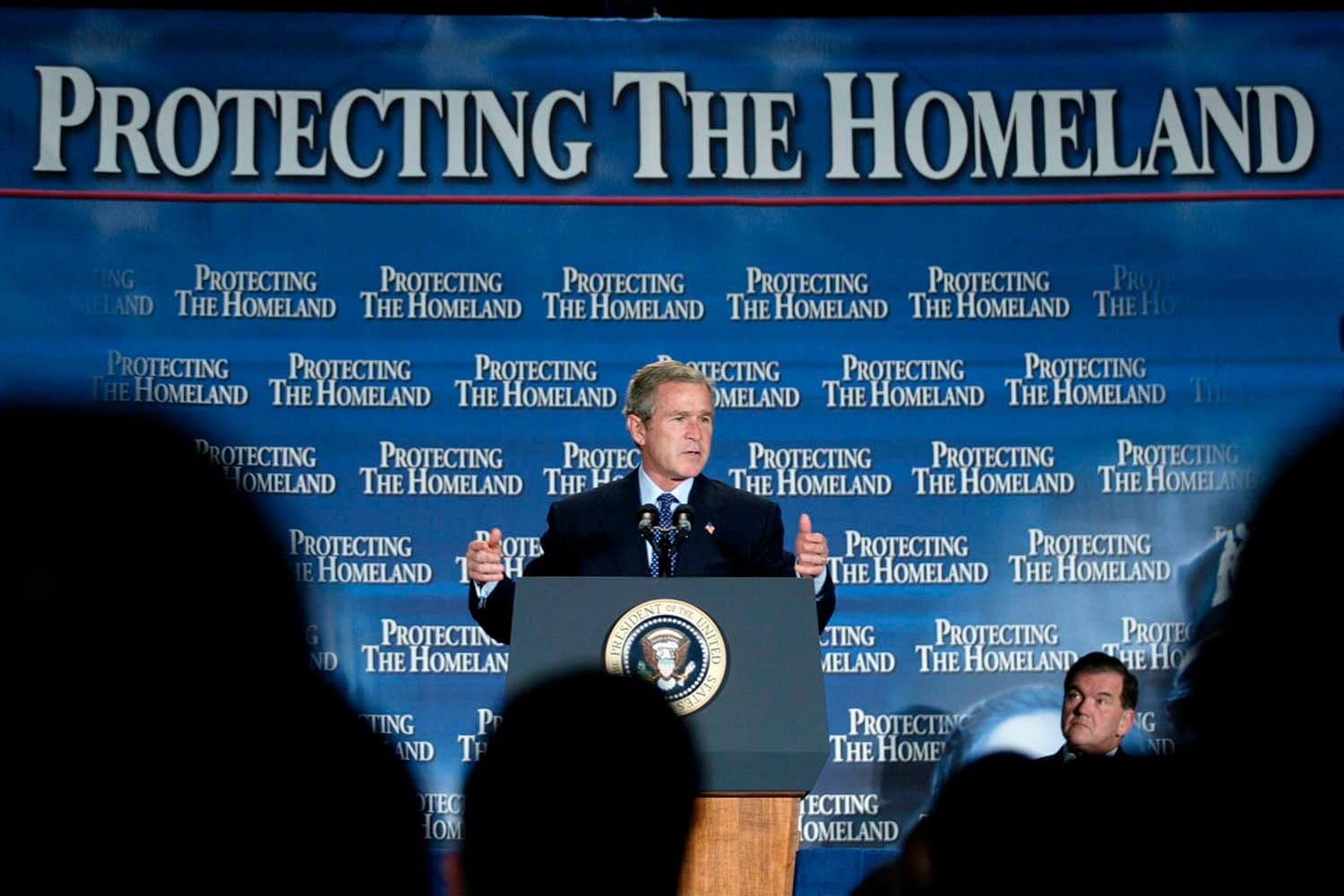
In a high-stakes standoff on Capitol Hill, Senate Democrats have withheld funding for the Department of Homeland Security (DHS) until Republicans agree to reforms of U.S. Immigration and Customs Enforcement (ICE). That DHS unit that has become a focal point of intense controversy following the deaths of two U.S. citizens at the hands of federal agents. The presence of ICE agents in cities across the country—including Houston; Phoenix; Portland, Maine; Portland, Oregon; Chicago; New York; Los Angeles; and Minneapolis—as they carry out an extraordinarily aggressive deportation campaign has shocked much of the nation. According to one recent poll, 60 percent of Americans believe that ICE has gone too far. The controversy over ICE has raised questions about its home institution, the Department of Homeland Security, which grants the president extensive resources to deploy within U.S. borders. In a country that has long prided itself on the separation of powers and limits on the executive branch, DHS looks much more like the “garrison state” that traditional conservatives and civil libertarians have always warned against. With DHS at his command, a president can quickly become imperial. The story of its creation is a reminder of how profoundly President George W. Bush transformed the country in the aftermath of 9/11, building a massive national security apparatus comparable to the one established at the onset of the Cold War in the late 1940s. Although Bush’s policies were implemented with the aim of preventing another catastrophic terrorist attack akin to the one carried out by al Qaeda, President Donald Trump has shown that, in different hands, these centralized institutions can easily be repurposed and used in ways far removed from what most Americans had envisioned. Fears about creating an institution as powerful as DHS were central to the reform efforts of the mid-1970s. In 1975 and 1976, high-level congressional hearings led by New York Rep. Otis Pike and Idaho Sen. Frank Church exposed the underside of U.S. Cold War policies since World War II. Through the hearings and reports, the country learned how the CIA had conducted surveillance of anti-war protesters, attempted to assassinate foreign leaders, and operated with little accountability to elected officials. The national security apparatus had given the president formidable tools to wield at his discretion. “Intelligence agencies have undermined the constitutional rights of citizens,” the resulting Church Committee report warned, “primarily because checks and balances designed by the framers of the Constitution to assure accountability have not been applied.” As a result, Congress passed a series of major reforms designed to curb the power of these agencies, including the Foreign Intelligence Surveillance Act of 1978, which created the Foreign Intelligence Surveillance Court and charged it with approving warrants for surveillance. President Gerald Ford’s attorney general, Edward Levi, also issued guidelines that imposed restrictions on FBI investigations. In addition, the creation of the Senate and House Intelligence Committees in 1976 and 1977, respectively, aimed to strengthen oversight, while a firewall was established between the CIA and FBI to prevent abuses of intelligence gathering. Some of those reforms began to come under question during the 1990s, as the Cold War ended and the United States confronted the growing threat of stateless terrorist networks. In 1993, a terrorist cell set off a bomb beneath the North Tower of the World Trade Center in New York City, killing six people and injuring over 1,000. Two years later, in 1995, two men connected to the white nationalist movement blew up a federal office building in Oklahoma City, killing 168 people. In 1998, al Qaeda targeted U.S. embassies in Kenya and Tanzania. In response to these developments, a federal commission led by former Sens. Gary Hart and Warren Rudman released a report on January 31, 2001, warning that the United States was not prepared for a major terrorist attack. “Americans will likely die on American soil, possibly in large numbers,” it warned, unless there was a major reorganization of outdated national security institutions, including the integration and consolidation of functions scattered across multiple agencies. Then came 9/11. The United States suffered a devastating terrorist attack of the kind the Hart-Rudman Commission had feared when al Qaeda agents flew hijacked planes into the World Trade Center in New York and the Pentagon outside of Washington. Nearly 3,000 people were killed, and nation was deeply traumatized. The sense of fear did not subside: Anthrax attacks in the mail later in September, which reached Senate offices and major media organizations, heightened concern in the White House and on Capitol Hill that terrorism had not ended. President Bush responded by issuing an executive order that created the Office of Homeland Security within the White House to coordinate the activities of various agencies with jurisdiction over these policies. He appointed former Pennsylvania Gov. Tom Ridge to lead the effort. The office lacked independent budget authority, leaving Ridge to rely on negotiation and persuasion to “oversee and coordinate a comprehensive national security strategy,” as Bush described his job. Democrats, who controlled the Senate, argued that this reorganization did not go far enough. Democratic Connecticut Sen. Joseph Lieberman who had been former Vice President Al Gore’s running mate in 2000, led the push for legislation to create a cabinet-level department with jurisdiction over several critical areas, including border control and emergency management. Although Bush initially opposed the plan, he shifted course in June 2002 after investigations revealed that the FBI had failed to act on early warnings about al Qaeda and that the CIA had not shared critical intelligence it had collected. The Democratic proposal also seemed popular. In June 2002, roughly three out of four Americans, according to Gallup, favored a cabinet-level agency. Once Bush embraced the idea, his proposal proved even more expansive than Lieberman’s. Some civil libertarians warned that creating such a vast security agency ran counter to the reforms of the 1970s. The ACLU warned that the proposal “does not contain sufficient structural guarantees to ensure that this vast new Department will be accountable to the public, both to ensure it is doing its job and to ensure against abuse. Instead, the plan eviscerates many of the existing safeguards for government agencies.” Yet with memories of 9/11 fresh in the minds of the public, there were few people willing to oppose strengthening the protective shield of the country. The main partisan fault line centered on employment. Bush demanded flexibility in hiring and firing, seeking to strip civil service protections from workers. Congressional Democrats accused the president of exploiting a national security crisis to attack public sector employees and unions, arguing (with many experts in agreement) that abandoning employment protections could reduce the quality of the workforce. The debate spilled into the 2002 midterms as Republicans attacked Democrats for delaying the legislation. Such Democrats included Georgia Sen. Max Cleland—a triple amputee Vietnam veteran—who had opposed the president’s effort to privatize the workforce. Republicans aired a controversial television ad against him, featuring images of al Qaeda leader Osama Bin Laden and Iraqi President Sadaam Hussein. Cleland ultimately lost his reelection bid. National security policies helped Republicans increase their numbers in the House and gain control of the Senate—and thus Congress, defying the historical pattern in which the president’s party typically suffers significant losses in its first midterm election. On Nov. 7, basking in victory, Bush told reporters that “[t]he single most important item of unfinished business on Capitol Hill is to create a unified Department of Homeland Security … It’s imperative that the Congress send me a bill that I can sign before the 107th Congress ends.” A bipartisan coalition ultimately broke the impasse during the lame duck session. The midterms shook Democrats, who agreed to provisions that would allow the president to bypass many civil service protections for DHS workers and grant greater flexibility than normally allowed in hiring and firing decisions. On Nov. 25, Bush signed the bill into law. All or part of 22 federal agencies were consolidated into the new Department of Homeland Security—including the U.S. Customs Service, the Federal Emergency Management Agency, the U.S. Secret Service, parts of the Immigration and Naturalization Service (INS), the U.S. Coast Guard, and the Transportation Security Administration—which encompassed roughly 170,000 employees. “The Homeland Security Act of 2002,” Bush declared, “takes the next critical steps in defending our country. The continuing threat of terrorism, the threat of mass murder on our own soil will be met with a unified, effective response.” In 2003, Immigration and Customs Enforcement replaced INS inside the DHS. At the time, most INS workers were left in the dark about what would happen to them and how the new operation would work. Others worried about the implications of treating immigration like a national security question. “Since this is homeland security,” Greg Simons of the Committee for Human Immigrant Rights of Los Angeles warned in the Los Angeles Times, “people are afraid it will taint immigrants as potential threats rather than as benefits to society.” Post 9/11 counterterrorism policies converged with a bipartisan rightward shift in border enforcement and deportation policy that had begun in the mid-1990s. In 1996, President Bill Clinton had signed the Antiterrorism and Effective Death Penalty Act and the Illegal Immigration Reform and Immigrant Responsibility Act, wh
Share this story