breitbart.com
Clustered Story
Exclusive Former IDF General : Iran May Arm Missiles with Chemical Warheads
breitbart.com · Feb 26, 2026 · Collected from GDELT
Summary
Published: 20260226T031500Z
Full Article
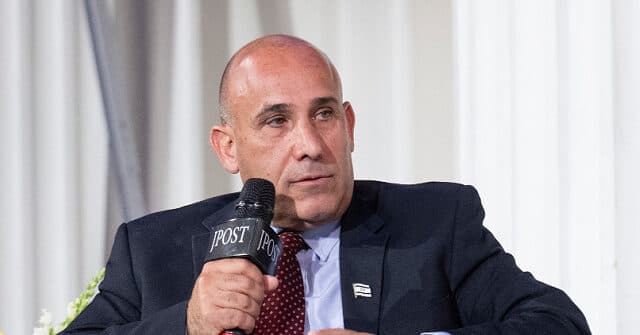
A former senior Israeli commander warned that Iran could seek to arm its rapidly expanding ballistic missile arsenal — which already threatens Israel, U.S. bases, and allied interests across the region — with chemical or biological warheads, arguing that the “only viable option” may be a “massive” and “decisive” strike to bring down the regime as nuclear negotiations reach a critical juncture. Speaking in an exclusive interview with Breitbart News on Wednesday — on the eve of a pivotal third round of U.S.-Iran nuclear talks in Geneva — Brig. Gen. (Res.) Amir Avivi, founder and chairman of the Israel Defense and Security Forum and a former senior IDF commander who continues to advise Israeli defense circles, said the most urgent danger now facing not only Israel but also American forces and regional stability is Tehran’s accelerating ballistic missile production. “Looking at the moment, the main issue which is urgent — not only to Israel but to American forces and regional stability — is the massive production of ballistic missiles,” Avivi said. While Iran’s nuclear sites were “hit severely” last year and rebuilding efforts take time, he warned that Tehran is recovering “much faster” when it comes to manufacturing advanced missiles — systems he described as “more advanced and dangerous” than those launched during the 12-day war. He said Iranian leaders appear “very determined to retaliate” after what they view as a humiliating blow that undermined their deterrence both internally and internationally. One underreported dimension of that missile surge, Avivi cautioned, is the possibility that Tehran could seek to equip some of those systems with unconventional payloads. “There is a discussion about that,” he said, confirming that Israeli defense officials are actively assessing “what are the capabilities and what are the chances that there is readiness to put a warhead that has these capabilities.” The prospect that Iran could attach chemical or biological agents to long-range ballistic missiles, he argued, “strengthens the understanding that we need a preventive attack” to suppress any attempted strike. Avivi has raised similar concerns in recent days in public briefings and interviews, warning that Iran is “continuing preparations for war” and expanding missile production even as diplomacy continues. His warning comes as a report from the Foundation for Defense of Democracies this week urged greater scrutiny of Iran’s opaque chemical weapons program, arguing that policymakers have focused heavily on the nuclear file while paying comparatively less attention to potential chemical capabilities. The report cited allegations that Iranian security forces deployed unknown chemical substances against protesters earlier this year — claims Tehran denies — and noted that U.S. officials have repeatedly found Iran in noncompliance with aspects of the Chemical Weapons Convention. Asked to assess what could unfold in the coming days or weeks, the retired general outlined three possible scenarios. The first, he said, is an Iranian preemptive strike against Israel or U.S. targets in the region. “If the Iranians attack preemptively, they can launch a massive amount of ballistic missiles that will overwhelm defenses in Israel and in other places,” he warned. Israel, he added, is monitoring “very, very closely” every Iranian movement. A second scenario would be an Israeli preemptive strike if Jerusalem determines that Tehran is crossing defined red lines or preparing an imminent attack. The third — and, in his view, increasingly likely — is a U.S.-led military campaign drawing heavily on Israeli intelligence and targeting data. “There’s a very big chance this is what will happen — a massive U.S.-led attack,” Avivi said, describing the current period as “a very defining moment.” Beyond the immediate battlefield calculations, Avivi framed the confrontation — particularly in light of President Donald Trump’s stated red lines — as a broader test of American deterrence and global credibility. “At the end of the day, America has to build back its deterrence,” he said, arguing that projecting strength against Tehran would reverberate beyond the Middle East, including in dealings with China and Russia. But the retired Israeli commander said limited strikes on nuclear or missile facilities would not be enough. “If the U.S. wants to push the vision of stability and peace in the region, this regime must go,” Avivi said, contending that Iran’s network of proxies — including Hezbollah, the Houthis, and militias operating in Iraq and Syria — ultimately derive their power from Tehran’s leadership. What would be required, he argued, is a far broader and more decisive military effort aimed directly at collapsing the regime’s command structure and removing its leadership. “This is a completely different kind of operation,” he explained. “It’s not just about military sites or nuclear sites. This is about the leadership. It’s about the centers of government, media, Revolutionary Guard, Basij forces.” For such a campaign to succeed, Avivi said, two developments would need to occur simultaneously: a massive, coordinated assault degrading the regime’s ability to govern and command its forces — and a domestic uprising from within. “America is going into this big war without boots on the ground,” he said. “This is not similar to Iraq. The boots on the ground are the Iranian people.” Avivi expressed confidence that many Iranians, battered by economic collapse and repeated crackdowns, would view such a moment as an opportunity for change. Despite President Trump’s public preference for diplomacy, Avivi said there is “no way to bridge” the gap between Israeli-American demands and what Tehran would ultimately accept — or genuinely implement. “They are going to deceive and lie and continue their path toward nuclear capabilities and rebuilding their proxies and ballistic missiles,” he warned, arguing that even a negotiated settlement would not alter the regime’s long-term ambitions. “Therefore, the only viable option is to attack — massive attacks, simultaneous, decisive — to bring this regime down,” Avivi said. “And I believe that this is what will happen.” As negotiators prepare to meet in Geneva on Thursday, Avivi’s warning frames the stark choice now facing Washington and Jerusalem: secure an agreement that permanently halts Iran’s weapons ambitions — or prepare for a military confrontation that could reshape the region. Joshua Klein is a reporter for Breitbart News. Email him at jklein@breitbart.com. Follow him on Twitter @JoshuaKlein.
Share this story