Gizmodo
Why This Part of Antarctica Bleeds Blood Red
Gizmodo · Feb 25, 2026 · Collected from RSS
Summary
Perhaps surprisingly, the answer isn't climate change.
Full Article
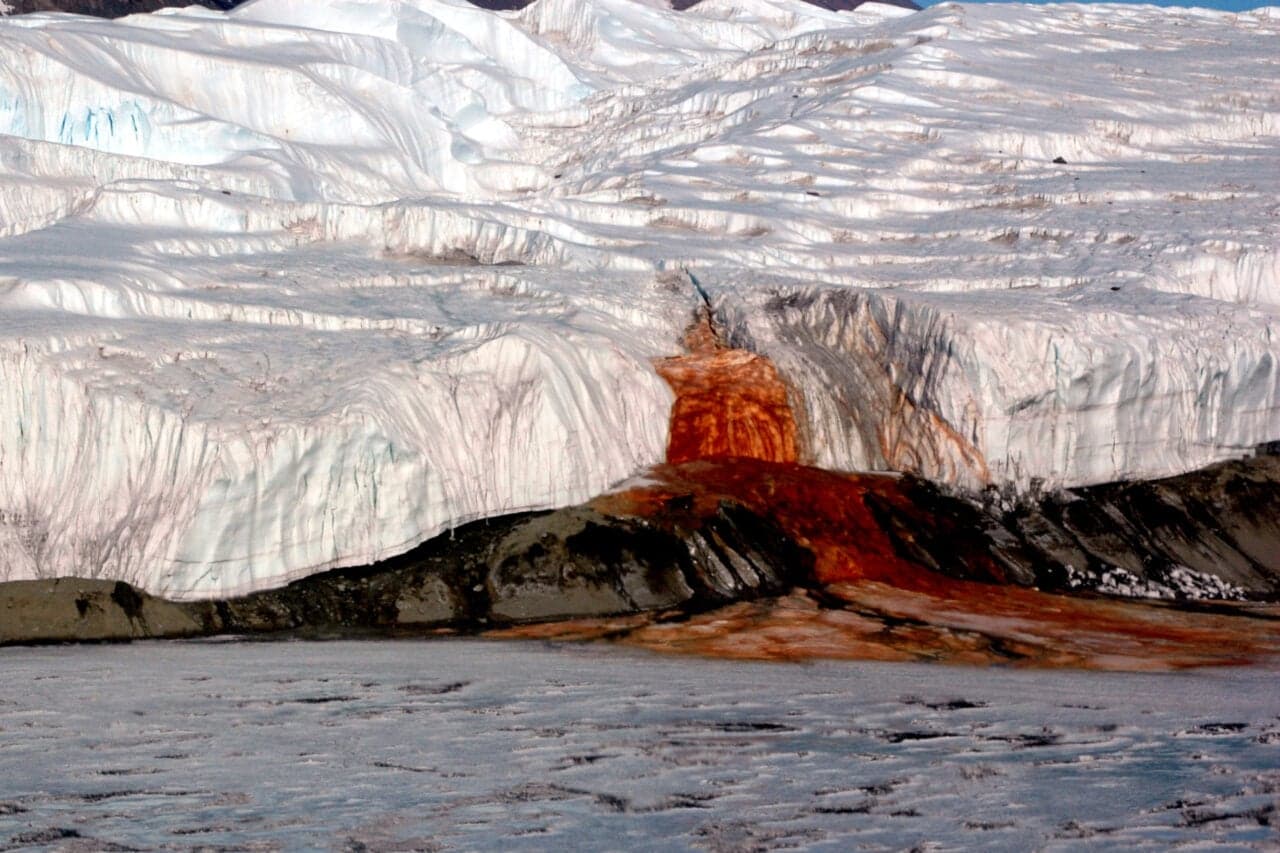
In 1911, Australian geologist Thomas Griffith Taylor discovered the Blood Falls—an odd, blood-red flow of saltwater seeping out from the tip of East Antarctica. Researchers later confirmed the color came from iron oxide, although they weren’t quite sure how, or how the iron even got there. But a new proposal may finally bring closure to this century-long mystery. In a recent paper published in Antarctic Science, researchers propose that the reddish coloration at Blood Falls could be the product of pressure variations beneath nearby glaciers. The crushing weight of the glacier exerts enough pressure on the salty water below, leading to periodic bursts of seawater and minerals trickling out from the cracks. When iron meets air and oxidizes, the mixture takes on a rusty red color. The findings underscore the “tight coupling between glacier dynamics, subglacial hydrology, and ecosystem processes in the McMurdo Dry Valleys,” where Blood Falls is located, the researchers noted in the paper. An icy desert Blood Falls lives in the Dry Valleys of Antarctica, patches of snow-free ground hosting a collection of icy lakes. These icy lakes all differ in chemical composition, making them crucial landmarks for scientists hoping to understand geological evolution in Antarctica. Blood Falls seeps out from the edge of the Taylor Glacier and into one such lake, Lake Bonney, a salty lake with a permanent ice cover. Slow and steady An overhead view of the Taylor Glacier, with annotations noting the location of Blood Falls. Credit: Robert Simmon/NASA Earth Observatory Exploring Antarctic environments is no easy task. Accordingly, research advances regarding Blood Falls came sparingly, often several decades apart. In the mid-1960s, researchers first confirmed that the reddish color was iron salts, or ferric hydroxide, staining the ice sheets. Then in 2003 scientists at Ohio State University analyzed samples of the reddish discharge over 10 years, concluding that the salts likely came from an ancient lakebed, now freeze-dried and trapped below the Taylor Glacier. Six years later, another team found at least 17 different types of microbes in water samples from Blood Falls, suggesting that there was a lot going on behind the rusty red curtain. The final puzzle piece The new study emerged from a more recent series of observations, which began around 2018. In these investigations, researchers, including lead author Peter T. Doran, a geologist at Louisiana State University Baton Rouge, found that the subglacial water flow in the region was much more elaborate and widespread than was previously believed. When Doran and colleagues used GPS data to construct a time lapse of temperature, depth, and ice changes at Blood Falls. They found that temperature anomalies, which affect the motion of the Taylor Glacier, corresponded to the depth and density of the briny water. Fascinatingly, the downward pressure placed by the glacier on subglacial brine led to periodic bursts of pressurized water. At the same time, these outburst events caused tiny disruptions in the glacier’s movements as well. Although the study concludes one outstanding mystery surrounding Blood Falls, the researchers aren’t sure how the region may change from the ever-growing influence of climate change. That will come to light with continued monitoring of our planet’s southernmost region, the paper concluded.
Share this story