vietnamnews.vn
Việt Nam advances toward mastering UAV technology
vietnamnews.vn · Feb 27, 2026 · Collected from GDELT
Summary
Published: 20260227T041500Z
Full Article
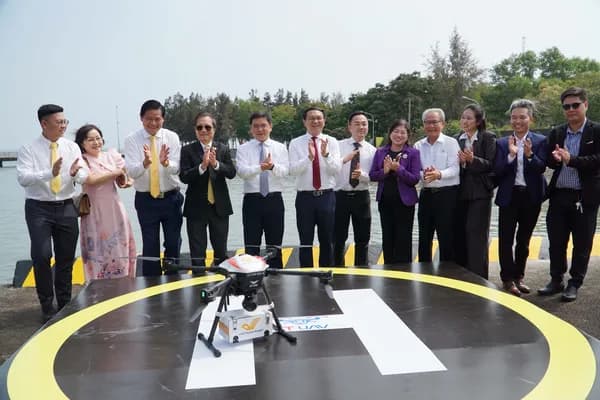
The Saigon Hi-Tech Park. — VNA/VNS PhotoHCM CITY — Enterprises producing the latest in high-tech unmanned aerial vehicles (UAVs) are seeing their businesses take-off – reaching new heights around the world.The journey of UAVs, from trial flights under the sandbox mechanism at the Saigon Hi-Tech Park to the first cross-sea postal route, reflects the methodical and strategic development of the sector in HCM City.Products are already making their way into the US market, but this is not merely a story of applying new technology in practice, but a gradual process of mastering core details and affirming international capabilities in the UAV industry, one of Việt Nam’s strategic high-tech sectors.HCM City inaugurated a postal transport route using unmanned aerial vehicles (UAVs) connecting Cần Giờ Commune and Vũng Tàu Ward on February 12.This marks the first cross-sea postal route, representing a significant milestone in integrating advanced technology into logistics operations while opening new directions for the city’s digital economy and low-altitude economy.Pilot results will provide valuable real-world data for regulators to refine policies for developing the low-altitude economy and assess the feasibility of expanding the model into more specialised areas such as emergency medical transport, search and rescue, disaster response, and smart urban management.Nguyễn Như Thuận, director of HCM City Post, said that close coordination between businesses and regulatory authorities was a prerequisite for effective operations.After completing the pilot phase, the implementing unit would report to authorities to finalise licensing procedures and related processes, he said.In parallel, the postal sector would develop operational procedures, invest in infrastructure, and prepare resources for professional deployment. If widely adopted, order volumes were expected to increase significantly, Thuận emphasised.From a state management perspective, Phạm Huỳnh Quang Hiếu, deputy director of the Department of Science and Technology of HCM City, noted that the launch was not merely a technological event but demonstrated the city’s determination to bring scientific and technological achievements into daily life, promote innovation and advance the digital economy.Amid rising delivery demand requiring faster, more flexible and more efficient solutions, UAVs are expected to become a breakthrough solution, shortening transport times, optimising costs, expanding service coverage and gradually easing pressure on traditional transport infrastructure.UAVs were not limited to delivery services but were also oriented toward applications in forest monitoring, urban surveillance, and urban management support, an important step toward building a modern, safe, and sustainable low-altitude economy, Hiếu said.On January 5, the Department of Science and Technology of HCM City, in coordination with the management board of the Saigon Hi-Tech Park and technology enterprises such as Saolatek, Real-Time Robotics Vietnam and Di Dong Viet, launched a pilot programme applying UAVs in delivery operations within the hi-tech park area.Beyond technical testing, this initiative represents a strategic step toward standardising controlled UAV operations and creating a safe innovation space where breakthrough technologies can be nurtured into new growth drivers.Nguyễn Kỳ Phùng, head of the Saigon Hi-Tech Park management board, stated that integrating UAVs into urban logistics posed challenges in both technology and airspace safety.These pilot steps were therefore necessary to gather real-world data, refine policies, and implement subsequent phases, he said.He projected that the low-altitude economy could generate billions of US dollars and hundreds of thousands of jobs for Việt Nam in the coming decade.With the emergence and growth of UAV enterprises at the hi-tech park, HCM City has the opportunity to become a leading UAV manufacturing and application hub in the region, he added.HCM City inaugurated a postal transport route using unmanned aerial vehicles (UAVs) connecting Cần Giờ Commune and Vũng Tàu Ward on February 12. — VNA/VNS PhotoReaching international marketsPhan Văn Hán, director of the Global Technical Support Centre at CT UAV JSC, noted that cross-sea flights represented one of the most challenging problems in unmanned logistics. The company therefore made long-term preparations, particularly in selecting appropriate technologies and technical solutions.“We believe Vietnamese enterprises are fully capable of achieving higher and farther-reaching goals," Hán said."As one of the major UAV units in ASEAN with 16 UAV product lines across various applications, we are confident in meeting domestic demand and moving toward export markets."When business confidence, customer trust, and government support converge, success is certain.”Trần Anh Tuấn, founder of Saolatek, underscored that the technology testing phase was crucial for enterprises to master technologies, innovate and ensure UAVs were both flight-ready and marketable.Following these trials, the company hoped to secure more domestic orders and move toward exports, he said.He noted that the world was seeking UAV manufacturing hubs for global markets, and Việt Nam has favourable conditions to integrate deeply into this value chain.Since the issuance of Resolution 57-NQ/TW on breakthroughs in science, technology, innovation, and national digital transformation, along with various support mechanisms, the technological development environment had improved significantly, Tuấn said.The sandbox mechanism and reasonable risk acceptance in scientific research enable enterprises to experiment, develop technologies and refine their products.Nevertheless, enterprises still require stronger State support, from resource assistance to ecosystem development, to focus on research and development (R&D).“Vietnamese engineers are fully capable of producing complete, high-tech UAVs that can compete in international markets,” he said.Lương Việt Quốc, CEO of Real-Time Robotics Vietnam Corporation, observed that the greatest challenge for Việt Nam’s UAV industry was how to rise and compete globally.This demands superior inventions and technologies, the only path to enter global markets while maintaining domestic competitiveness, he asserted.However, achieving global reach was not solely an enterprise-level story but a national challenge built upon three main pillars: finance, human resources, and institutions, he noted.The 'triple helix' model, linking government, enterprises, and academia, must be further strengthened to transform technological capacity into national competitive power.To reach international markets, Quốc suggested that the State create optimal conditions for enterprises to develop breakthrough products and solutions.This included financial support policies such as grants and incubation for start-ups, and 'order-based' mechanisms for enterprises that have proven international competitiveness, enabling continued investment in R&D, he said. — VNS
Share this story