utulsa.edu
UTulsa awarded $12 . 6M for research projects in AI , cyber , energy
utulsa.edu · Feb 23, 2026 · Collected from GDELT
Summary
Published: 20260223T220000Z
Full Article
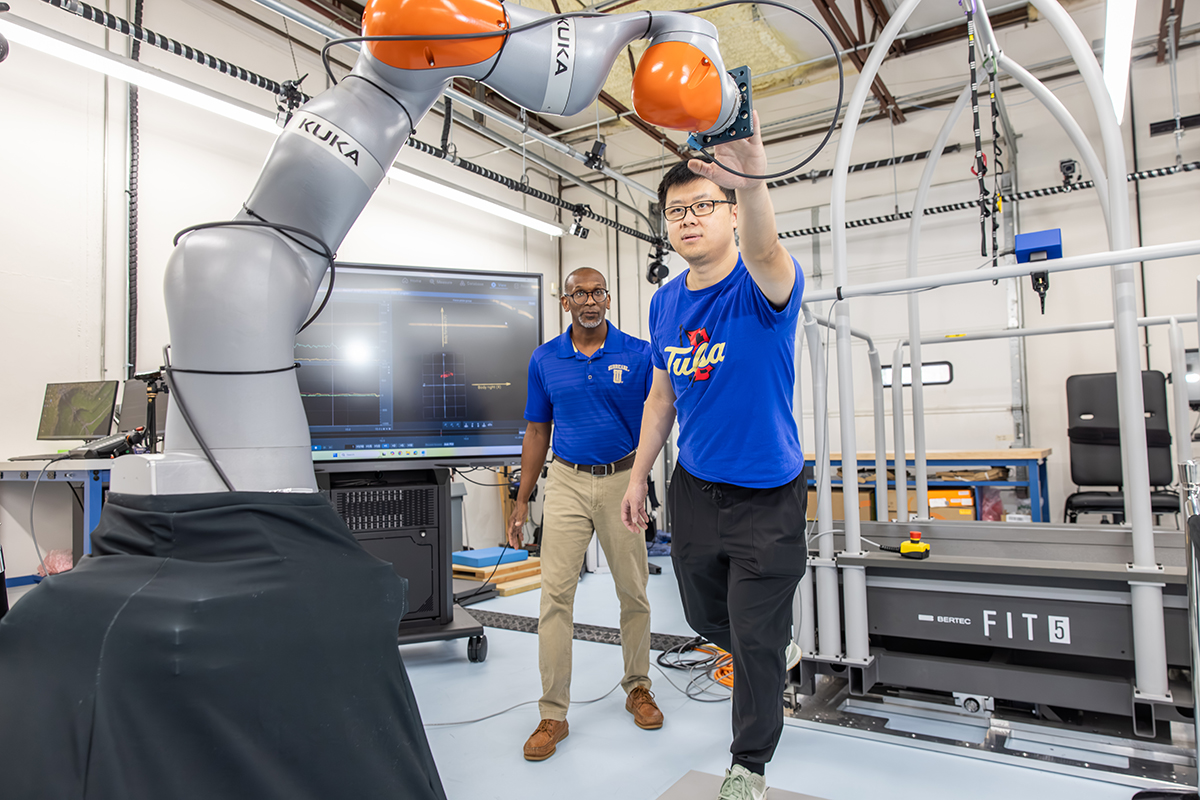
The University of Tulsa has received four federal appropriations supporting major research initiatives that will strengthen the nation’s energy resilience, advance next-generation materials and manufacturing and position Oklahoma as a hub for secure autonomous-systems innovation. These awards will expand UTulsa’s pilot-scale research infrastructure, deepen industry and community partnerships and create new pathways for student engagement in cutting-edge discovery. “From providing novel energy systems to securing physical artificial intelligence systems, these investments reaffirm UTulsa’s role as a national leader in applied research that delivers real-world impact,” said Rose Gamble, vice president for research and government relations. “We are excited to broaden and enhance UTulsa’s expertise, facilities and industry collaborations that enable transformative innovation.” These four federally funded initiatives will: Expand UTulsa’s pilot-scale research facilities on the North Campus Grow Oklahoma’s workforce in materials science, energy systems, autonomy and cybersecurity through faculty-led research, student participation and industry involvement Support area manufacturers and energy firms with fabrication partnerships, prototype testing and data-driven insights “UTulsa’s partnerships with industry and community stakeholders ensure these breakthroughs translate into economic and societal benefits,” said Interim President Rick Dickson. “We are grateful to U.S. Sen. Markwayne Mullin and the entire Oklahoma congressional delegation for their leadership and support in securing these federal appropriations. Their commitment to strengthening Oklahoma’s research capacity and economic future is instrumental in advancing initiatives in these critical areas.” Advanced, Low-Cost, Grid-Scale Energy Storage Department of Energy — Energy Projects FY26 federal funding: $3.2 million UTulsa researchers will develop pilot-scale zinc-sulfur (ZnS) batteries as a safer, lower-cost alternative to lithium-ion technology for utility-scale battery-energy-storage systems. The project combines new battery-manufacturing capability, industrial-grade characterization equipment, grid-simulation systems and GPU-based artificial intelligence and machine learning (AI/ML) modeling to evaluate performance, safety and reliability under real-world grid conditions. UTulsa’s history in advanced battery research positions the university to lead in emerging domestic battery chemistries. Resilient and Safe Energy Transportation Department of Energy — Energy Projects FY26 federal funding: $3.2 million Building on UTulsa’s pilot-scale pipeline facilities, researchers will analyze multifuel flow behavior, corrosion risks and leak-detection challenges using advanced distributed sensor networks and machine-learning models. Results will inform industry best practices and future design codes, supporting U.S. energy security and Oklahoma’s energy economy. Extreme Materials Department of Energy — Energy Projects FY26 federal funding: $3.2 million This project focuses on materials capable of withstanding extreme environments, including temperatures above 600 degrees and corrosive or high-velocity conditions relevant to deep-well drilling, hypersonics and spacecraft reentry. UTulsa is one of the few U.S. universities able to manufacture carbon-carbon composites through chemical vapor infiltration and perform pilot-scale performance testing. The research integrates thermomechanical characterization, porosity analysis, micro-CT imaging and AI/ML-driven materials discovery. Cooperative and Secure Physical AI Systems National Institute of Standards and Technology (NIST) — Scientific and Technical Research and Services (STRS) FY26 federal funding: $3 million UTulsa will advance the next generation of physical AI systems in the form of autonomous robots that interact with the world through real-time sensing, adaptation and decision-making. While the outcome can have broadly beneficial results for industrial systems, the initiative integrates robotics, AI/ML, kinesiology, user-experience research and cybersecurity toward assistive robotics people how may need home services and care. UTulsa’s Institute for Robotics & Autonomy and Oklahoma Cyber Innovation Institute will partner on the project to combine their expertise in physical AI system development and cybersecurity vulnerability detection and mitigation. We use cookies on our website to give you the most relevant experience by remembering your preferences and repeat visits. By clicking “Accept”, you consent to the use of ALL the cookies. .
Share this story