news.unm.edu
UNM professor emeritus Nasir Ahmed elected to National Academy of Engineering
news.unm.edu · Mar 1, 2026 · Collected from GDELT
Summary
Published: 20260301T181500Z
Full Article
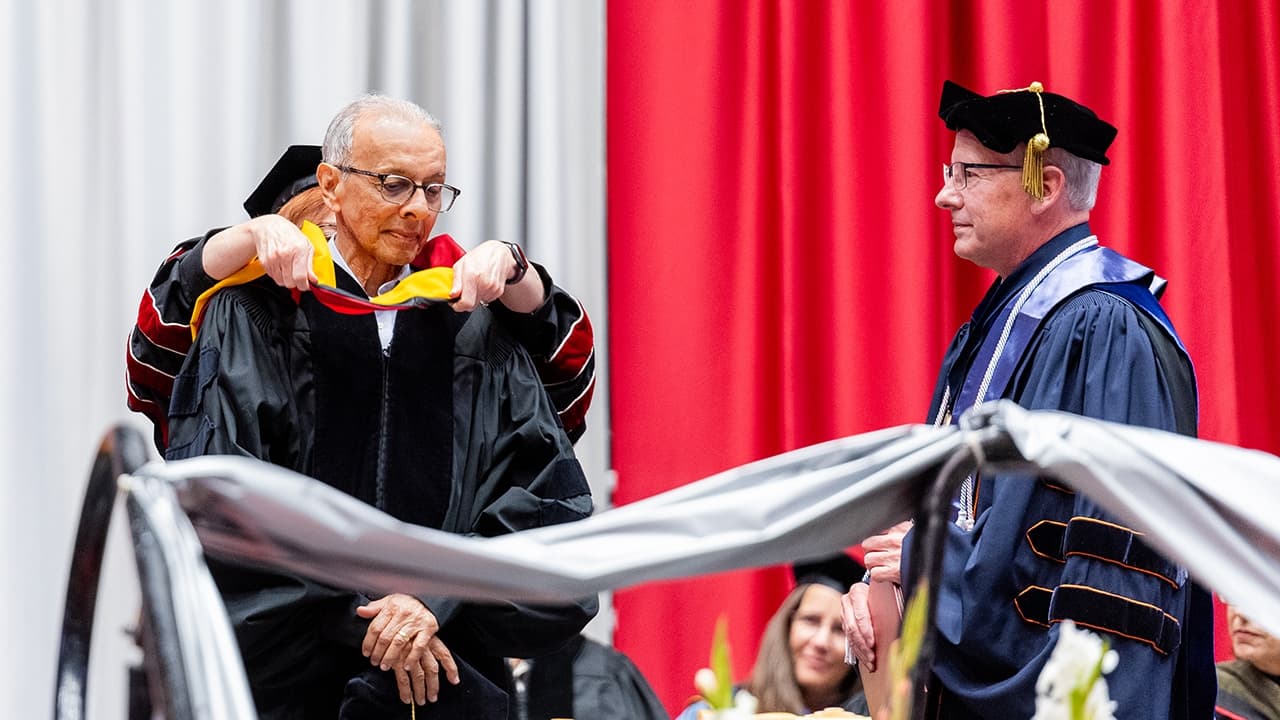
Nasir Ahmed, a University of New Mexico alumnus and professor emeritus, has been selected to the National Academy of Engineering’s class of 2026 for his work inventing the discrete cosine transform, which is the data compression format that serves as the basis for most digital media standards. Ahmed, who was hooded as an Honorary Doctor of Science in May 2025, worked at UNM from 1983-2001 after graduating from the university with his master’s and doctorate degrees in the 1960s. He was nominated by University of Colorado professor Alan Bovik, who, despite never meeting Ahmed, saw firsthand the impact of his work, both while teaching and in his everyday life. “I did not know him personally nor meet him in person,” Bovik said. “However, I certainly knew him well through the outcomes of his amazing work that I have used nearly every day, researched various aspects of, and taught in my classes. He was a quiet and unassuming giant who was also dedicated to education, and became a department head, and Dean, and more, so I did not see him at conferences.” The NAE is a non-profit entity based in Washington D.C. that operates under the same congressional act, signed by President Lincoln in 1863, which founded the National Academy of Sciences. As part of this, the NAE is tasked with providing objective analysis and advice to the nation, in addition to furthering the profession of engineering. Ahmed first proposed the DCT in 1972 while working at Kansas State University, where he spent the first 15 years of his academic career before returning to UNM. The DCT is a foundational element of modern data compression, and it allows technologies such as Zoom calls, HDTV and echocardiograms to exist. Much of the work involved with Ahmed’s nomination was done by Jagdeesh Pyati, who met Ahmed when the two were graduate students at UNM in 1964. ‘I had just arrived as a 23-year-old from Bangalore, India. (Ahmed) had come to UNM in 1961, also from Bangalore, and had already obtained his MS from UNM and was doing his PhD, Professor Shlomo Karni being his research adviser,” Pyati said. “We used to go for coffee at night as we, like most research students, worked in the labs late at night. In addition to his admittance to the NAE, Ahmed was also honored with the 2026 Institute of Electrical and Electronics Engineers Fourier Award for Signal Processing, the Prince Philip Medal by the United Kingdom’s Royal Academy of Engineering and won the institution of Engineering and Technology’s JJ Thomson Medal. Ahmed returned to UNM in 1983 as the Presidential Professor of Electrical and Computer Engineering and became chair of the department in 1989. He would go on to serve as the dean of the school of engineering from 1994 to 1996 before becoming the associate provost for research and dean of Graduate Studies until his retirement in 2001. Ahmed and his wife, Esther Pariente-Ahmed, met at UNM where she also earned a PhD. Their son, Michael Pariente earned his bachelor’s degree from UNM in the 1990s. He and his wife, Esther, were featured on the NBC drama This Is Us in 2021 as the series highlighted the impact his discovery had on the ability to stay connected during the COVID-19 pandemic. “Albuquerque was wonderful, and I was lucky to get educated at UNM,” Ahmed told UNM in 2021. “All three of us received our degrees here: Our son Michael; Esther received Ph.D. in 1994 [she earned a master’s degree at KSU], and I received my Ph.D. in 1966. As such, we are all grateful to UNM.” Ahmed becomes the eighth representative of UNM inducted into the National Academy of Sciences.
Share this story