taipeitimes.com
Thousands stranded after Middle East hubs are shut
taipeitimes.com · Mar 2, 2026 · Collected from GDELT
Summary
Published: 20260302T204500Z
Full Article
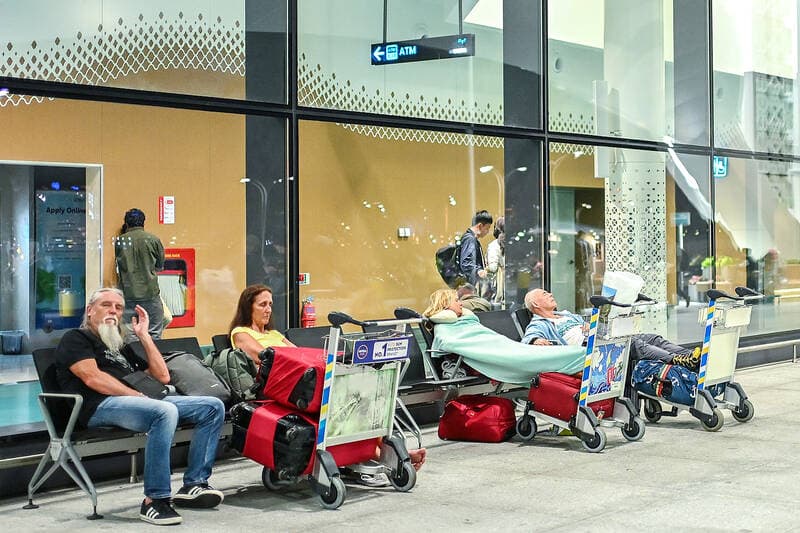
AFP, DUBAI, United Arab Emirates The biggest disruption to global air transport since the COVID-19 pandemic snarled travel for a second day on Sunday, with thousands of flights affected and busy Gulf hubs including Dubai, United Arab Emirates, and Doha shuttered as Iran lashed out after US-Israeli strikes.Passengers were stranded around the world as airlines sought to reroute around the Middle East, where most nations had slammed their airspace shut as Iran launched retaliatory strikes on the glittering Gulf cities.Tehran hit both Dubai International Airport — the world’s busiest for international traffic — and Kuwait’s main airport during its retaliation a day earlier. Stranded passengers wait at Velana International Airport in Male on Sunday after the cancelation of several flights destined for the Middle East. Photo: AFP Iran, Iraq, Israel, Syria, Kuwait, Qatar and the United Arab Emirates had all announced at least partial closures of their skies.“There haven’t been any other crises of this magnitude since COVID[-19],” said Didier Brechemier, an expert at business consultancy Roland Berger. Even Russia’s invasion of Ukraine did not affect the major air hubs of the Middle East through which travelers to destinations in much of Asia almost always transit, he said.Aviation analytics firm Cirium said more than 1,500 flights to the Middle East were canceled on Sunday, more than 40 percent of scheduled traffic.Flight tracking Web site FlightAware said that more than 2,700 flights had been canceled globally and more than 12,300 delayed as of Sunday evening.The costs are “already amounting to hundreds of millions of euros in losses for air transport,” said Didier Arino, chief executive officer of the consulting firm Protourisme.For some passengers, the flight disruptions went far beyond the annoyance of being stranded.Italian rapper BigMama said she had been on a flight from Male in the Maldives which was rerouted to a spot in the desert near Dubai — one of the cities targeted by Iran in its wave of retaliatory strikes.“We keep hearing missiles over our heads. I’m terrified,” the artist said in a tearful video on social media on Saturday.“We didn’t sleep a wink all night,” she wrote in a new message on Sunday. “We still have no news. We just want to go home.”Other travelers were in more philosophical spirits.“I have got work tomorrow so, if my manager is watching: Johnny, I will be back later this week, hopefully,” a traveler stuck at Johannesburg’s main international airport told SABC News after his Emirates flight to London was canceled.“I tried ... to book a ticket back with a different provider and the prices are going up every 10 minutes, 20 minutes,” he said.“I don’t know where I am sleeping tonight,” one passenger in Cape Town identified only as Farhad, who was trying to return to Germany after a holiday, told broadcaster Newzroom Afrika.“The whole world is connecting, and something that happened 10,000km away is also in Cape Town or Germany or wherever,” he said.Nations including France and Thailand have said they are looking at evacuating citizens from the Middle East.Patrice Caradec, president of the French Association of Tour Operators, said that the goal now is to establish “air bridges” via alternative hubs such as Istanbul, Turkey.Arino said Tehran’s attacks and the impact on air travel dealt a blow to the “soft power” of the Gulf monarchies.“What they sell is the security of property and people,” he said. “Dubai was often talked about a bit like Switzerland, so this inevitably tarnishes that image.”Explosions rocked Dubai’s Palm Jumeirah island and drone debris caused a fire at the Burj Al Arab ultra-luxury hotel as waves of Iranian missiles targeted the United Arab Emirates.Claudine Schwartz, a 49-year-old French tourist staying at the Royal Atlantis on The Palm, said that she heard explosions and saw plumes of smoke on Saturday.“We were playing night golf and rushed back to the hotel. I saw a fireball coming toward us and at the same time an alert message on our phones telling us to take shelter. We were put on the lowest level of the hotel,” she said.On Sunday they were “confined inside”, she said — but, as Tehran launched new strikes on the region, she said from the gym that “I could see a large plume of black smoke coming from what I think was a port.”They were registered on a hotline for stranded passengers run by the French Ministry for Europe and Foreign Affairs, she said, adding: “We’re waiting.”
Share this story