wtop.com
Clustered Story
The Latest : Israel hits Tehran as Iran counterattacks widen after supreme leader is killed
wtop.com · Mar 1, 2026 · Collected from GDELT
Summary
Published: 20260301T134500Z
Full Article
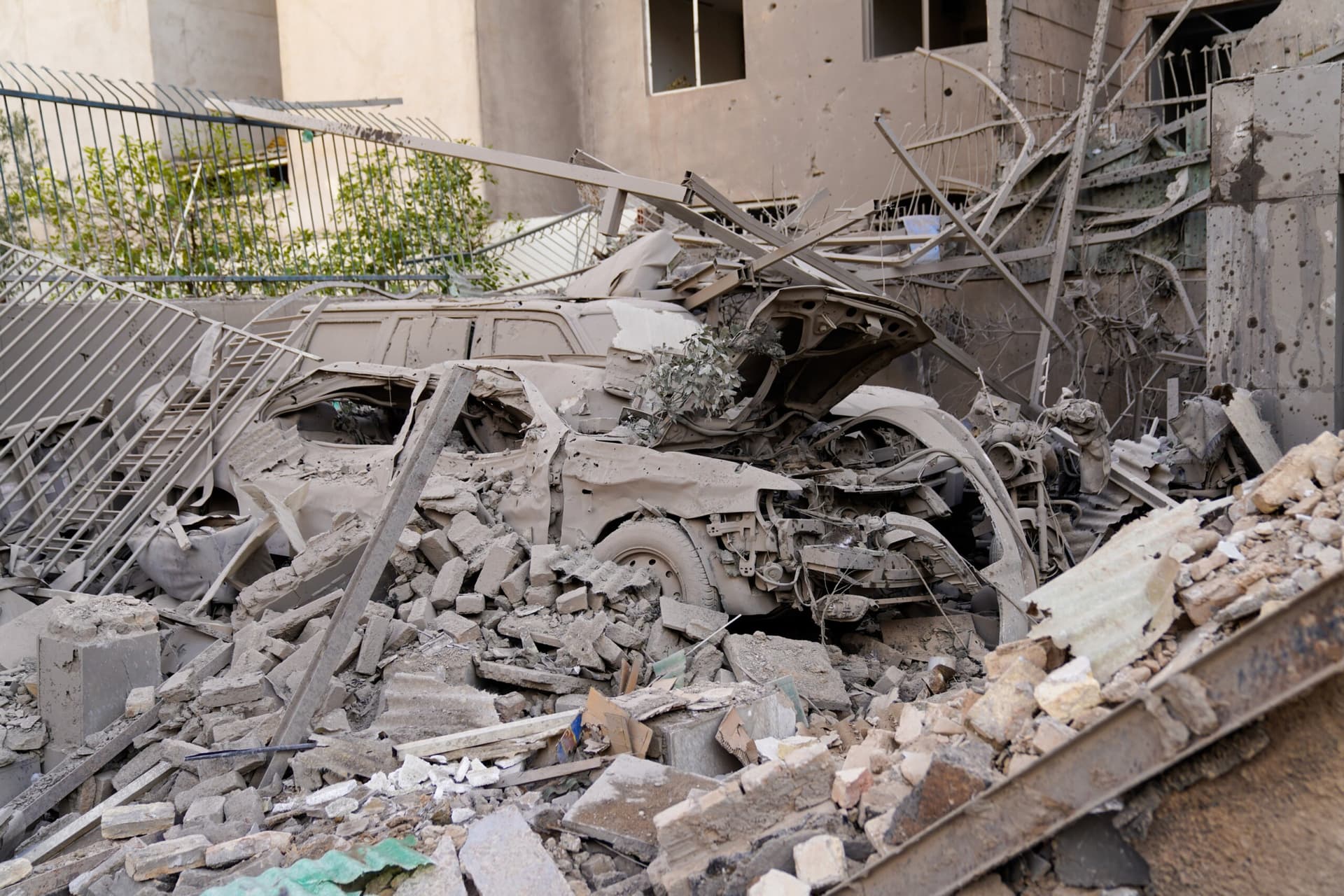
People watches from a rooftop as a plume of smoke rises after a strike in Tehran, Iran, Sunday, March 1, 2026. (AP Photo/Vahid Salemi) AP Photo/Vahid Salemi Smoke rises up after a strike in Tehran, Iran, Sunday, March 1, 2026. (AP Photo/Vahid Salemi) AP Photo/Vahid Salemi Government supporters mourn during a gathering after state TV officially announced the death of Iranian Supreme Leader Ayatollah Ali Khamenei, shown in the poster, in Tehran, Iran, Sunday, March 1, 2026. (AP Photo/Vahid Salemi) AP Photo/Vahid Salemi Iranian Australians react outside Iran’s embassy in Canberra, Australia, Sunday, March 1, 2026. (Mick Tsikas/AAP Image via AP) Mick Tsikas/AAP Image via AP Iranian Australians react outside Iran’s embassy in Canberra, Australia, Sunday, March 1, 2026. (Mick Tsikas/AAP Image via AP) Mick Tsikas/AAP Image via AP Shiite Muslims hold placards and chant slogans during a protest against the U.S. and Israel, and to show solidarity with Iran, in Lahore, Pakistan, Saturday, Feb. 28, 2026. (AP Photo/K.M. Chaudary) AP Photo/K.M. Chaudary U.S.-Israeli strikes on Iran continued for a second day on Sunday after the killing of Iranian Supreme Leader Ayatollah Ali Khamenei threw the future of the Islamic Republic into uncertainty and raised the risk of regional instability. There were explosions in Tehran on Sunday as Israel said it was taking its attacks to the “heart” of Iran’s capital. Iran retaliated by firing missiles and drones at Israel and at U.S. military installations around the Gulf, and also at the Saudi capital and the global business hub of Dubai. Earlier Sunday, Iran’s paramilitary Revolutionary Guard threatened to launch its “most intense offensive operation” ever, targeting Israel and U.S. bases. Iran also selected a 66-year-old cleric to join the three-member leadership council that will govern the country until a new supreme leader is selected. Here is the latest: US senator warns US doesn’t know what follows Khamenei’s death Sen. Mark Warner, D-Va., said that the death of Iran’s Supreme Leader Ali Khamenei is creating uncertainty about the trajectory of the conflict. “We have had very little visibility into what happens next after the supreme leader is eliminated,” Warner told CNN on Sunday. “I think we still don’t know what is happening next.” Warner said he hoped the Iranian people would rise up, but he didn’t believe that would be the outcome. He said the fear is that the U.S. is seeing the “opening salvos” of “what could be a sustained war in the region.” Maersk rerouting ships from Suez to Cape of Good Hope Maersk, the world’s biggest shipping company, said it has paused vessels’ traffic through the Ban el-Mandab Strait and the Suez Canal. The company said in a statement Sunday it has decided to reroute the ships from the Suez Canal to the Cape of Good Hope. Iranian-backed Houthi rebels in Yemen had targeted vessels in the Bab el-Mandeb and the Red Sea in 2024 and 2025. Turkey’s Erdogan calls for diplomacy Turkish President Recep Tayyip Erdogan emphasized that diplomacy remains “the most rational path forward” during a telephone call with Saudi Crown Prince Mohammed bin Salman. According to a statement from the Turkish presidency, Erdogan also extended his well‑wishes to Saudi Arabia following recent attacks on the country and warned that, without decisive action, the conflict could escalate with “serious consequences for both regional and global security.” Hundreds in Iraq mourn the killing of Iran’s leader Hundreds of Iraqis have decried the killing of Iran Supreme Leader Ali Khamenei and expressed solidarity with the Islamic Republic. The mourners wore black and waved flags belonging to Iran-backed Iraqi militias and red flags that symbolize vengeance in the Shiite Muslim faith as they marched across Sadr City. Some held Iran flags and portraits of Khamenei, who was killed in U.S. and Israeli strikes across the Islamic Republic. Iraq has for years tried to balance a delicate relationship with both the U.S. and Iran, and has called for an end to the conflict and a return to dialogue. Iran’s retaliatory strikes on U.S. bases have struck a handful of cities across the Mideast, several in the northern Iraqi city of Irbil. US senator disagrees with Trump’s ‘gamble’ on Iran A leading U.S. senator says he fears that President Donald Trump will cause “a more repressive, more aggressive Iranian regime” by “choosing the path of war when diplomacy was still within reach.” Sen. Chris Coons, a Delaware Democrat and a member of the Senate Foreign Relations Committee, also says he hopes “our national security apparatus is as prepared as it can be for attacks anywhere in the world against the United States and our interests.” Coons says he understands Trump “taking a bold gamble” given how “weak” the Iranian leadership was, “but I disagree with this gamble at this point.” OPEC Plus will increase oil production OPEC Plus, a group of eight oil-producing countries, says it will increase oil production by 206,000 barrels a day in April in an effort to mitigate the impact on oil prices during the latest conflict in the Middle East. The group, which includes Arab Gulf countries and Russia, has said in a statement that its members will “closely monitor and assess market conditions, and in their continuous efforts to support market stability.” New leadership council begins its work in Iran Iran’s President Masoud Pezeshkian said Sunday that a new leadership council “has begun its work” after the death of Supreme Leader Ayatollah Ali Khamenei. Pezeshkian made the comment in a prerecorded message aired on Iranian state television. Pezeshkian is one of three officials on the council. The other two are head of judiciary cleric Gholam Hossein Mohseni Ejehei and Ayatollah Ali Reza Arafi. Another vessel attacked in Strait of Hormuz A second vessel has come under attack in the Strait of Hormuz, according to an agency of the British military. The U.K. Maritime Trade Operations center said that the attack happened off Mina Saqr, United Arab Emirates. It said that the vessel had been hit by a projectile that caused a fire. The blaze was extinguished and the vessel will continue on its way. Another vessel earlier in the Strait of Hormuz off Iran also came under attack. The attacks come as Iranian officials reportedly have been threatening vessels transiting the strait over the radio. The Strait of Hormuz sees a fifth of the world’s traded oil pass through it. 1 killed, 20 wounded in Kuwait in latest barrage from Iran Kuwait’s Ministry of Health says one person has been killed and 20 people have been wounded in new retaliatory attacks by Iran. The country’s news agency reported the latest toll. None of the casualties are Kuwaiti citizens, the ministry said. A dozen people were injured in Kuwait in previous attacks on Saturday. The Kuwaiti army said Sunday that it has destroyed a number of ballistic missiles and drones launched against the Gulf country “since the start of the Iranian aggression.” The spokesperson for the Kuwaiti defense ministry, Saud Abdulaziz al-Otwan, said in a statement 97 Iranian ballistic missiles launched toward the State of Kuwait were detected, along with 283. He said debris falling on facilities led to “minor material damage.” North Korea condemns strikes on Iran North Korea has condemned the joint U.S.-Israel strikes on Iran as an “illegal act of aggression” and “the most despicable form of violation of sovereignty.” The North’s foreign ministry in a statement on Sunday said the attack shows how they continue to destabilize the region by pursuing hegemonic interests under the pretext of “fake peace.” North Korea has suspended meaningful dialogue with Washington since 2019, when a summit between leader Kim Jong Un and President Donald Trump during his first term collapsed over disagreements on exchanging the release of U.S.-led sanctions and the North’s denuclearization steps. Pyongyang and Tehran were among the few governments in the world that supported Russian President Vladimir Putin’s invasion of Ukraine, and both have been accused of providing Russia with military equipment. US priority is Iran’s ‘vast missile arsenal’ The chairman of the U.S. Senate Intelligence Committee says a priority for its joint military campaign is Iran’s “vast missile arsenal.” Republican Tom Cotton of Arkansas told CBS’ “Face the Nation” that those missiles threatened American troops “from bases as far flung as the Indian Ocean to Western Europe.” “We’re stopping a lot of them from being fired before Iran can fire them. It’s much easier to kill the archer on the ground than it is to shoot his arrows out of the sky,” he said in the television interview. 3 people killed in the UAE The United Arab Emirates’ Defense Ministry said Sunday that three people have been killed so far in Iranian attacks on the country. The ministry said Iran had launched 165 ballistic missiles targeting the country, of which 152 were destroyed. Thirteen fell into the sea, it added. Iran launched 541 bomb-carrying drones at the UAE, of which 506 were destroyed. Another 35 struck the country, killing three people from Pakistan, Nepal and Bangladesh, while 58 others were wounded. Iran has launched 97 ballistic missiles at Kuwait Iran fired 97 ballistic missiles and 283 drones at Kuwait since the start of the war between the U.S., Israel and Iran, the Gulf nation’s military said. The military said in a statement interception operations led to shrapnel falling in parts of the county, causing “limited damage.” On Saturday, the military said three Kuwaiti troops were wounded when shrapnel landed in the Ali Al Salem air base. At least 6 killed in Israel Israel’s police said at least five people were killed and 23 others wounded in a strike that hit central Israel on Sunday. A spokesperson for the rescue services said searches were ongoing for additional victims. Iran has so far launched dozens of rockets at Israel. Czech government is ready to evac
Share this story