playboy.com
Clustered Story
The 1984 Playboy Interview With Jesse Jackson
playboy.com · Feb 17, 2026 · Collected from GDELT
Summary
Published: 20260217T223000Z
Full Article
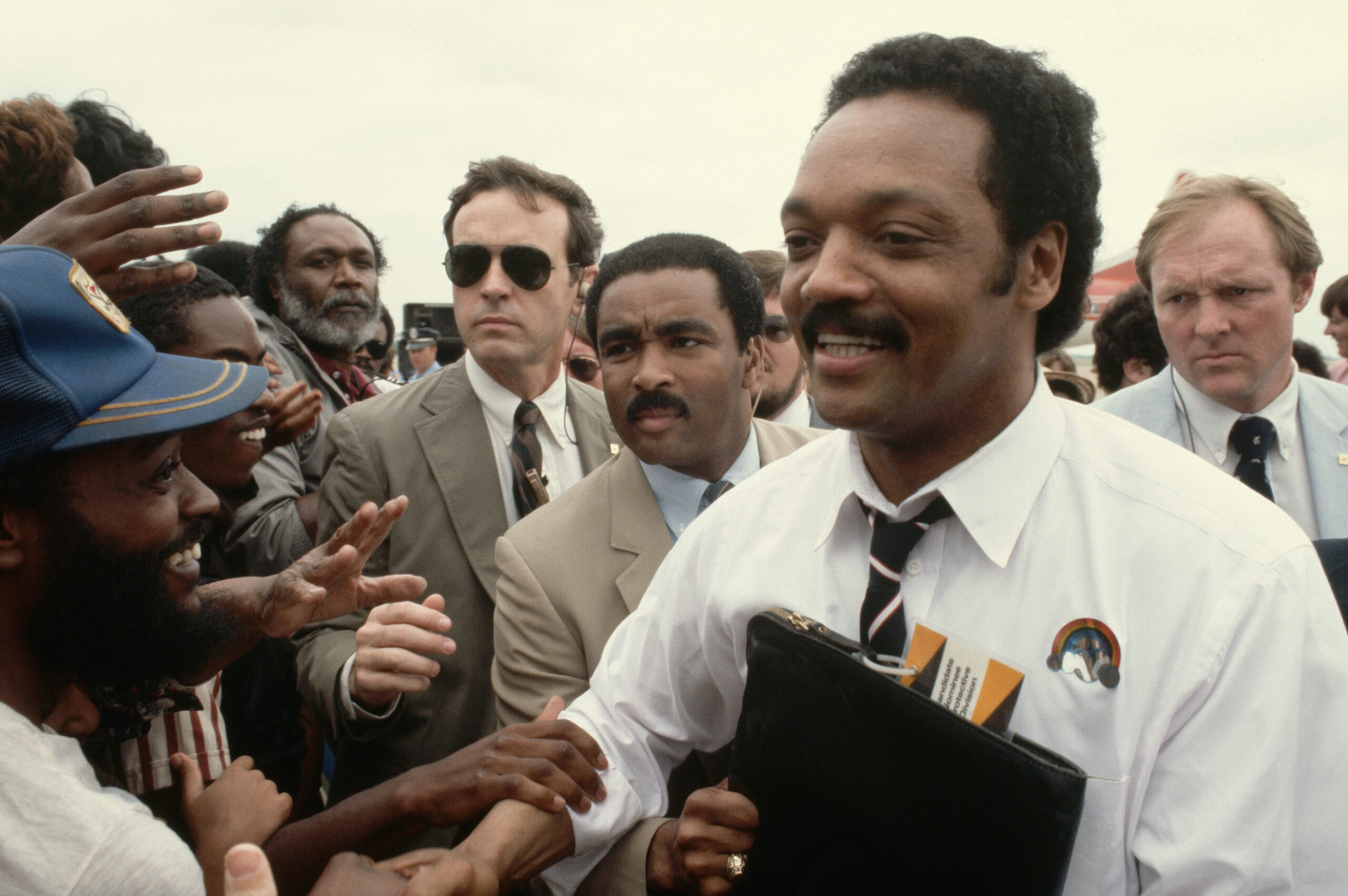
A candid conversation with the preacher and presidential candidate about his controversial views and the leadership of black America. Jesse Jackson, Baptist minister and candidate for the Democratic presidential nomination in 1984, shakes hands with supporters during a campaign stop in Texas. (Photo by Jacques M. Chenet/CORBIS/Corbis via Getty Images) Written by ROBERT SCHEER In June, 1984, Playboy sat down for the second time with Rev. Jesse Jackson, this time amid one of his two Presidential runs. In honor of his recent death, find the full Playboy Interview here. No matter what eventually happens at the Democratic Convention this summer in San Francisco, Jesse Jackson has already won some big prizes. Since he announced for the Presidency last November, the panache, pace and ever-present controversy of his candidacy have transformed the sharp-dressing, eloquent 42- year-old Baptist minister and civil rights activist from a party irritant to a force at large.Jackson has been prominent on the national scene ever since his days as a college activist in his native South during the Sixties, when he followed the call of Dr. Martin Luther King, Jr., to complete the emancipation of blacks through nonviolent civil disobedience. Born to segregation in Greenville, South Carolina, Jackson emerged in his college days as a hero to those intimidated by racists and Southern sheriffs and as a firebrand to those who found segregation less offensive than the turmoil of the civil rights movement.He was with Dr. King in Memphis at the time of his assassination and moved forcibly—some thought too forcibly—to provide leadership to a movement suddenly deprived of King’s overshadowing presence. Returning to his base in Chicago to organize the poor for the Southern Christian Leadership Conference, the then-27- year-old minister came to be known for a fiery rhetoric that did not always seem to jibe with the Gandhian philosophy of nonviolence, which Jackson espouses.His experiences in the early civil rights movement and later in PUSH, the anti- poverty and self-help organization he founded, left Jackson with many admirers and detractors—but few who are indifferent. To many, especially in the black community, he is talked about with a reverence and adulation that would seem appropriate for a combination of saint and rock star. To many others—surprisingly, as much among liberals as in the strong-holds of white racism—he is seen as a scourge and an opportunist.Now, in the 1984 Presidential campaign, Jackson is a player on the highest level. Mixing Bible Belt moralizing with a fierce commitment to dispossessed constituencies—from gays to Indians and, some would add, Arabs—he sparked the Democratic race with both his candidacy and his daring mission to Syria to free a captured airman, Lieutenant Robert Goodman, Jr. Before Senator Gary Hart began to give Walter Mondale a run for his money in New Hampshire, columnist Jack Anderson wrote, “The Reverend Jesse Jackson, bless his heart, has succeeded singlehandedly in lifting the Democratic Presidential race out of the terminal doldrums that threaten to bore us all to death.” Others who concede the effective- ness of Jackson’s thundering oratory nevertheless charge that his style smacks of demagoguery. “In passing out misinformation, the Democrats now have their own Ronald Reagan,” wrote The Washington Post‘s Richard Cohen.Like it or not, Jackson reached center stage, representing not only blacks but a much larger constituency within the Democratic Party. As The New York Times put it recently, “Jackson is now making history, not as a black Presidential candidate but as a ‘serious’ black Presidential candidate. That development alone is likely to have far-reaching effects on the American political scene by energizing the black vote and by altering the perceptions among whites of black candidates for elective office.”But the Times indicated that the real prize lay beyond electoral politics and concerns, involving nothing less than the mantle of black leadership, one passed around or, more accurately, grasped at but never comfortably worn since an assassin’s bullet killed King 16 years ago. What Jackson “really seeks to be,” the Times noted, is “the nation’s premier black leader: a mover and shaker with a constituencywithin the Democratic Party.”Jackson denies that he wants to be the predominant black leader and dutifully ticks off the names of the scores of elected black officials he holds in high esteem. But whatever his intentions, the enormouspublicity surrounding his campaign, as well as his proven ability to attract what he calls the Rainbow Coalition of supporters—including many whites—makes Jackson a man for more than just this electoral season. (In fact, this is his second appearance in the “Playboy Interview” slot. His first was in November 1969, just over a year and a half after King’s death.)Jackson watching is not a placid journalistic assignment. The reverend has a lot of ups and downs, with contretemps dotting his candidacy at almost every stop. Just what significance should be attached to the various charges ranging from financial mismanagement of PUSH to “tainted” contributions from the Arab League? Why does Jackson say the things he says? Is he against whites? Is he against Jews? And if not, what is the fuss in the media all about? Could it be, as the reverend thinks, that he has been subjected to a double standard of criticism because he is the first black to run seriously for the Presidency?Given Jackson’s prominence, the answers to those questions will remain important long after the election. To try to get some of them, PLAYBOY assigned Robert Scheer, whose political reporting for PLAYBOY (“Interview’s with Jerry Brown and Jimmy Carter, profiles of Nelson Rockefeller and Ronald Reagan) is well known to its readers. Scheer, a national reporter for the Los Angeles Times, followed Jackson through the early primaries and filed the following report:“Jesse Jackson is hard to ignore. He is tall, muscular, bright and quick and uses all of that to let an interviewer know that he intends to finish his thoughts. Looking down on the questioner, he rears back and rocks a bit, punctuating the air with his finger while the cadenced statements roll on and on until the point to be made is wrapped and delivered. Then, and only then, another question. Jackson takes questions cheerfully but with the air of one who has heard most of them before. And he has. All of his adult life has been spent parrying questions about blacks and politics, and he knows what he knows. He does not require issues experts, pollsters and media analysts to figure out his stance.“Jackson most often listens to a question with his head slightly tilted to suggest a cocked ear and with just the barest hint of a condescending smile about to flicker across his otherwise passive face. On those occasions when the question is not familiar, a suspicion as to the interviewer’s motives may mark his manner, and the mood can get tense-not threatening but suddenly more serious and personal than one had bargained for. It’s less a matter of intimidation than one of the force of personality and presence of someone who’s battle-scarred. “Like Ronald Reagan, whom I have also interviewed at some length, Jackson is a veteran of past battles over issues that truly matter to him. And while he may again, like Reagan, occasionally get some facts wrong and exaggerate others, he remains committed to core beliefs.“For Jackson, those beliefs revolve around whatever he feels is necessary for the advancement of blacks, and while one may take issue with his preoccupation and/or his prescriptions for change, personal exposure to the man did not, in my case, support a cynical view of his level of commitment.“Both Jackson and Reagan are clearly in the political arena to do serious battle over the social direction of this country, no matter what other material and psychological rewards may be provided by the exercise. For both, it has been a long and not always fashionable political struggle.“Neither gentleman is of the school of the modern politician touted by hip pollsters and committed only to winning. Jackson and Reagan may say and do wrong things, but when they do, it is with the altruistic aplomb of the true believer certain of the virtue of his ends and convinced that he is not driven by personal political ambition. And when they do commit a grand gaffe, they find it next to impossible to offer a profound apology, because soul-searching and doubt are simply alien to their make-up. But they are not shallow. Both have paid their dues, anguishing over causes rather than overthe political style of the moment.“There the similarity ends. Indeed, what is perhaps most interesting about Jackson is that he has risen to challenge the assumptions of Reaganism as a political philosophy more directly and energetically than has any of the other candidates.“After hours of interviews with Jackson, I found myself fantasizing about Reagan’s taking my place in the room. Let them argue about the truly needy, about affirmative action, civil disobedience and the Third World. Let them match programs for ending poverty and crime in Chicago and bringing peace to the Middle East. Do we need more weapons or fewer? More social programs or fewer? Is God, whom they both invoke incessantly, a staunch free enterpriser or a closet liberal? Now, that would be the debate for this election year.“But Jackson will not just go away after this election any more than Reagan did following his many times out on the hustings. Both have a constituency. Jackson may not have succeeded in building his Rainbow Coalition, but his campaign has demonstrated his basic appeal to the growing number of black voters. Thus, what Jackson has to say in this campaign and in this Interview’ warrants serious attention, for it will likely present itself again and with even greater force in the future.” PLAYBOY: As
Share this story