NewsWorld
PredictionsDigestsScorecardTimelinesArticles
NewsWorld
HomePredictionsDigestsScorecardTimelinesArticlesWorldTechnologyPoliticsBusiness
AI-powered predictive news aggregation© 2026 NewsWorld. All rights reserved.
Trending
FebruaryChinaSignificantMilitaryTimelineDigestFaceDiplomaticFederalTurkeyFridayTrumpDrugGovernanceTensionsCompanyStateIranParticularlyEscalatingCaliforniaTargetingNuclearDespite
All Articles
Scientists discover giant bird - like dinosaur in Niger desert
thepeninsulaqatar.com
Clustered Story
Published about 11 hours ago

Scientists discover giant bird - like dinosaur in Niger desert

thepeninsulaqatar.com · Feb 27, 2026 · Collected from GDELT

Summary

Published: 20260227T154500Z

Full Article

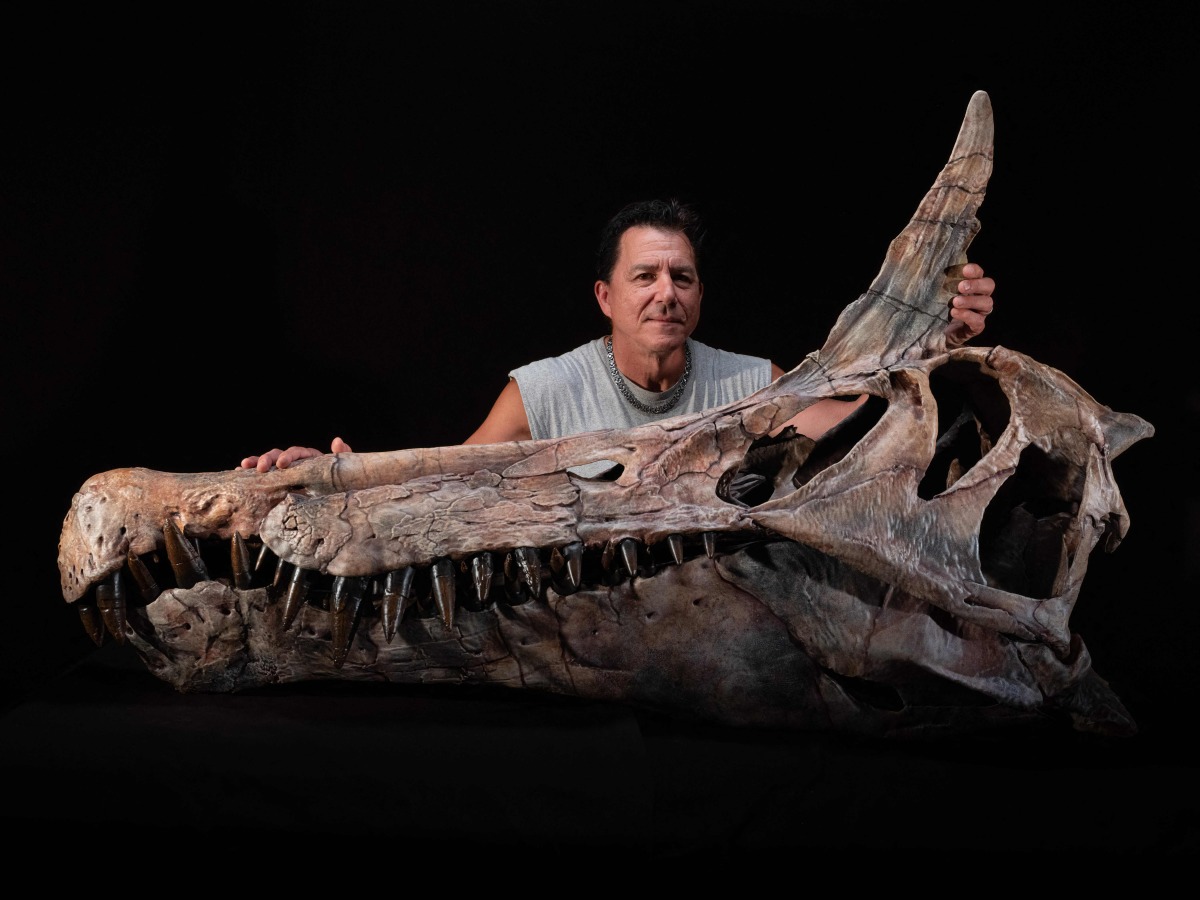
US Palaeontologist Paul Sereno poses at the Fossil Lab of the University of Chicago, Illinois, on September 19, 2025. (Photo by Keith Ladzinski / Fossil Lab, University of Chicago / AFP) Abidjan: Deep in the desert of Niger, scientists have unearthed an unknown species of dinosaur, a giant fissvery of its kind in more than a century. Around 95 million years ago, the Spinosaurus, a massive beast with a blade-shaped head crest and interlocking teeth, roamed the African continent. Scientists believe it rivalled the fearsome Tyrannosaurus rex in size, measuring around 40 feet long with a 20-inch sword-like crest on its head. Researchers dug up fossils that belonged to the Spinosaurus mirabilis or "hell heron", in the words of Paul Sereno, the University of Chicago palaeontologist and lead author of the research published in the journal Science. "Look at the length of the skull, the length of the neck, and the length of the hind limb, you're in heron territory." Spinosaurus mirabilis lived when forests and rivers covered the now-barren Sahara. Previously, most spinosaurid fossils had been found near coastlines in North Africa. Some scientists thought these fish-eating creatures may have been fully aquatic, gliding through deep waters to snare prey. But this time, the fossils were discovered further inland, hundreds of miles from what would have been the nearest ocean. "I think it was an animal that could have waded easily into the water," Sereno said. "But I do not think it was a diver, I do not think it was a good swimmer." 'Earth-shattering site' The search began in 2019 in the Sahara Desert, where French geologist Hugues Faure had said he found a tooth belonging to the giant predator Carcharodontosaurus in the 1950s. "We've got a couple of things that Faure could never dream of. We have GPS coordinates, we have drones and better vehicles," said Sereno. The barren sands yielded nothing and the team, disheartened, headed back to their camp. But a Tuareg man in a black trench coat approached Sereno's team on a motorcycle, claiming to know where "big bones" lay. After a long journey through the desert, Sereno worried they "had made a mistake". "We jokingly said, are we still in Niger? I mean, we drove for a day and a half until we had no more gas to spare because we wouldn't get back." But eventually they reached a remote site where the "biggest bones... I have ever seen in my life" emerged from the ground. Far out in the desert, the researchers gaped at the six-foot-long femur, the jaw, teeth, and base of the crest. In 2022, Sereno returned with a 100-person team and 64 Nigerien guards to excavate the "earth-shattering site". They unearthed a skull, fragments of the hind legs and several crests. "The crest was like nothing we'd ever seen before," said Sereno. Some were brought to tears, he said, by the "overwhelming" experience. "It's actually like looking at a digital image of your new dinosaur and gawking over it in the tent in the middle of the Sahara." The team realised "it was a new species... and it was going to be a landmark discovery." "That's your Jurassic Park moment, one to remember for a lifetime."


Share this story

Read Original at thepeninsulaqatar.com

Related Articles

anlatilaninotesi.com.tr4 days ago
Sahrada yeni bir dinozor keşfedildi : Spinosaurus ailesine yeni ve dev bir üye

Published: 20260223T150000Z

news.tuoitre.vn5 days ago
Fossils of a new species of huge dinosaur Spinosaurus unearthed in Niger

Published: 20260223T094500Z

Science Daily5 days ago
A giant blade-crested spinosaurus, the “hell heron,” discovered in the Sahara

Deep in the heart of the Sahara, scientists have uncovered Spinosaurus mirabilis — a spectacular new predator crowned with a massive, scimitar-shaped crest that may once have blazed with color under the desert sun. Discovered in remote inland river deposits in Niger, the fossil rewrites what we thought we knew about spinosaur dinosaurs, suggesting they weren’t fully aquatic hunters but powerful waders stalking fish in forested waterways hundreds of miles from the sea.

NPR News5 days ago
Newly discovered dinosaur species was a fish-eater with a huge horn

The semi-aquatic dinosaur, Spinosaurus mirabilis, was discovered by an international team of scientists working in Niger.

thepeninsulaqatar.com5 days ago
Residents embrace winter Ramadan atmosphere across nation

Published: 20260223T073000Z

Engadgetabout 3 hours ago
FCC approves the merger of cable giants Cox and Charter

The Federal Communications Commission has given the go ahead for two of the US' biggest cable providers, Charter Communications and Cox Communications, to merge. Charter announced its intention to acquire Cox for $34.5 billion in May 2025, with specific plans to inherit Cox's managed IT, commercial fiber and cloud businesses, while folding the company's residential cable service into a subsidiary. “By approving this deal, the FCC ensures big wins for Americans," FCC Chairman Brendan Carr said in a statement. "This deal means that jobs are coming back to America that had been shipped overseas. It means that modern, high-speed networks will get built out in more communities across rural America. And it means that customers will get access to lower priced plans. On top of this, the deal enshrines protections against DEI discrimination." The FCC claims that Charter plans to invest "billions" to upgrade its network following the closure of the deal, leading to "faster broadband and lower prices." The company's "Rural Construction Initiative" will also extend those improvements to rural states lacking in consistent internet service, a project the FCC was heavily invested in during the Biden administration, but has been pulling back from since President Donald Trump appointed Carr. The FCC also claims Charter will onshore jobs currently handled off-shore by Cox employees and commit to "new safeguards to protect against DEI discrimination," which essentially amounts to hiring, recruiting and promoting employees based on "skills, qualifications, and experience." While Carr's FCC paints a rosy picture of Charter's acquisition, history has provided multiple examples of mergers having the opposite effect on jobs and pricing. For example, redundancies created when T-Mobile merged with Sprint in 2020 led to a wave of layoffs at the carrier. And funnily enough in 2018, not long after Charter's merger with Time Warner Cable was approved by the FCC, the company raised prices on its