en.globes.co.il
Reconnecting with nature , from shoes to buildings
en.globes.co.il · Mar 1, 2026 · Collected from GDELT
Summary
Published: 20260301T083000Z
Full Article
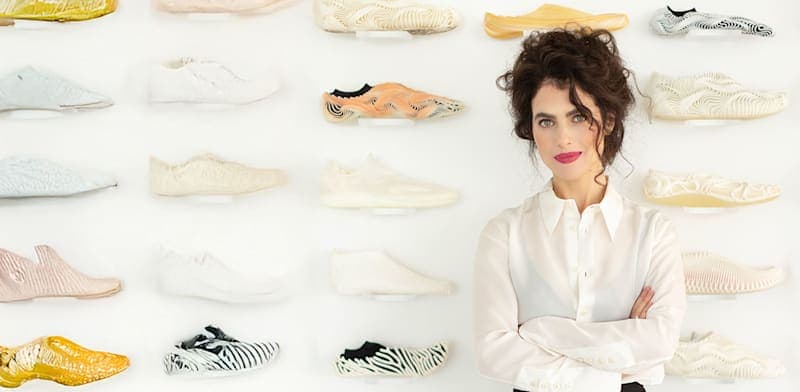
For more than five years, Prof. Neri Oxman, formerly a faculty member at MIT Media Lab, who has received awards as one of the most influential researchers in design, architecture and technology, has been working outside the university, and with little media attention. During this time, she founded OXMAN, a company intended to implement her scientific ideas in the real world, but so far little is known about its products, employees, and customers. Anyone who goes into the company’s website is likely to leave it confused, but inspired. At first it looks completely dark, and only after interaction with it do the questions start to appear: "Can buildings rewild ecosystems?", "Can molecules encode communication signals of polycultures?", and one answer: "We envision a world where Nature and humans cocreate as one." So what’s actually happening there, at the offices of the Israeli researcher who has become a global celebrity and who in recent years has divulged only crumbs of information about her activity? We bring you, for the first time in the Israeli media (and almost anywhere), the story of the company she set up, and try to understand how her ambitious ideas could look and make an impact in reality. " I’ve been in academia for almost 25 years, first as a student and a PhD scholar and later as a tenured member of the faculty at MIT," Oxman relates in an interview by correspondence. "My next 25 are dedicated to putting inventions out there in the real world, to pushing against the grain and to making real impact. "When I moved to Cambridge, my NYC friends used to say that Boston is ‘a practice city.’ I find that academia is very much like that, a sliver of the world that’s protected from it. A place where you’re allowed and even incentivized to dream big without fully turning your inventions into real-world change at massive scale. It’s a double edge sword." The conversation with Oxman takes place at a rarified level. There are those who assert that she uses long words to hide from genuine scrutiny of her work; others see her verbal style as part of her art. But in correspondence with her, Oxman sometimes suddenly becomes down to earth, and even translates the vision into real products and projects that the company is working on. The conversation with her thus takes place simultaneously on several levels. You seem to have a special relationship with nature. While most people seem to me to be predominately either nature-appreciators or nature-changers, you see it in a different way, that you can appreciate nature and use it to change itself. RELATED ARTICLES "For good or bad I occupy the space between appreciation and change, between reverence and transformation. ‘To be and not to have’ are words we often utter at the lab. To revere nature without losing the craving to interact with it, to respect it without losing the ability to interact with it. "In so many ways we have collectively lost touch with our connection to nature. We respect nature from afar, often just as an idea. We count carbon, put our groceries in canvas bags, but we never put our hands in the garden, our feet in the mud. What I’m interested in is closeness, relationship. "I love how you phrase it, ‘to use it to change itself’. Empowering nature, without the emphasis on human-centric pretense, is really what we are after. How can we empower nature to help itself while also helping humanity. Can there be synergy between natural production and human consumption? What’s the golden ratio? "One of my daughter’s favorite books is ‘The Giving Tree’ by Shel Silverstein. I cry every time I read it because it depicts so completely our broken-yet-hopeful bond with nature. And right now, we find ourselves reliving the last scene in the book, where the boy is now an old man returning to the Giving Tree for one last time. He no longer has the need for things material-money, a house, a boat. He’s after ‘a quiet place to sit and rest.’ The tree has nothing more to offer, but a small place to sit. And despite all the taking on the boy’s part, and all the giving on the tree’s part, the tree still loves the boy. Unconditional love. "We are altogether after a different plot. Not The Giving Tree but The Growing Shoe, a Rewilded City, a Restored Ecosystem. In this story, humans are the givers and we, humans, and nature reunite as unadulterated partners. A love story." The shoes that Oxman mentions are already advertised by the company. In accordance with her vision, the shoe combines programmed living organisms (in this case bacteria) to grow the material, which is then shaped by means of robots. The materials of which the shoe is made are called PHAs - polyhydroxyalkanoates - a perishable polymer. With this method of production there is no need to transport a range of materials to a shoe factory. The shoes themselves are covered in various fabrics according to their required function, and the fabric is also perishable. The O° shoes look amazing! When do you think we’ll be able to buy them? "O° was born as a biodegradable single-material shoe that brings you closer to the earth and in turn, closer to yourself. It’s a physical expression of the ‘get closer’ mindset, an antidote to the problem of disconnection. "Production at scale is a challenge we welcome, especially since the creation of PHA yarn, as far as we are aware, has never been accomplished before. With regards to thermal degradation, the intention behind the first concept shoes we created is to degrade naturally, in entirely ambient temperatures. "It’s ironic, right? How with food, biodegradation is a sign of freshness. Not so with shoes. P-FAS is the currency of permanence, and we need to break this cycle. So yes, while PHAs and bio-TPU’s are not even close to their synthetic counterparts in terms of mechanical performance attributes, it’s a starting point. We need to start somewhere." The company is also working on biological pigments, produced by engineered microorganisms. Oxman promises that within the year we’ll be able to see and touch these biological fabrics and that she’ll launch a new electronic product, a "breath" meter that measures the biological degradation of perishable products. Customers in real estate On a completely different scale, Oxman designs building complexes and parks. What is special about them is that they are full of nature, inside and out, and some of the construction, like the production of the shoe, is carried out with the help of living organisms. Special calculation methods are used to work out how to plant the living materials so that they will develop into the system that Oxman envisions. You shape complete ecological systems? "Exactly! Ecosystems around the world already sequester about 50% of our carbon emissions and filter all our drinkable water. Those ecosystem services amount to a $140 trillion economy that’s entirely undesigned. By tapping into this dynamic economy, we can design and engineer ecosystems that can do things humans cannot do: sequester more carbon, filter more water, increase biodiversity, rewild and restore endangered habitats, and so on." Can you give a simple example? "We often share the following example: If you have one hectare of land, a little bit bigger than a football pitch, you can sequester over 40 tons of carbon every single year if you design it thoughtfully, as an ecosystem. This alone can cool a home and cut down on its energy by 50% if done thoughtfully, as well as filter a sufficient supply of water for thirteen neighborhoods if you design it correctly. "The big question then becomes, how to design ecosystems thoughtfully? How to design a world where people can design ecosystems that accomplish the kinds of tasks we and they need? How to design ecosystems that do things that we cannot do? This is where EDEN comes into the picture." EDEN stands for Ecosystem Design and Engineering for with and by Nature, a project within the company that is gradually developing into a company in its own right. "As part of our EDEN platform, we are building technologies for AI-driven ecosystem design and engineering," Oxman says. "Ecosystem engineering is the process by which organisms like beavers and coral reefs actively shape their environment, as well as the physical and biological attributes of an ecosystem. Rather than facilitating the thriving of certain species, our goal is to support the thriving of entire ecosystems. "EDEN’s technologies enable our clients to maximize ecosystem services such as increased biodiversity, thermal buffering and air filtration while augmenting human-centric functions on sites that are dozens to hundreds of hectares in surface area. These technologies enable us to think of ecosystems in architectural terms and of landscape architecture in ecosystem terms." Who are your clients, and how large are your sites? "In 2025 alone we designed for almost 800 hectares of land, across several clients. We’ve worked on over 128 species of plants and animals around the world. Our first client was a global industrial real estate company, The Goodman Group. They own, develop, and manage logistics and warehouse properties across major cities worldwide, focusing on sustainable infrastructure. While we continue our work with The Goodman Group, we have signed on a new client focusing on a large former landfill site of roughly 375 acres, transforming a landfill into a mixed-use site. We are growing!" As we were preparing this article, Oxman informed us of the signing of an agreement with real estate company Greystar. Impression of EDEN project in collaboration with real estate developer Goodman Group courtesy of OXMAN What is the anticipated business model of OXMAN? Do you intend to take your products directly to the market at some point, maybe to make sure that your vision is preserved in the packaging, delivery, and marketing of the product as well? Or do you intend to license most of the products to focus on inventing? "I set up OXMAN
Share this story