island.lk
Reconciliation : Grand Hopes or Simple Steps
island.lk · Feb 15, 2026 · Collected from GDELT
Summary
Published: 20260215T030000Z
Full Article
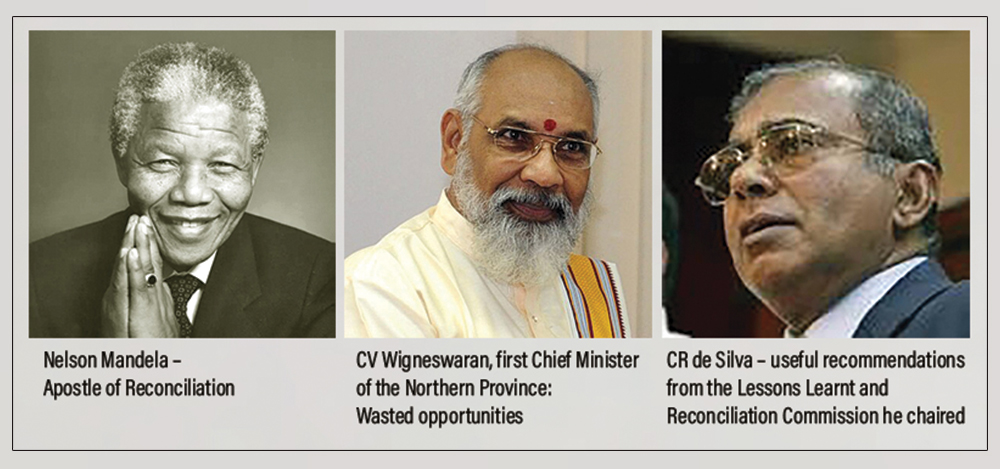
Share Tweet In politics, there is the grand language and the simple words. As they say in North America, you don’t need a $20-word or $50-word where a simple $5-world will do. There is also the formal and the functional. People of different categories can functionally get along without always needing formal arrangements involving constitutional structures and rights declarations. The latter are necessary and needed to protect the weak from the bullies, especially from the bullying instruments of the state, or for protecting a small country from a Trump state. In the society at large, people can get along in their daily lives in spite of differences between them, provided they are left alone without busybody interferences. There have been too many busybody interferences in Sri Lanka in all the years after independence, so much so they exploded into violence that took a toll on everyone for as many as many as 26 (1983-2009) years. The fight was over grand language matters – selective claims of history, sovereignty assertions and self-determination counters, and territorial litigations – you name it. The lives of ordinary people, even those living in their isolated corners and communicating in the simple words of life, were turned upside down. Ironically in their name and as often in the name of ‘future generations yet unborn’ – to recall the old political rhetoric always in full flight. The current American anti-abortionists would have loved this deference to unborn babies. At the end of it all came the call for Reconciliation. The term and concept are a direct outcome of South Africa’s post-apartheid experience. Quite laudably, the concept of reconciliation is based on choosing restorative justice as opposed to retributive justice, forgiveness over prosecution and reparation over retaliation. The concept was soon turned into a remedial toolkit for societies and polities emerging from autocracies and/or civil wars. Even though, South Africa’s apartheid and post-apartheid experiences are quite unique and quite different from experiences elsewhere, there was also the common sharing among them of both the colonial and postcolonial experiences. The experience of facilitating and implementing reconciliation, however, has not been wholly positive or encouraging. The results have been mixed even in South Africa, even though it is difficult to imagine a different path South Africa could have taken to launch its post-apartheid era. There is no resounding success elsewhere, mostly instances of non-starters and stallers. There are also signs of acknowledgement among activists and academics that the project of reconciliation has more roadblocks to overcome than springboards for taking off. Ultimately, if state power is not fully behind it the reconciliation project is not likely to take off, let alone succeed. The irony is that it is the abuse of state power that created the necessity for reconciliation in the first place. Now, the full blessing and weight of state power is needed to deliver reconciliation. Sri Lanka’s Reconciliation Journey After the end of the war in 2009, Sri Lanka was an obvious candidate for reconciliation by every objective measure or metric. This was so for most of the external actors, but there were differences in the extent of support and in their relationship with the Sri Lankan government. The Rajapaksa government that saw the end of the war was clearly more reluctant than enthusiastic about embarking on the reconciliation journey. But they could not totally disavow it because of external pressure. The Tamil political leadership spurred on by expatriate Tamils was insistent on maximalist claims as part of reconciliation, with a not too subtle tone of retribution rather than restoration. As for the people at large, there was lukewarm interest among the Sinhalese at best, along with strident opposition by the more nationalistic sections. The Tamils living in the north and east had too much to do putting their shattered lives together to have any energy left to expend on the grand claims of reconciliation. The expatriates were more fortuitously placed to be totally insistent on making maximalist claims and vigorously lobbying the western governments to take a hardline against the Sri Lankan government. The singular bone of contention was about alleged war crimes and their investigation, and that totally divided the political actors over the very purpose of reconciliation – grand or simple. By far the most significant contribution of the Rajapaksa government towards reconciliation was the establishment of the Lessons Learnt and Reconciliation Commission (LLRC) that released its Report and recommendations on December 16, 2011, which turned out to be the 40th anniversary of the liberation of Bangladesh. I noted the irony of it in my Sunday Island article at that time. Its shortcomings notwithstanding, the LLRC Report included many practical recommendations, viz., demilitarization of the North and East; dismantling of High Security Zones and the release of confiscated houses and farmland back to the original property owners; rehabilitation of impacted families and child soldiers; ending unlawful detention; and the return of internally displaced people including Muslims who were forced out of Jaffna during the early stages of the war. There were other recommendations regarding the record of missing persons and claims for reparation. The implementation of these practical measures was tardy at best or totally ignored at worst. What could have been a simple but effective reconciliation program of implementation was swept away by the assertion of the grand claims of reconciliation. In the first, and so far only, Northern Provincial Council election in 2013, the TNA swept the board, winning 30 out of 38 seats in provincial council. The TNA’s handpicked a Chief Minister parachuted from Colombo, CV Wigneswaran, was supposed to be a bridge builder and was widely expected to bring much needed redress to the people in the devastated districts of the Northern Province. Instead, he wasted a whole term – bandying the claim of genocide and the genealogy of Tamil. Neither was his mandated business, and rather than being a bridge builder he turned out to be a total wrecking ball. The Ultimate Betrayal The Rajapaksa government mischievously poked the Chief Minister by being inflexible on the meddling by the Governor and the appointment of the Provincial Secretary. The 2015 change in government and the duopolistic regime of Maithripala Sirisena as President and Ranil Wickremesinghe as Prime Minister brought about a change in tone and a spurt for the hopes of reconciliation. In the parliamentary contraption that only Ranil Wickremesinghe was capable of, the cabinet of ministers included both UNP and SLFP MPs, while the TNA was both a part of the government and the leading Opposition Party in parliament. Even the JVP straddled the aisle between the government and the opposition in what was hailed as the yahapalana experiment. The experiment collapsed even as it began by the scandal of the notorious bond scam. The project of reconciliation limped along as increased hopes were frustrated by persistent inaction. Foreign Minister Mangala Samaraweera struck an inclusive tone at the UNHRC and among his western admirers but could not quite translate his promises abroad into progress at home. The Chief Minister proved to be as intransigent as ever and the TNA could not make any positively lasting impact on the one elected body for exercising devolved powers, for which the alliance and all its predecessors have been agitating for from the time SJV Chelvanayakam broke away from GG Ponnambalam’s Tamil Congress in 1949 and set up the Ilankai Tamil Arasu Kadchi aka the Federal Party. The ultimate betrayal came when the TNA acceded to the Sirisena-Wickremesinghe government’s decision to indefinitely postpone the Provincial Council elections that were due in 2018, and let the Northern Provincial Council and all other provincial councils slip into abeyance. That is where things are now. There is a website for the Northern Provincial Council even though there is no elected council or any indication of a date for the long overdue provincial council elections. The website merely serves as a notice board for the central government’s initiatives in the north through its unelected appointees such as the Provincial Governor and the Secretary. Yet there has been some progress made in implementing the LLRC recommendations although not nearly as much as could have been done. Much work has been done in the restoration of physical infrastructure but almost all of which under contracts by the central government without any provincial participation. Clearing of the land infested by landmines is another area where there has been much progress. While welcoming de-mining, it is also necessary to reflect on the madness that led to such an extensive broadcasting of landmines in the first place – turning farmland into killing and maiming fields. On the institutional front, the Office on Missing Persons (OMP) and the Office for Reparations have been established but their operations and contributions are yet being streamlined. These agencies have also been criticized for their lack of transparency and lack of welcome towards victims. While there has been physical resettlement of displaced people their emotional rehabilitation is quite a distance away. The main cause for this is the chronically unsettled land issue and the continuingly disproportionate military presence in the northern districts. (Next week: Reconciliation and the NPP Government) by Rajan Philips Continue Reading Features The Rise of Takaichi Published 5 hours agoon 2026/02/15 Japan PM Sanae Takaichi after election (ABC News) Her victory is remarkable, and yet, beyond the arithmetic of seats, it is the audacity, unpredictability, and sheer strategic opportunism of Sanae Takaichi that has unsett
Share this story