Foreign Policy
Clustered Story
Pentagon Says Iran War Is ‘Not Iraq,’ but Won’t Rule Out Boots on the Ground
Foreign Policy · Mar 2, 2026 · Collected from RSS
Summary
“This is not a so-called regime change war,” Hegseth said.
Full Article
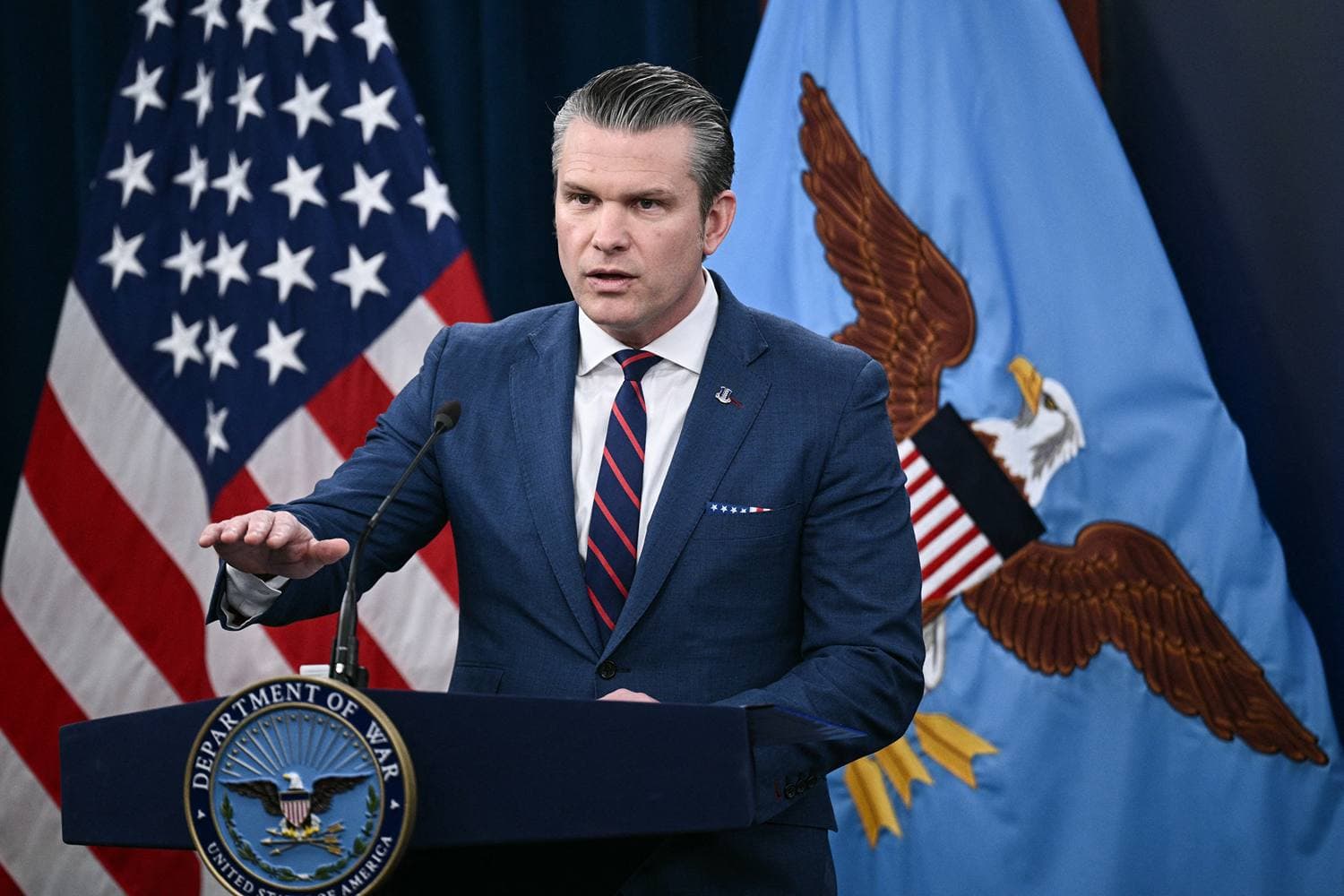
U.S. Defense Secretary Pete Hegseth on Monday gave a full-throated defense of the United States’ actions in the escalating war with Iran during the Defense Department’s first detailed briefing since the operation began on Saturday. Hegseth, who appeared alongside Joint Chiefs of Staff Chairman Gen. Dan Caine, pushed back on early critiques of the war, which was launched without congressional approval and amid ongoing diplomatic talks with Iran. “We didn’t start this war, but under President [Donald] Trump, we’re finishing it,” Hegseth said, accusing Iran of waging a “savage, one-sided war against America” for 47 years. “They didn’t always declare it openly, except for their constant chants of ‘death to America.’ They did it through the blood of our people, car bombs in Beirut, rocket attacks on our ships, murders at our embassies, roadside bombs in Iraq and Afghanistan, funded and armed by Iranian Quds Force and IRGC [Islamic Revolutionary Guard Corps] killers,” Hegseth said. Hegseth’s characterization of who started the war is false. While there is no doubt that there have been years of tensions between Washington and Tehran that have led to both direct and indirect hostilities—and hundreds of U.S. troops are estimated to have been killed by Iran-backed militias in Iraq—the first shots in the current conflict were fired by the United States and Israel. The Pentagon chief also suggested that Iran was not serious about diplomacy with the United States over its nuclear program. “Tehran was not negotiating,” Hegseth said. “They were stalling, buying time to reload their missile stockpiles and restart their nuclear ambitions. Their goal: hold us hostage, threatening to strike our forces. President Trump doesn’t play those games.” On that last point, Hegseth’s claim again appears to be false, as Trump administration officials reportedly told members of Congress that there was no intelligence suggesting that Iran planned to strike U.S. forces first. Hegseth also denied that the war was about regime change. “This is not a so-called regime change war, but the regime sure did change, and the world is better off for it,” Hegseth declared, in an apparent reference to the death of Iranian Supreme Leader Ayatollah Ali Khamenei, who was killed by an Israeli strike on Saturday. But Trump has openly endorsed regime change from the moment that he announced the operation. In a video statement posted on Saturday, Trump said, “To the great proud people of Iran, I say tonight that the hour of your freedom is at hand. … Take over your government.” Later in Monday’s briefing while taking questions, Hegseth also echoed this call from Trump. “I think the message the president has given has been clear: To the people of Iran, this is your moment,” he said. The briefing came amid open questions about Trump’s endgame in the war, on top of criticism that the operation—along with other military actions taken by the president—undermines his campaign pledge of “no new wars.” Trump had vowed to keep the United States out of “forever wars” and nation-building conflicts such as those in Iraq and Afghanistan. But Hegseth rejected any suggestions that the new conflict is akin to the war in Iraq. “To the media outlets and political left screaming ‘endless wars!’ Stop. This is not Iraq. This is not endless. I was there for both. Our generation knows better, and so does this president. He called the last 20 years of nation-building wars ‘dumb.’ And he’s right. This is the opposite,” he said. Hegseth is a former infantry officer in the U.S. Army National Guard who served in both Iraq and Afghanistan. Hegseth said the United States’ objectives in the war are to destroy the Iranian missile threat and navy and ensure that the country can never obtain a nuclear weapon—an ambition that Tehran has long denied having. Throwing cold water on this notion, Hegseth said that “peaceful nuclear ambitions do not need to be buried underneath mountains,” alluding to the Iranian nuclear facility at Fordow, which was among those targeted last June. The Pentagon chief was clear that the Trump administration will not be apologetic about its approach to this war. “No stupid rules of engagement, no nation-building quagmire, no democracy-building exercise, no politically correct wars. We fight to win, and we don’t waste time or lives,” Hegseth said. Caine seemed to add yet another, arguably more ambitious goal of the war effort, saying that the U.S. military objectives are “to protect and defend ourselves, and together with our regional partners, prevent Iran from the ability to project power outside of its borders.” Four U.S. service members have so far been killed in the war, nicknamed Operation Epic Fury, which Hegseth and Caine both acknowledged. “They’re heroes and represent the best our nation has to offer,” Caine said. “We expect to take additional losses, and as always, we will work to minimize U.S. losses,” Caine added, emphasizing that this “is not a single, overnight operation” and in “some cases” will involve “difficult and gritty work.” The top U.S. general said that more troops are being deployed to the region, though he did not offer specific numbers. Hegseth offered some new details on the circumstances that led to the deaths of U.S. service members, revealing that the troops were killed when a munition struck a tactical operations center. Reports have suggested that the fatalities occurred in Kuwait, though Hegseth did not specify a location. “We have incredible air defenders. Every once in a while, you might have one, unfortunately—we call it a ‘squirter’—that makes its way through,” Hegseth said. “And in that particular case, it happened to hit a tactical operations center that was fortified, but these are powerful weapons.” Meanwhile, Caine also touched on the accidental downing of three U.S. fighter jets by Kuwaiti air defenses. “I am aware of the loss of three U.S. F-15Es overnight in the region,” Caine said. “I am grateful for the safety of the crews, and we know it was not from hostile enemy fire.” Notably, Hegseth would not rule out boots on the ground during Monday’s briefing, even as some of Trump’s top Republican allies in Congress who have been cheerleading the operation—such as Sen. Lindsey Graham—continue to suggest that doing so would not be necessary “We are not going into the exercise of [saying] what we will or will not do,” Hegseth said. “President Trump ensures that our enemies understand we’ll go as far as we need to go to advance American interests.” Hegseth added, “But we’re not dumb about it. You don’t have to roll 200,000 people in there and stay 20 years.” In comments to the New York Post on Monday, Trump also would not rule out sending troops into Iran. “I don’t have the yips with respect to boots on the ground — like every president says, ‘There will be no boots on the ground.’ I don’t say it,” Trump said. “I say ‘probably don’t need them,’ [or] ‘if they were necessary.’” During Monday’s briefing, Caine also offered new details on how the U.S. military prepared for the operation, stating that aspects of the attack were the result of months and years of deliberate planning. He said that over the past 30 days, the United States built up its military presence in the region “to reinforce deterrence and provide the president with credible options should action be required.” Trump gave the order for Operation Epic Fury on Friday afternoon, the top U.S. general said, and the “first movers were U.S. Cybercom [Cyber Command] and U.S. Spacecom [Space Command], layering nonkinetic effects, disrupting and degrading and blinding Iran’s ability to see, communicate, and respond.” The operation itself began around 1:15 a.m. ET (9:45 a.m. in Tehran) on Saturday. “The skies surged to life,” Caine said. “More than 100 aircraft launched from land, sea—fighters, tankers, airborne early warning, electronic attack, bombers from the [United] States and unmanned platforms—forming a single synchronized wave.” More than 1,000 targets were hit in the first 24 hours of the operation, Caine said, with the initial phase focused on Iranian command-and-control sites, naval forces, ballistic missile sites, and intelligence infrastructure. Similar to Operation Midnight Hammer, which saw the United States hit Iran’s key nuclear facilities last June, Caine said that B-2 stealth bombers were also involved and flew 37-hour missions to strike underground facilities with penetrating munitions. The operation has killed a number of top Iranian leaders in addition to the supreme leader, but the regime has vowed to select a replacement for Khamenei. Though Trump has expressed a willingness to engage in diplomacy, his administration has offered fluctuating assessments on how long the war could last. Trump suggested on Sunday that the operation could go on for four weeks. Addressing this on Monday, Hegseth said, “Trump has all the latitude in the world to talk about how long it may or may not take. Four weeks, two weeks, six weeks. It could move up. It could move back.” In his comments to the New York Post on Monday, Trump said that the operation is “going to go pretty quickly.” “We’re right on schedule, way ahead of schedule in terms of leadership — 49 killed — and that was, you know, going to take, we figured, at least four weeks, and we did it in one day,” Trump said.
Share this story