spiked-online.com
Labour sleazeocracy
spiked-online.com · Feb 15, 2026 · Collected from GDELT
Summary
Published: 20260215T171500Z
Full Article
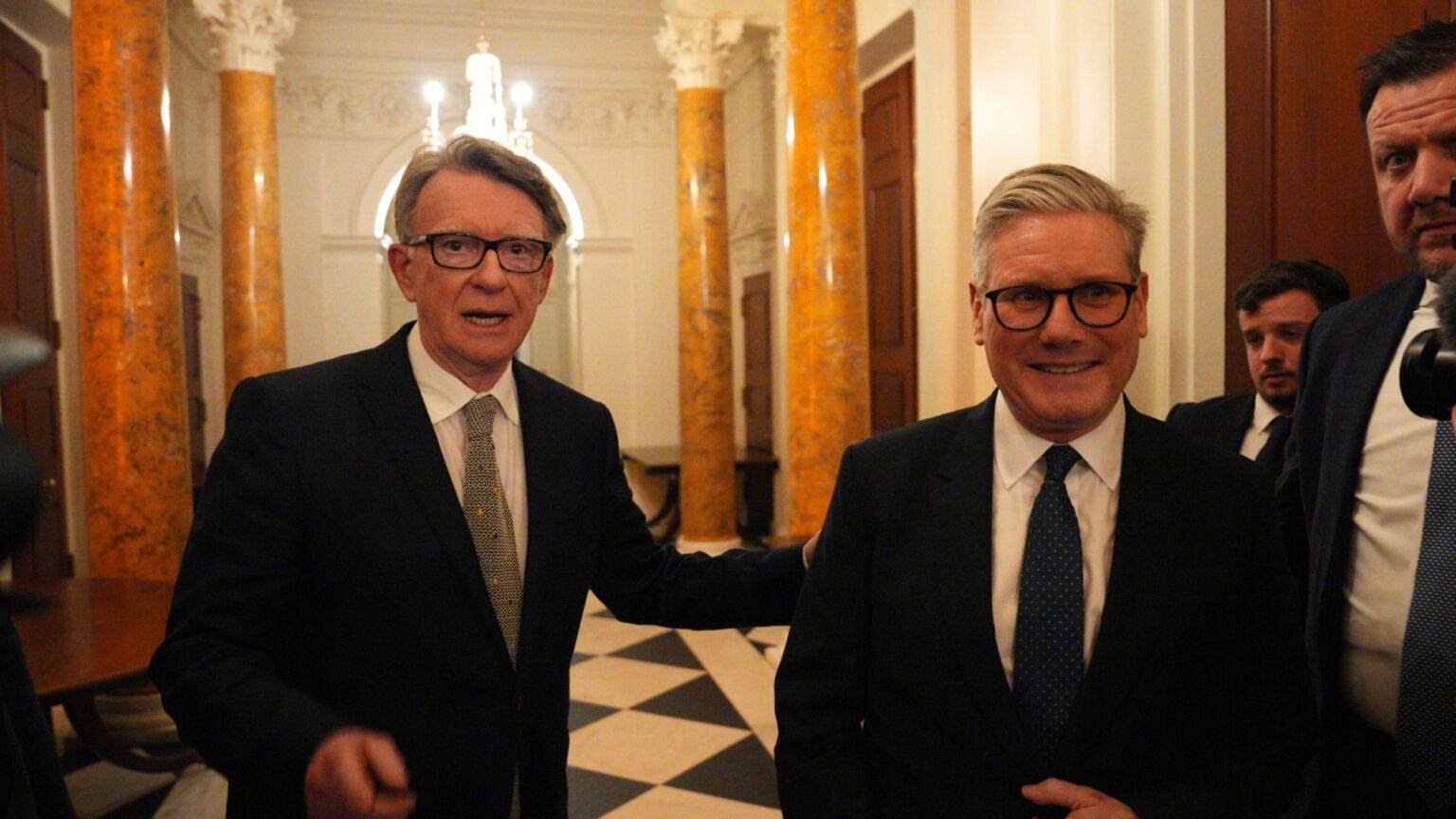
The exhaustion of Keir Starmer’s Labour government has certainly been far quicker than that of the New Labour administrations of the 1990s and 2000s. But the parallels are unmistakable. Both New Labour and its Starmer-fronted retread pitched themselves to voters as virtue incarnate, making almost identical pledges to restore trust in politics after years of Tory ‘sleaze’ – a catch-all pejorative for a whole range of misbehaviour, from financial impropriety to marital infidelity. And yet almost no sooner had they both entered Downing Street, than they found themselves up to their necks in their own lakes of sleaze. For the fast-forwarded descent of Starmer’s Labour to so closely mirror the years-long fall of Blair’s New Labour is no quirk of history. Nor is it solely attributable to the central role played in both administrations by New Labour figures, especially the now disgraced Labour bigwig and certified sleaze magnet, Peter Mandelson. It’s more significant than that. It is a testament to modern Labour’s fundamental problem with sleaze. The Labour Party we know today emerged during the 1990s as a very different beast to its earlier 20th-century versions. Under Tony Blair’s leadership, it had set about ‘modernising’ itself – a process of jettisoning the last remaining vestiges of Labour’s ‘old left’ past in order to bring it bang up to date with the post-Cold War world. This was to be a party free, as Tony Blair put it in 1997, of ‘out-dated ideology or doctrine’. A post-political party committed to managerialism rather than socialism. A party determined to administer businesses and society alike, to regulate and audit through quangos and other unaccountable, expert-stuffed bodies. It was a technocratic ‘Third Way’ project entirely of a piece with the ethos of globalism then emerging, in which decision-making was being shifted away from national electorates and towards those who knew best in transnational institutions, such as the EU and the World Trade Organisation. But there was another key aspect of New Labour, which is of particular relevance right now. Namely, that at the same time as it was ‘modernising’ and embracing managerialism, it was also constructing itself as the ‘anti-sleaze’ party, the Party of the Virtuous. Within months of John Major’s Conservative Party winning the 1992 General Election, his government’s popularity plummeted after the collapse of the pound following Britain’s withdrawal from the European exchange-rate mechanism – a process that was meant to pave the way for Britain’s adoption of what would become the Euro. The following year, Major attempted to resurrect his party’s fortunes by calling for a return to a ‘conservatism of a traditional kind’: ‘We must go back to basics and the Conservative Party will lead the country back to those basics right across the board: sound money, free trade, traditional teaching, respect for the family and the law.’ Enjoying spiked? Why not make an instant, one-off donation? We are funded by you. Thank you! Please wait... Thank you! ‘Back to basics’, as this vision came to be known, wasn’t meant to be a reference to personal or private morality. But that is how the press eagerly interpreted it. This provided the tabloids with an excuse to reveal all the sordid affairs and sexual shenanigans that had long been gathering dust in journalists’ files. At the time, it seemed barely a week passed without a red-top tale of bed-hopping Tories, from David Mellor to Tim Yeo, failing to live up to their own party’s supposedly puritanical values. By 1994, the respectable broadsheet press was getting in on the act, focussing less on sex-capades and more on dodgy financial dealings. The most notorious of which was the cash-for-questions affair, in which the Guardian alleged (rightly as it eventually turned out) that Tory MPs Neil Hamilton and Tim Smith had received money from Harrods owner Mohamed Al-Fayed in return for asking questions on his behalf in the Commons. The respectable media, staffed by many who long harboured a distaste for the Tories, feasted on their myriad personal failings, tarring it all with the broad brush of ‘sleaze’. As a 1994 piece for the high-brow London Review of Books had it, ‘The Tories are of course the party of sleazeocracy’. It was perhaps not fully grasped at the time, but British political culture was undergoing a profound shift. It was effectively being re-oriented around personal conduct, rather than political ideas. It mattered less what a politician stood for, than how personally virtuous they could appear. Getty Former BBC war correspondent Martin Bell arrives for the 1997 General Election count at Macclesfield Leisure Centre, 2 May 1997. This was captured best by what happened in the Cheshire constituency of Tatton at the 1997 General Election. The incumbent MP Neil Hamilton, the Tory junior minister at the centre of the cash-for-questions affair, refused to stand down. And so both Labour and the Lib Dems agreed to withdraw their own candidates to allow an independent candidate to face off against Hamilton. This independent candidate in question was BBC war correspondent Martin Bell, who had pledged at a press conference to remove the ‘poison in the democratic system’. Bell wasn’t a traditional politician at all – he had no party and no policies. He was a pompous, moralistic gesture stuffed into a tellingly white suit – the crass symbolism of which he had made famous while reporting on the war in Bosnia, before bringing it to the streets of Tatton. He effectively set up the General Election for Tatton voters not as political choice, but as a moral one. A chance to side with good over evil, the pure over the tainted, the white-suited man from the BBC over the wicked Tory. While Bell may have become the poster boy of the anti-sleaze crusade, it was Labour that became its party-political wing. As a complement to its post-political managerialism, its leading figures adopted an intensely personal, moralistic style – think of it as ‘high sanctimonious’. Shadow foreign secretary Robin Cook would be condemning the Tories as a ‘government that knows no shame’ one week, before Blair himself would be talking of being ‘tough on sleaze and tough on the causes of sleaze’ the next. As The Economist said of the 1997 General Election, ‘the word [“sleaze”] was on the lips of every Labour candidate’. New Labourites, immersed in managerialism, no longer bothered promoting a vision of the good life; they pushed themselves forward as good people instead. They were the virtuous ones, the Elliot Nesses of the British political scene – ‘purer than pure’, as Blair once put it. And, in turn, the Tories were cast as perpetual wrongdoers, the vice-ridden ones. Through the idea of ‘sleaze’ pushed and promoted by the media, Labour was refashioning itself for the post-political, post-class age – and reframing party politics in the process. It was no longer a contest over the economy, a battle between two still relatively distinct visions of the future, grounded on relatively clear social constituencies. It was now a contest between good people and bad people, a battle between clean and the dirty, a fight to restore public standards, integrity etc, etc. This wasn’t just a moral performance. Labour were also determined to institutionalise this anti-sleaze crusade. ‘We will change the law to make the Tories clean up their act’, Blair pledged in 1996. And that’s what New Labour did when it finally won power in 1997, promising, as the new prime minister did on that sunny day in May nearly three decades ago, ‘to restore trust in politics in this country… [to] clean it up [and give] people hope once again that politics is and always should be about the service of the public’. To this end, Labour set about installing the ethos of anti-sleaze within the state. Building on the new ‘code of conduct’, introduced in 1996 by the equally new Committee on Standards in Public Life, Labour also strengthened the ministerial code in 1997, even creating the role of ‘independent adviser on ministerial standards’ to advise on said code in 2006. It also enacted various anti-sleaze measures under the Political Parties, Elections and Referendums Act 2000. This was New Labour. A combination of managerialism and personal moralism. A party that positioned itself beyond politics, as an almost ethical force full of Good People. A government that was determined to create new rules and procedures, overseen by unelected experts, to hold the bad, ‘sleazy’ Tories to account. And almost from the moment Blair stepped across the threshold of No10 on 2 May 1997, it all backfired. Labour found itself hoist by its own moralistic petard. By the autumn of 1997, Labour was already facing several allegations of sleazy conduct. Mohammed Sarwar, MP for Glasgow Central (and father of current Scottish Labour leader Anas) had been suspended from parliament over bribery allegations. Liverpool West Derby MP Bob Wareing was found guilty of failing to register financial interests. And Robin Cook, a particularly self-righteous New-ish Labourite, was caught having an affair with his personal assistant. More troubling still, it also emerged that Formula One chief Bernie Ecclestone had given Labour a £1million donation and, seemingly in return, Labour exempted Formula One from its ban on tobacco advertising. Getty Tony Blair at the Labour conference in Blackpool, October 1994. As the years passed, New Labour continued to wrack up the sleaze allegations. Alongside countless marital infidelities and the usual sexual shenanigans, there were significant donations from porn baron Richard Desmond and eccentric businessman Richard Abrahams, all seemingly made in an attempt to influence government policy in some unspecified way. Then there were ‘Tony’s cronies’, the press’s epithet for those supporters and donors Labour attempted to reward for their loyalty and cash with peerages. Indeed, it was Labour’s ultimately thw
Share this story