news.uark.edu
Kartik Balachandran to Be Inducted Into National Academy of Inventors
news.uark.edu · Feb 27, 2026 · Collected from GDELT
Summary
Published: 20260227T083000Z
Full Article
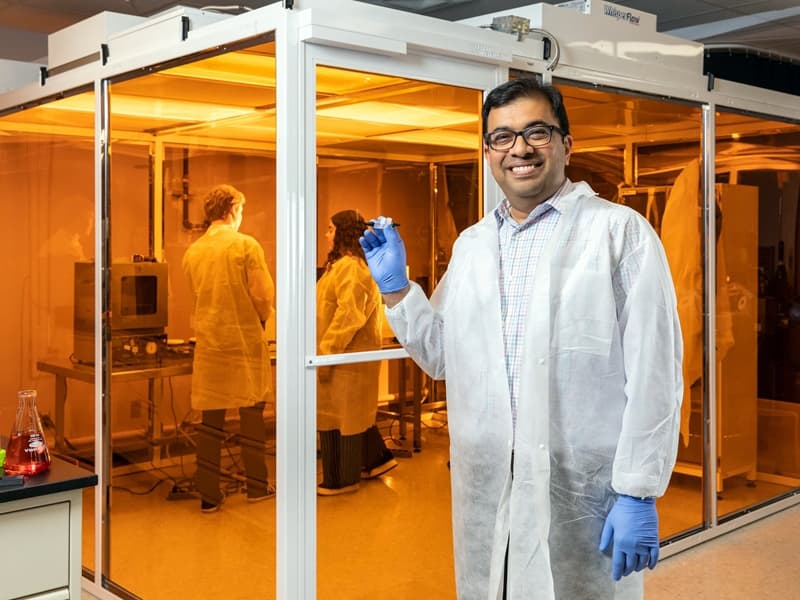
Kartik Balachandran holding an example organ-on-chip. Kartik Balachandran, a professor of biomedical engineering and associate dean for research at the University of Arkansas, has been named a senior member of the National Academy of Inventors. He joins members from around the world who will be formally inducted into the academy, known as the NAI, at the 15th annual meeting to be held in June of 2026. "It is truly an honor to be inducted as a senior member of the NAI," Balachandran said. "I give credit to all my mentors, collaborators and students who have driven me along this path of innovation and translational impact of my research." During Balachandran's 15-year career with the U of A, he has built a national reputation for his pioneering work in organ-on-chip (or OOC) microphysiological systems. The OOC technology mimics the structure and function of human organs in vitro and accelerates drug discovery and toxicology research. His research has resulted in four issued patents and three applications pending, all of which list his former graduate students as co-inventors, with whom he works closely. Working out of the Mechanobiology and Soft Materials Laboratory, informally known as "the Balalab," Balachandran has developed OOC platforms that mimic the heart, heart valve, brain and nasal airways of humans. By replicating human tissues on the cellular level, he can study the effects of disease, pollution, injury or drug compounds without harm to humans or animals. These chips are so precise that the nasal airway OOC will even produce mucus. By ensuring human-relevant data is always generated from research, OOCs have the ability to eliminate ineffective compounds before expensive clinical trials. This can significantly reduce the time and cost associated with traditional development of new drugs using animal models, which average around $3 billion over a decade and have a 90% failure rate. Balachandran co-founded a new company, Humimic Biosystems, based on the proposition that OOC platforms could shave two years and $250 million off the time and cost of developing new therapeutics. He co-founded the company with his Ph.D. student Lexi Applequist, who is the chief executive officer. Balachandran has received more than $4 million in research funding from entities such as the Department of Defense, the National Science Foundation, the National Institutes of Health and the Arkansas Biosciences Institute. Balachandran hopes to someday integrate these various chips into a full body platform in which "the brain can talk to the heart in some meaningful way." Ideally, he will design systems independently that can function together with biochemical communication on a cellular level. "That's the next big leap," he says. David Hinton, associate vice chancellor for research and innovation and executive director of Technology Ventures at the U of A, nominated Balachandran, who joins associate professor of mechanical engineering Wenchao Zhou as a senior member in NAI 2026 class.
Share this story