theage.com.au
Clustered Story
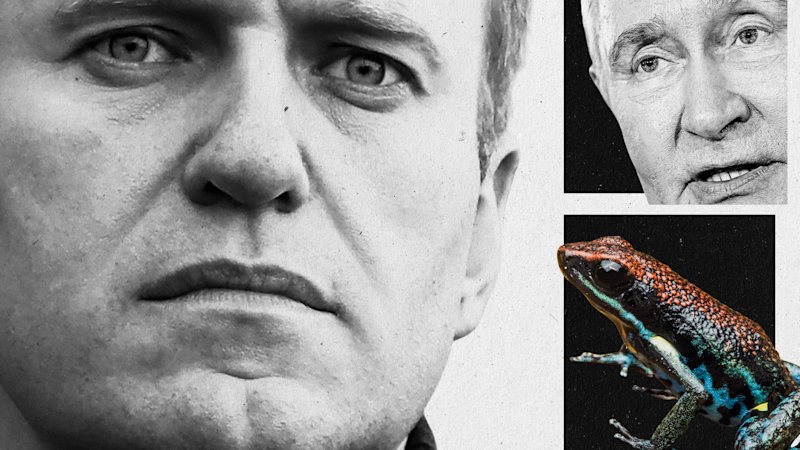
How British scientists found Putin frog poison – and exposed a secret chemical arsenal
theage.com.au · Feb 16, 2026 · Collected from GDELT
Summary
Published: 20260216T050000Z
Full Article
Timothy Sigsworth, Rozina Sabur and James RothwellFebruary 16, 2026 — 3:30pmLondon/Munich: In their high-security base in the Wiltshire countryside in England, the scientists of Porton Down made an astonishing discovery.Tissue samples taken from the body of Russian opposition leader Alexei Navalny and smuggled out of Russia showed he had been assassinated using the toxin produced by an Ecuadorian poison dart frog.Long-time Putin opponent Alexei Navalny (left) died in prison in 2024.Marija ErcegovacEight years ago, scientists at the UK Ministry of Defence research centre revealed that the nerve agent Novichok had been used in the attempted killing of KGB defector Sergei Skripal and his daughter Yulia in Salisbury.The finding was central to establishing that Russia was responsible for the failed assassination, which resulted in the death of innocent bystander Dawn Sturgess.It called into question whether Moscow had been telling the truth when it claimed in 2017 to have destroyed its chemical weapons in line with the Biological and Toxin Weapons Convention, which bans them.But the British scientists have now left the Foreign Office convinced that Russian President Vladimir Putin is indeed in possession of illegal chemical weapons – made in secret laboratories for use against his enemies at home and abroad.Navalny was 47 when he died at a high-security Arctic prison in February 2024 after years of accusing Putin and the Kremlin of corruption.He had fallen suddenly ill while exercising outside. Escorted back to his cell, the dissident began vomiting as he writhed in pain on the floor. His sudden collapse, loss of consciousness and the failure of resuscitation efforts aroused suspicions.State investigators, however, dismissed them, saying instead that his death was caused by arrhythmia, an abnormal heart rhythm, and another medical condition. His body was released to his family, and he was buried after a Russian Orthodox funeral service.It was then that his supporters embarked on a daring mission to show the world what really happened to a man who had been hailed as “the fiercest advocate for Russian democracy”.Tissue samples were surreptitiously taken, smuggled out of Russia and secretly transferred across Europe to Porton Down, one of the world’s leading centres of scientific research.The headquarters of the Defence Science and Technology Laboratory (Dstl) hosts some of Britain’s most advanced chemical laboratory capabilities, and researchers at the secretive base have a deep expertise in testing for chemical and biological weapons.Deploying newly discovered toxicology techniques, researchers concluded that Navalny’s sudden collapse was caused by epibatidine, a toxin produced by the Ecuadorian poison dart frog.The results, confirmed through collaboration with Sweden, France, the Netherlands and Germany, were shocking.‘By using this form of poison, the Russian state demonstrated the despicable tools it has at its disposal and the overwhelming fear it has of political opposition.’Yvette Cooper, British Foreign SecretaryDiscovered in the 1970s, the toxin is a fast-acting nicotinic receptor agonist that was first considered for use as a painkiller due to its numbing effects.Those efforts were abandoned because, in large doses, it can cause death within 30 minutes by triggering respiratory failure, convulsions and paralysis.There was “no innocent explanation” for the toxin – which is 200 times more potent than morphine, not native to Russia and found only in wild frogs – being in Navalny’s body, the government said.Although a well-known poison, it does not appear to have ever been used in targeted killings before – at least that the West knows of.The Ecuadorian poison dart frog’s toxin is 200 times more potent than morphine.Getty Images/iStockphotoShow of strengthThere is a question mark over whether it was chosen for use because it is difficult to detect, in which case Russia would not have expected the West to have the technical capabilities to detect its use.It is not impossible, however, that it was chosen precisely so that it would be uncovered as a calling card – a show of strength and ingenuity intended to signal Russian power.Colonel Hamish de Bretton-Gordon, former commanding officer of Britain’s Joint Chemical, Biological, Radiological and Nuclear Regiment, said: “This is a classic FSB/GRU [Russian security services] modus operandi, using deadly toxins and chemical weapons.Sergei Skripal (left), pictured in 2006, and his daughter Yulia Skripal after her recovery from the nerve agent poisoning.AP“But it also shows how leaky and pretty inept the Russian secret service is, that we know so much detail.”Such a message would have been intended to intimidate the West and neighbouring former Soviet nations, which Russia believes rightfully belong to its sphere of influence, as well as the Russian public amid rising discontent over the war in Ukraine and the flat-lining economy.“By using this form of poison, the Russian state demonstrated the despicable tools it has at its disposal and the overwhelming fear it has of political opposition,” British Foreign Secretary Yvette Cooper said on Saturday.The toxin’s development in sufficient quantities for an assassination would have required serious technical capabilities – most likely a special laboratory – which put to bed the notion that Russia has abandoned its arsenal of chemical weapons.It has shed light on the breadth of the Kremlin’s chemical stockpile and revealed the extent of its expertise in chemical weapons production.“This is not something you order online,” one specialist told Russian outlet The Insider. “You would need a state-level chemical program or access to an advanced research laboratory. The number of actors capable of synthesising and weaponising epibatidine is extremely small.”The tightly controlled environment in the Arctic prison where Navalny was held gave the Russian state free rein over when it would attempt to kill him.In a joint statement, the foreign ministers of France, Germany, the Netherlands, Sweden and Britain said Moscow had “the means, motive and opportunity to administer this poison to him”.Attention will now turn to the consequences Putin faces for his use of banned chemical weapons, which contradicts Russia’s claim that it had disposed of all 40,000 tonnes of toxins it inherited from the Soviet Union.Since then, Moscow has used Novichok against the Skripals in 2018, as well as on Navalny on a flight to Munich in 2020. In addition to the use of ebipatidine to kill Navalny, it has also deployed chloropicrin, a potentially fatal World War I choking agent, during the war in Ukraine.De Bretton-Gordon said: “This confirms what we were all thinking, that Russia’s chemical weapons program is almost certainly extant and of course they are using industrial amounts of chemical weapons in Ukraine.”As well as the 1972 Biological and Toxin Weapons Convention, Russia is a signatory to the 1993 Chemical Weapons Convention, which also prohibits the use of such weapons.“Russia is a signatory of both, so if it was behind the poisoning of Navalny, it has broken treaties it has sworn to uphold,” said Professor Alastair Hay, a British toxicology expert.The conventions do not include a system of sanctions for non-compliance, and instead direct complaints to the United Nations Security Council, of which Russia is a permanent member. The council can recommend imposing sanctions following an investigation.“These latest findings once again underline the need to hold Russia accountable for its repeated violations of the Chemical Weapons Convention and, in this instance, the Biological and Toxin Weapons Convention,” the foreign ministers’ joint statement said.“Our permanent representatives to the organisation for the prohibition of chemical weapons have written today to the director-general to inform him of this Russian breach of the Chemical Weapons Convention.“We are further concerned that Russia did not destroy all of its chemical weapons. We and our partners will make use of all policy levers at our disposal to continue to hold Russia to account.”The Telegraph, LondonGet a note directly from our foreign correspondents on what’s making headlines around the world. Sign up for our weekly What in the World newsletter.More:Putin's RussiaVladimir PutinAlexei Navalny RussiaUKArcticFor subscribersFrom our partners
Share this story