Science News
Earth’s core may hide dozens of oceans of hydrogen
Science News · Feb 10, 2026 · Collected from RSS
Summary
Hydrogen reserves in Earth’s core large enough to supply at least nine oceans may influence processes on the surface today.
Full Article
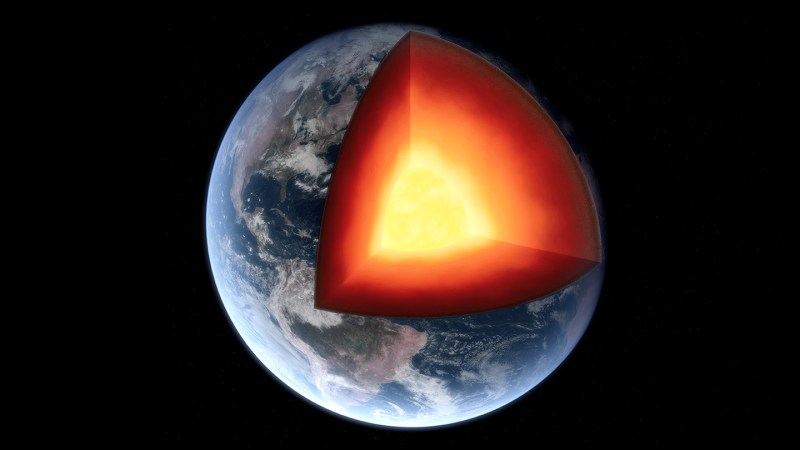
Experiments suggest that Earth’s core is up to 0.36 percent hydrogen by weight Earth’s core may contain vast reserves of the element hydrogen, which can form water if it leaks into the oxygen-rich mantle. fpm/E+/Getty Images Plus This is a human-written story voiced by AI. Got feedback? Take our survey . (See our AI policy here .) The oceans are the largest entity on Earth’s surface. All that blue, however, may be dwarfed by an immense reservoir of hydrogen concealed in the planet’s heart. Experiments indicate that enough hydrogen to form dozens of oceans of water may have been entombed in Earth’s core during its formation, researchers report February 10 in Nature Communications. Those chthonic reserves may influence processes on the planet’s surface. Hydrogen does not exist as liquid water in the core, but it becomes water as it escapes upward into the mantle and reacts with oxygen, says geodynamicist Motohiko Murakami of ETH Zurich. “Oxygen is one of the most abundant mineral elements in the mantle.” Earlier estimates of the core’s hydrogen reserves varied enormously and were based on indirect measurements of the element’s abundance in iron, taken by adding hydrogen to iron and measuring the resulting volume change. For the new study, Murakami and colleagues went for a more direct approach. The team started with artificial pieces of the core — iron shards enveloped in a hydrogen-bearing glass. The researchers then squeezed the shards between two diamonds in a powerful mechanical press and beamed a laser through the diamonds to heat the samples up to 4,826° Celsius (8,720° Fahrenheit). At those conditions, the samples melted into iron blobs laced with silicon, hydrogen and oxygen. The early core coalesced from such blobs, Murakami says, as much of early Earth was a magma ocean. After quickly cooling and solidifying the samples, the researchers used a special probe to map out the distribution of elements, finding tiny structures that had solidified amid the iron. Silicon and hydrogen were found only within these structures — and in equal amounts of atoms. That one-to-one ratio was key, as earlier experiments, simulations and geophysical observations of the core had already indicated it was 2 to 10 percent silicon by weight. Based on their new calculations, Murakami and colleagues estimate roughly 0.07 to 0.36 percent of the weight of Earth’s core consists of the much lighter hydrogen. “That’s nine to 45 oceans” of water, Murakami says. Over time, some of that hydrogen has probably leaked into the mantle and become water, Murakami says. That water would make it easier for mantle rocks to melt, he says, generating magma and fueling volcanic eruptions all the way up on Earth’s surface. More Stories from Science News on Earth
Share this story