insideclimatenews.org
Clustered Story
Could a New Illinois Bill Be a Blueprint for Curbing Data Center Climate Impacts ?
insideclimatenews.org · Feb 19, 2026 · Collected from GDELT
Summary
Published: 20260219T124500Z
Full Article
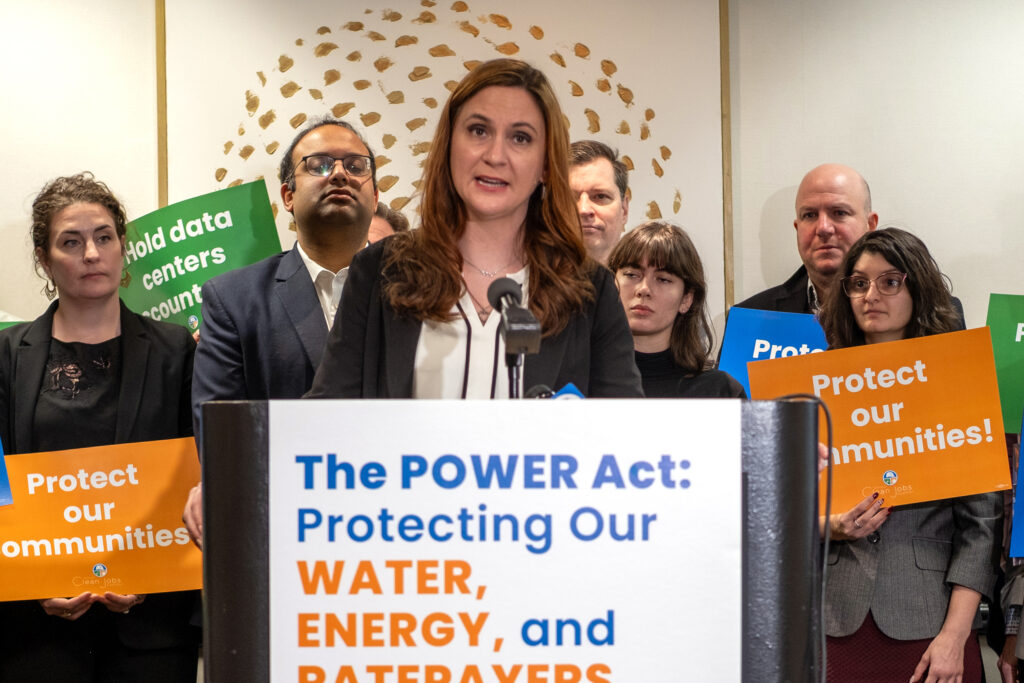
CHICAGO—A new Illinois bill seeks to rein in power- and water-hungry data centers’ impacts on residents and get the state back on track to meet its climate goals. The speed of the data center boom has outpaced calls for national regulations, leaving the industry largely unchecked as its climate impacts grow: A study from November predicted that U.S. data centers could consume as much water as 10 million Americans and match the carbon dioxide emissions of 10 million cars by the end of this decade. That paired with rising consumer electric bills in a number of places with data-center growth has prompted calls for a moratorium on the industry’s expansion while more research is done. Meanwhile, local communities are fighting back against data centers proposed in their backyards, and states from New York to Georgia are considering legislation to mitigate the developments’ impacts. The Illinois bill, introduced on Feb. 6, has been nicknamed the POWER Act—Protecting Our Water, Energy and Ratepayers. It aims to shift energy costs related to this growth from consumers to the data center companies, incentivize clean-energy sourcing, limit water use and protect local communities from pollution. The Illinois proposal stands out to supporters and opponents alike as particularly wide-reaching. Last week, environmental advocates gathered in downtown Chicago to support the bill. “These energy- and water-intensive facilities represent the most significant threat that we’ve seen to our energy grid in decades, all while polluting our air, threatening our water supply and straining Illinois’ landmark climate goals,” Jen Walling, chief executive officer of the Illinois Environmental Council, said at the event. “Without common-sense guardrails in place, we will no doubt suffer the consequences of the rushed build-out of these behemoth facilities.” Some provisions of the POWER Act specifically target hyperscale data centers, defined in the bill as any facility focused on electronic information services with a peak energy demand surpassing 50 megawatts. Democratic state Sen. Ram Villivalam of Chicago, one of the bill’s sponsors, said regulating the industry should be an urgent priority. “This is not too much to ask,” Villivalam said. “We can work towards a future built for technology to support our daily lives, not deplete our resources and price us out of our homes.” Proponents call it “nation leading” for its holistic approach, but the bill is already receiving pushback. Brad Tietz, state policy director of the Data Center Coalition, an industry member association, said the bill, coupled with other Illinois laws, could “significantly harm” and even close the market in the state. “It’s just a giant maze of regulatory complexities that would make it very difficult to get a project off the ground in Illinois,” he said. Energy Costs and Climate Goals Data centers are already contributing to increasingly unaffordable bills in Northern Illinois, including in Chicago. But the biggest impacts are likely yet to come. A Pew Research Center report in October said data centers’ U.S. energy demand is expected to more than double by the end of the decade, as the artificial intelligence industry grows. And a December report by Illinois regulators found that the state could face significant energy shortfalls and rising energy costs in the coming decade. An analysis by the Union of Concerned Scientists, which supports the POWER Act, projected that data centers will account for up to 72 percent of Illinois’ overall electricity growth by 2030. By 2050, the advocacy group said, the industry could increase electricity system costs in the state by 15 to 24 percent and drive billions of dollars in health costs and climate damages through increased use of gas and coal-fired power plants. “The POWER Act establishes policies that ensure data centers pay their fair share to protect consumers and their climate,” said James Gignac, Midwest policy director for the climate and energy program at the Union of Concerned Scientists, at the press conference. Illinois is already behind on its climate goals, which include binding targets in 2030 for clean energy and electric vehicles and 100 percent clean energy by 2050. Data center proliferation could further delay these goals, although some state officials say they are still committed to the targets. The new bill would incentivize data center companies to create new renewable energy and battery storage to meet their capacity needs by requiring companies to submit clean energy supply plans in order to receive a firm, uninterrupted connection to the existing grid. It would also offer fast-track interconnection to data centers that secure their own clean energy by certain deadlines. Kady McFadden, a lobbyist for the Illinois Clean Jobs Coalition, emphasized that the bill incentivizes clean energy rather than banning fossil fuels before state deadlines go into effect. “It is truly carrots,” McFadden said. Seeking to shift costs from consumers to data center companies, the bill would also require electric utilities to establish new rate tariffs specifically for hyperscale data centers. “Taken together, these policies make sure data center growth doesn’t raise electricity bills, doesn’t undermine our clean energy goals and strengthens the grid instead of straining it,” said MeLena Hessel, Midwest deputy program director at Vote Solar, a national clean energy nonprofit. The bill would also require data centers to report expected and actual water usage and sourcing, information that’s hard to come by nationally. And it would mandate more efficient methods of cooling, the main driver of water use at these complexes. This story is funded by readers like you.Our nonprofit newsroom provides award-winning climate coverage free of charge and advertising. We rely on donations from readers like you to keep going. Please donate now to support our work.Donate Now Fengqi You, an energy systems engineering professor at Cornell University whose research focuses on the environmental impacts of data centers, said water is an often overlooked but extremely important environmental consideration in the conversation around the industry’s growth. He was encouraged to see those provisions included in the bill. You said the proposal reflects a broader shift in how states are thinking about data center growth. Its emphasis on transparency and reporting is crucial for understanding the sector’s impacts, he said. “Illinois is leading the way in terms of how these policies are evolving,” he said. You added that the real test of the bill, if it passes, would be in its implementation. The measure also seeks to address the health and environmental justice concerns that data centers can bring, like hazardous air pollution. The sites often rely on backup generators running on diesel, which emit pollutants like toxic particulate matter and nitrogen oxides. Lucy Contreras, the Illinois state program director at GreenLatinos, a national nonprofit focused on environmental and climate justice, grew up in Cicero. The Chicago suburb has long suffered from industrial pollution and flooding, and she’s worried about residents struggling with asthma and other respiratory diseases. “The pollution doesn’t just disappear, it settles in our lungs,” Contreras said at the press conference. “These are the real human costs of industrial pollution.” Lucy Contreras, Illinois state program director at GreenLatinos, spoke about pollution and health concerns due to data centers at the POWER Act press conference on Feb. 11. Credit: Keerti Gopal/Inside Climate News The bill would only allow data centers to use back-up diesel generators during emergencies. Companies wanting to build data centers within three miles of an environmental justice community—areas already struggling with pollution—must first get a cumulative impact assessment from the Illinois Environmental Protection Agency that finds the project would not disproportionately increase health and environmental risks there. The bill would require companies to enter into legally binding, publicly disclosed community benefits agreements with representatives from the areas their facilities are located. Those agreements require companies to more deeply invest in the local communities where they’re building, such as with workforce training or infrastructure improvements. And hyperscale data centers would also be required to pay into a fund to address energy affordability problems and help pay for air quality monitoring and water infrastructure improvements. Contreras said the POWER Act could protect communities like hers from more environmental burdens. “Stand with families who deserve clean air, affordable energy and a real voice in what gets built in their neighborhoods,” Contreras said, calling for its passage. Illinois has been a leading destination for data centers, in part because of a tax incentive program from 2019, but in recent years the state has been outpaced by growing markets in Pennsylvania, Georgia and Texas, said Tietz of the Data Center Coalition. Gov. JB Pritzker proposed a two-year pause on tax credits for data centers during his State of the State address on Wednesday, citing “rising demand and surging prices.” He also called on Northern Illinois grid operator PJM Interconnection to protect consumers from rate hikes by forcing data center companies to pay for the resources to power their operations. “With the shifting energy landscape, it is imperative that our growth does not undermine affordability and stability for our families,” Pritzker said. Gov. JB Pritzker speaks at the groundbreaking of the Illinois Quantum and Microelectronics Park in Chicago on Sept. 30, 2025. Credit: Keerti Gopal/Inside Climate News Jen Young, vice president of data at Baxtel, a market intelligence and advisory firm for the data center industry, tracks data centers using a combination of methods including direct communication wi
Share this story