dhakacourier.com.bd
Bangladesh : Rahman wins but faces challenges
dhakacourier.com.bd · Feb 27, 2026 · Collected from GDELT
Summary
Published: 20260227T191500Z
Full Article
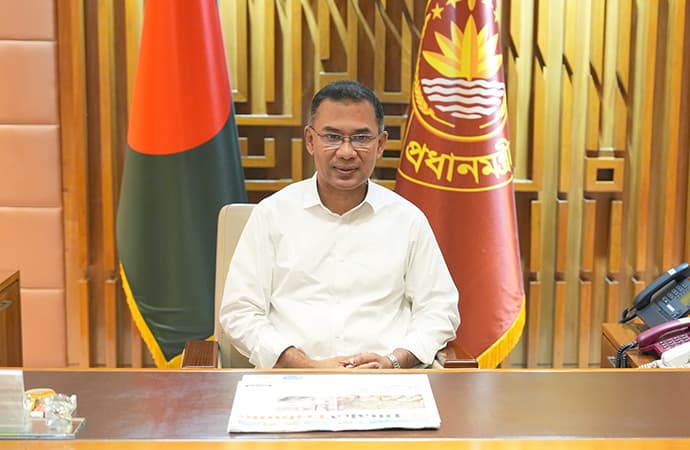
Tarique Rahman won a landslide victory in the recent Bangladeshi elections. His government now has to overcome domestic tensions and conduct a careful foreign policy in the region. Tarique Rahman, the 60-year-old leader of the centre-right Bangladesh Nationalist Party (BNP), was sworn in as prime minister of Bangladesh on 17 February 2026 following a decisive victory in the country's first parliamentary elections (on 12 February) since the ouster of former prime minister Sheikh Hasina in student-led protests in August 2024. This marked the return to power of the BNP after a gap of nearly 20 years since the 2001-06 administration of Tarique's late mother Khaleda Zia. Tarique's late father, Ziaur Rahman, a former army chief and founding president of the BNP, was the sixth president of Bangladesh (1977-81). Despite the Awami League being banned from participating in the elections, the overall turnout was almost 60% (76 million out of 128m), compared with only 42% at the 2024 elections, which the BNP boycotted. The European Union election-observation mission to Bangladesh described the elections as credible and competitive. They were also largely peaceful. Rahman's top priorities for Bangladesh - whose population of 173.5m makes it the world's fourth most populous Muslim-majority country - will be to provide stability and safety to a deeply polarised society, ensure growth and employment amid severe economic challenges, and hedge its foreign policy while not alienating its largest neighbour, India. Domestic stability After 17 years of self-imposed exile in London, Rahman returned to Dhaka in December 2025 to lead his party to win 50% of the total votes, which gave it 209 out of the 297 seats where the election was contested and a two-thirds majority in the Bangladeshi parliament, the Jatiya Sangsad. Claiming the centrist and liberal-secular space once occupied by the Awami League, the BNP campaigned for religious freedom, the protection of minorities, and law and order. Rahman apologised for the BNP's past mistakes, the party having been heavily criticised during its previous tenure amid accusations of widespread corruption. The largest Islamist party, the Jamaat-e-Islami (JeI), banned under the Sheikh Hasina regime, made considerable gains, winning 68 seats and around 32% of the vote, its best-ever electoral performance. JeI chief Dr Shafiqur Rahman, appointed as leader of the opposition, had attempted to transform the image of his party, which had been criticised for its advocacy of sharia law in Bangladesh, but it still aroused concerns among many about the resurgence of regressive Islamist politics. Meanwhile, the National Citizen Party (NCP), formed by student leaders in the aftermath of Hasina's ouster, failed to mobilise support from young voters, winning only six seats. Even though Hasina, in self-imposed exile in New Delhi, had urged supporters to boycott the polls, it is likely that some Awami League members voted for the BNP, with the BNP gaining majorities in at least 62 constituencies previously considered Awami League strongholds. Hasina called the elections a 'well-planned farce'. Rahman will have to overcome political polarisation between the ruling BNP and the Awami League supporters, who are still a significant section of the electorate. The past 18 months of the army-backed interim government of Nobel laureate Muhammad Yunus also saw a breakdown of law and order, an ineffectual police force and targeted attacks on Bangladeshi Hindus, who number approximately 14m and are considered traditional Awami League supporters. Alongside this, in the referendum that accompanied the parliamentary elections on 12 February, 60% of the electorate voted in support of the 'July National Charter', a series of proposals for constitutional reform put forward by the Yunus government. The Rahman government is now legally obliged to implement these expansive reforms, which include checks on executive power, increasing the representation of women in parliament, and strengthening judicial independence. Prior to the elections the BNP expressed reservations about the charter and filed 'notes of dissent' on proposals for the design and legislative role of a new upper house for the parliament, which has the potential to significantly weaken the authority of the prime minister. Economic stability Economic growth is a key priority for Rahman. The BNP manifesto seeks to more than double the size of the currently decelerating economy by 2034, from US$450 billion to US$1 trillion. In the short term there will be strong pressure to boost economic growth, halt rising inflation, increase foreign-exchange reserves, attract foreign direct investment (which has stagnated during the recent period of political instability), and increase trade and economic connectivity. State-owned enterprises and the banking sector remain structurally weak. Economic stability Economic growth is a key priority for Rahman. The BNP manifesto seeks to more than double the size of the currently decelerating economy by 2034, from US$450 billion to US$1 trillion. In the short term there will be strong pressure to boost economic growth, halt rising inflation, increase foreign-exchange reserves, attract foreign direct investment (which has stagnated during the recent period of political instability), and increase trade and economic connectivity. State-owned enterprises and the banking sector remain structurally weak. The way forward With his decisive electoral victory, Prime Minister Rahman has an opportunity to achieve economic progress and development through the diversification of regional and international ties. To be successful, however, he will need to display confident leadership, in a role that is first official position in government, and to overcome significant challenges, including his country's societal and political tensions. From www.iiss.org
Share this story