frontline.thehindu.com
Clustered Story
Bangladesh Democracy Crisis 2026 : Secularism vs Islamism
frontline.thehindu.com · Feb 23, 2026 · Collected from GDELT
Summary
Published: 20260223T113000Z
Full Article
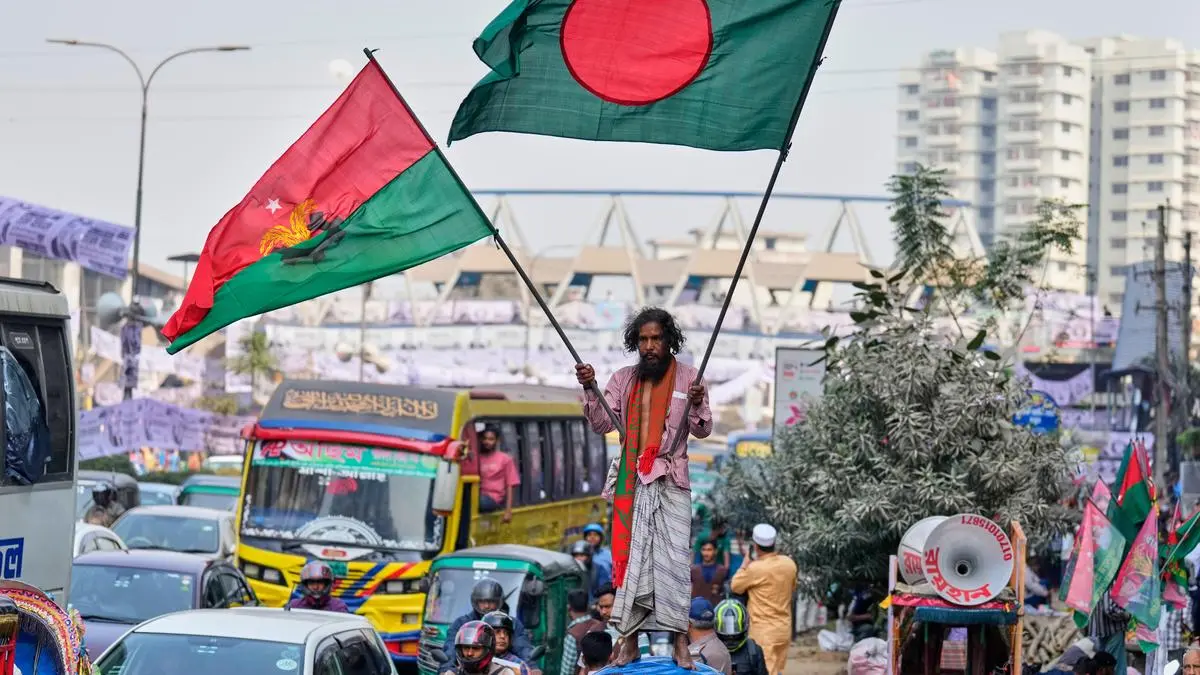
A man stands atop a rickshaw holding the Bangladesh national flag and the Bangladesh Nationalist Party flag during an election rally for Tarique Rahman, in Dhaka, on February 8, 2026. | Photo Credit: Anupam Nath/AP Those who have observed Bangladesh even until the July 2024 uprising know that the country’s politics is far from dull. The public space—where the performative aspects of politics are most visible—does not convey the impression of civil society as understood in its Western, Hegelian sense. There is, certainly, a semblance of civil society in Bangladesh that enables people to interact over politics, culture, and everyday life. But that space is constrained and often occupied by a tremendously volatile political reality.The historic elections in Bangladesh earlier this month ensured that political parties could campaign and contest freely, and that people could make their choices and vote for a new government. Allowing the Awami League to contest would have complicated matters for the state administration in ensuring a fair election, since the League would have attempted every means to regain its hegemony. But barring them—as the interim government eventually did, revoking the party’s registration in May 2025—also meant depriving their supporters and citizens at large of the right to register their democratic choice. The problem is that no party in Bangladesh stands above reproach; all carry a sordid record of anti-democratic conduct.There were reports of irregularities during the electoral process. Many citizens discovered, to their shock, that votes had been marked against their names at polling booths. There were also complaints of slow counting in certain constituencies. These problems were expected in a country where state institutions had been broken and non-functional for years. Elderly citizens braved physical constraints to exercise their right. Yet there was, unmistakably, something new in the air. That was the unexpected gift the elections brought to Bangladesh.Once it became clear that the Bangladesh Nationalist Party (BNP) had swept the polls with an overwhelming parliamentary majority—winning 209 of 297 declared seats, making it the largest mandate for any party in Bangladesh’s competitive electoral history—the Jamaat-e-Islami, which emerged as the primary opposition with a best-ever performance of 68 seats on its own and 77 including its alliance partners, began making familiar noises. It levelled strong allegations against the electoral process and, along with youth leaders of the National Citizen Party (NCP), threatened to take to the streets in protest.Since the July uprising, street agitation had become the new norm for the more restless factions of Bangladesh’s politics, especially the Inquilab Mancha and other breakaway groups from the broader students’ movement. (Individual NCP leaders, having served as advisers to the interim government of Muhammad Yunus, had since resigned those posts to lead the new party and moved deeper into institutional politics.) Their politics was organised around redressal: demands placed on the interim government, to be met immediately. The Mancha’s leaders had made violent threats if the killers of Sharif Osman Hadi—the uprising leader and Inquilab Mancha co-founder who was shot in Dhaka on December 12, 2025, and died in Singapore six days later—were not produced before the elections. They were fighting their own impending irrelevance in a fast-changing political landscape where a democratically elected government was about to supplant the instability of street-driven politics. The abiding disappointment of youth-led movements—across the world and across eras—is that they must end at some point, and the business of governing takes over. It is a difficult reality to confront and accept.The exit of the Awami League opened space for religious politics to reclaim ground and ideology. The frequent invocation of religious idiom has long served as a technique of political legitimation for such parties. Even when these forces spoke in a secular register—demanding accountability, equality, reform, employment, and an end to corruption—a religious undertone persisted. The general demand for insaaf (justice), for instance, is frequently viewed through an Islamic prism, and the precise connotation of what that justice entails is often left deliberately unclear, unsettling secularists and minorities alike. The implication, made more by suggestion than argument, is that since a secular regime indulged in unconstitutional violence, an Islamic one might deliver justice.The pathologyThe secular-religious debate in Bangladesh cannot, however, be read only through visible modes of political articulation. There is a deeper pathology at work.Youth leaders from the NCP and the Mancha speak from both sides of the mouth. They denounce the Awami League as “fascist”—not only from a secular standpoint that recognises authoritarianism, but also by simultaneously attacking the League’s secular credentials. The League’s attempt to enforce extra-constitutional measures against the Jamaat and those involved in pan-Islamic political activity proved deeply counter-productive, generating a reactive politics of radicalisation. It was the accumulated effect of that politics that ultimately drove Sheikh Hasina from power. Humiliating religious sentiment in the name of secularism has repeatedly proved self-defeating. A secular society cannot be created by compulsion. The state must, through democratic means, build and sustain institutions where a genuine political and ethical dialogue between the religious and the secular is possible. The absence of such dialogue was starkly visible in the targeting of secular-minded faculty at Bangladesh’s universities the moment Hasina was removed from office, as widely reported.The hypocrisy of the youth leaders lies in their refusal to acknowledge their political alignment with the Jamaat—an alignment that threatens to steer Bangladesh towards a religious, majoritarian polity. For now, the BNP, led by Prime Minister Tarique Rahman—who returned to Bangladesh from 17 years in self-imposed exile in London just weeks before the elections—is expected to keep the more extreme tendencies at bay.The distrustThe two central concerns that will persist in Bangladesh are social distrust and political violence. The social and political spheres are bound together by a profound deficit of faith—not merely in institutions or political will, but in the very possibility of a democratic language: one capable of addressing political rivalry soberly and without recourse to violence.Any nation shaped by the anti-democratic intrigues of military rule, whose shadow falls across subsequent quasi-democratic regimes, will inherit the psychology of friend-enemy politics. Coups translate into other forms of political murder—something Bangladesh has witnessed repeatedly since the end of military rule. Every side maintains its ledger of grievances against the other. The worst of it is this: the Jamaat, the BNP, and the Awami League continue to contest who first declared independence in 1971. If a nation cannot reach consensus over its own origins, its future will remain as fractured as its present. Political contestation is a sign of democratic health; the refusal to acknowledge historical truth is an impediment to the ethical foundation on which that contest must rest.The balancing actThis reflection ends with a recent interview of NCP leader Samantha Sharmin, who stopped participating in party activities to protest its electoral alliance with the Jamaat. The Senior Joint Convener of the NCP, she came to politics—and to a reckoning with her own relationship to Islam—in 2023, in the shadow of the war in Gaza. Sharmin holds that politics in Bangladesh can proceed neither by erasing or “annihilating” Islam, nor by allowing Islam to determine everything within that politics. The desire to maintain this balance will remain Bangladesh’s most precarious challenge, and will largely determine its democratic future.Sharmin recounts a moment from a political outreach walk in Sylhet after the 2024 uprising, when a mother handed her two boxes of chocolates to share with her fellow activists. She regards that “simplicity” as their political capital. The people of Bangladesh have handed the BNP a generous gift. It remains to be seen whether Rahman and his party can translate the plainness of public expectations into something lasting.Manash Firaq Bhattacharjee is the author of Gandhi: The End of Non-violence.Also Read | How Bangladesh has normalised political murderAlso Read | Bangladesh’s moment of reckoning
Share this story