salon.com
Amid mass ICE arrests , Trump pardon recipient Hernández given special treatment
salon.com · Feb 19, 2026 · Collected from GDELT
Summary
Published: 20260219T120000Z
Full Article
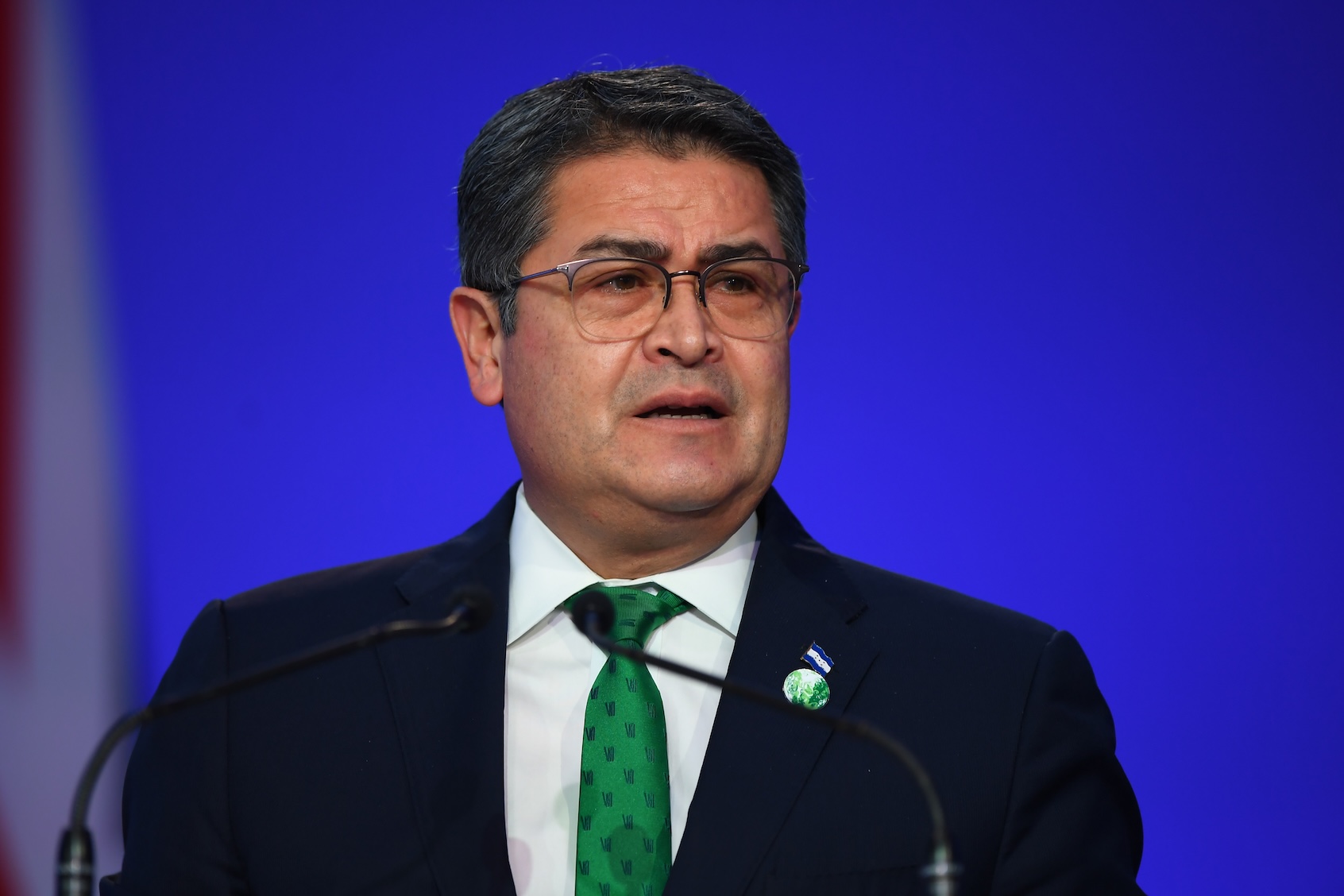
The former Honduran president was pardoned and was whisked away to a luxury hotel in New York City Published February 19, 2026 6:00AM (EST) Former Honduran President Juan Orlando Hernández speaks at COP26 at SECC on November 1, 2021. (Photo by Andy Buchanan/Getty Images) This article originally appeared on ProPublica. For months, President Donald Trump has railed against Latin American narcoterrorists flooding the United States with “lethal poison.” He has used the scourge of drug trafficking as a rationale for dozens of military strikes on alleged drug boats in the Caribbean and eastern Pacific Ocean, which have left more than 140 people dead. Last month, Trump cheered a military assault by U.S. forces that captured Venezuelan President Nicolás Maduro and his wife, Cilia Flores, and brought them to the U.S. to face charges related to cocaine trafficking. Maduro, Trump said, led a “vicious cartel” that “flooded our nation with lethal poison responsible for the deaths of countless Americans.” But when it comes to former Honduran President Juan Orlando Hernández, who was tried and convicted in the U.S. in 2024 and sentenced to 45 years in prison for taking bribes and allowing traffickers to export more than 400 tons of cocaine to the U.S., Trump has taken a decidedly softer tone. Advertisement: Hernández, he said, has been “treated very harshly and unfairly” — so unfairly that on Dec. 1, Trump pardoned the former president after he served less than four of those 45 years. But the federal government’s magnanimity did not end there. On the day he was to be released, records show, Hernández had an immigration detainer — a request for law enforcement agencies to hold noncitizens for pickup by Immigration and Customs Enforcement — in place. Here, too, the Trump’s administration’s treatment of Hernández differed from its public objectives. Other noncitizens caught up in recent immigration sweeps — the vast majority of whom do not have criminal records — have faced swift efforts to deport them, even to countries where they may face threats. But in Hernández’s case, the Federal Bureau of Prisons scrambled to get his detainer removed so he could walk free. And Hernández did not just walk out of the prison. Despite persistent budget and staffing shortages, prison officials paid a specialized tactical team overtime to drive Hernández from a high-security facility in West Virginia to the famed five-star Waldorf Astoria hotel in New York City, according to records and three people familiar with the situation. Before he left, Hernández was allowed to use the captain’s government phone to talk to the federal prison system’s deputy director, Joshua Smith, who was convicted in a drug trafficking conspiracy before Trump pardoned him in 2021. Advertisement: “The [prisons bureau] administration rolled out the red carpet for him,” said Joe Rojas, a retired prison worker and former union leader who has been speaking to the media on behalf of staff who fear reprisals for doing so since bureau leaders stopped recognizing the union last year. “The staff are disgusted.” Renato Stabile, the court-appointed lawyer representing Hernández — who has long maintained his innocence — said his client’s treatment was appropriate. “It would be particularly cruel to grant somebody a pardon and have them released from prison — only to have them immediately shipped back to a place like Honduras where they would’ve immediately arrested him or he would’ve been killed on sight by criminal elements that wanted to do him harm,” Stabile told ProPublica. Through his attorney, Hernández declined to comment. ICE referred all questions to the White House, which responded with a link to a November social media post announcing the President’s intent to pardon Hernández. Smith didn’t respond to an emailed request for comment. A BOP spokesperson said in an emailed statement that the bureau does not discuss conditions of confinement or security procedures and that employee standards of conduct prohibit staff from giving any prisoners preferential treatment. “Violators may be subject to disciplinary actions, including removal from federal service and criminal prosecution,” the statement said. Advertisement: The investigation that ultimately ensnared Hernández stretched across several U.S. presidencies. Despite looming legal trouble stateside and widespread allegations of corruption in his country, Hernández — often known by his initials, JOH — was seen as a key U.S. ally under the Obama and first Trump administrations, ostensibly because of his apparent willingness to help tackle drug trafficking and migration issues. In 2012, as president of Honduras’ National Congress, he famously pushed through a legal change allowing for the extradition of accused criminals to the U.S. — a reform that his attorney pointed out was ironically later used to extradite him. But in 2018, less than halfway through Hernández’s second term as president, the Drug Enforcement Administration arrested his younger brother, former Honduran congressman Tony Hernández, in Miami for a series of weapons and drug trafficking charges. A jury found him guilty the following year at a Manhattan federal trial in which Emil Bove — the federal prosecutor who would later become Trump’s personal defense lawyer — gave a closing argument replete with allegations implicating the Honduran president in criminal schemes. (Bove could not be reached for comment.) Although the sprawling criminal case focused on narcotrafficking concerns, Juan Orlando Hernández’s political career was fraught in other ways. Dana Frank, a University of California, Santa Cruz history professor who studies Honduras, described him as a “repressive criminal on multiple fronts.” Advertisement: While in congress in 2012, he led a “technical coup” in overthrowing the supreme court, she said. Then, he ran for reelection to the presidency in 2017 “in complete violation of the constitution,” she said. Amid the resulting protests, security forces shot and killed at least 16 people, including two children, among other human rights abuses, a United Nations report found. Hernández has said little publicly, but his government told the U.N. it would look into those cases. His party has tweeted that it has an “unwavering commitment to democracy and freedom.” Weeks after Hernández left office in 2022, he was arrested at his home in Honduras and extradited to the U.S. to face drug trafficking and weapons charges. Prosecutors said he funded his political career with millions of dollars he received from “violent drug-trafficking organizations” in exchange for allowing them to “move mountains of cocaine” out of the country. Stabile told ProPublica the case against his client was always a weak one, relying heavily on the word of unreliable drug traffickers with outlandish stories and little in the way of hard evidence. Still, the government’s case was enough to convince a jury to convict Hernández after just over eight hours of deliberations, and in June 2024 he was sentenced to 45 years in federal prison. Afterward, Stabile and his client began working on an appeal, which at that point appeared to be Hernández’s only shot at freedom. Advertisement: Early last year, prison officials transferred Hernández out of the federal detention center in Brooklyn, which largely holds pretrial detainees, and sent him to the high-security Hazelton penitentiary in West Virginia. Dubbed “Misery Mountain,” the notoriously violent prison is the same facility where mob boss James “Whitey” Bulger was beaten to death in his cell hours after his arrival in 2018. Yet prison sources said Hernández seemed to do his time quietly, eventually landing in the coveted housing unit set aside for a therapeutic program used to treat drug addiction, mental illness and “criminal thinking errors.” But after Trump returned to office last year, a much quicker route to freedom suddenly seemed possible: a pardon. Like Trump, Hernández was a member of his country’s right-wing party. And, like Trump, he believed he’d been targeted by leftist forces. He also had other reasons to be hopeful. During his time in office, Hernández had championed the creation of special economic zones that could set their own taxes and regulations, a move that benefitted the Trump-aligned Silicon Valley titans who invested in them, including Peter Thiel and Marc Andreessen. But the law was repealed by his successor, center-left party Libre member Xiomara Castro, putting plans for the zones in jeopardy. (Andreessen responded to a request for comment with a link to a social media post disavowing any involvement in the pardon. Thiel could not be reached for comment, though he has previously said he was not involved either.) Longtime political operative Roger Stone also suggested in a blog post co-authored with conservative activist Shane Trejo in January 2025 that pardoning Hernández could have political benefits for Trump. In the post, Trejo and Stone — who was pardoned by Trump five years ago after he was convicted of obstructing a congressional investigation into Russian election interference — urged the president to “crush socialism and save a freedom city in Honduras” with a “well-timed pardon” that “could be the final death blow to [Xiomara] Castro” in the 2025 elections. Advertisement: Eventually, Stone took on a more direct role in advocating for clemency when he gave Trump a four-page letter Hernández had written to the U.S. president, asking for a pardon and making the case that his conviction was a “political persecution” by the Biden administration. In a text message with ProPublica, Stone said he had received the letter from a journalist who’d gotten it from the family. He emphasized repeatedly that he was not compensated for his involvement. “I read the letter and then did my own research and elected to send the letter to President Trump,” Stone wrote. “I actually had no contact with JOH or anyone in his family
Share this story